I'm designing a Dc inductor
L = 55 mh
I = 35 Amp
freq = 170khz
I have chosen Kool mu material for my core my problem is that how can I know if the chosen core materiel can handle this much current!! and also maintain the inductance?
I'm designing a Dc inductor
L = 55 mh
I = 35 Amp
freq = 170khz
I have chosen Kool mu material for my core my problem is that how can I know if the chosen core materiel can handle this much current!! and also maintain the inductance?
So, in order to find the suitable core geometry, I tried the suggested Kg approach in Transformers & Inductors design handbook by Mclyman in chapter 13 page 428 attached below, but I get values out of scope like it should be something in 0,000x and I get thousands.
Cores don't handle current. Current flows in the wires. What is it that cores handle? It is magnetic flux – that's what they handle. The answer to your question, how much flux can the core handle, will be found in the datasheet for the material.
I think you want a common mode choke. It avoids saturation by having the DC current flow in both directions, allowing much higher currents on the same core.
Cores don't handle current. Current flows in the wires. What is it that cores handle? It is magnetic flux – that's what they handle. The answer to your question, how much flux can the core handle, will be found in the datasheet for the material.
Plz correct me if say anything wrong when current increases flux density value also does but the core has a limit to a certain flux density value if it passes it goes into saturation.
So Kool mu saturates at 1 T
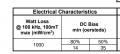
and according to the data sheet the core holds 80% of its inductance at 14 Oe & 50% at 35 Oe
So what would be the calculation steps or which approach to determine if the amount of current passes without passing the 1 tesla limit?
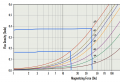
You are correct in your assertion and you can see from the characteristic curves that you are losing effective inductance long before you reach saturation. For the 60μ (yellow) curve you are between 90 mT and 220 mT for 14 & 35 Oe. This is to be expected from real inductors. What I would do is take the image and determine the pixel coordinates of several points on one of the curves and then do an exponential fit.
Often a small gap is added to the core to increase the core reluctance, and thus the saturation value, allowing more DC current before saturation.
Of course this also reduces inductance for a given number of turns.
You are correct in your assertion and you can see from the characteristic curves that you are losing effective inductance long before you reach saturation. For the 60μ (yellow) curve you are between 90 mT and 220 mT for 14 & 35 Oe. This is to be expected from real inductors. What I would do is take the image and determine the pixel coordinates of several points on one of the curves and then do an exponential fit.
I'm designing a Dc inductor
L = 55 mh
I = 35 Amp
freq = 170khz
I have chosen Kool mu material for my core my problem is that how can I know if the chosen core materiel can handle this much current!! and also maintain the inductance?
Plz correct me if say anything wrong when current increases flux density value also does but the core has a limit to a certain flux density value if it passes it goes into saturation.
So Kool mu saturates at 1 T
and according to the data sheet the core holds 80% of its inductance at 14 Oe & 50% at 35 Oe
So what would be the calculation steps or which approach to determine if the amount of current passes without passing the 1 tesla limit?
The flux is equal to the magnetomotive force divided by the reluctance
The flux density is equal to the flux divided by the cross sectional area
The reluctance is the reciprocal of the permeance (the Al value for the core)
The magentomotive force is the number of turns multiplied by the current.
I'm designing a Dc inductor
L = 55 mh
I = 35 Amp
freq = 170khz
I have chosen Kool mu material for my core my problem is that how can I know if the chosen core materiel can handle this much current!! and also maintain the inductance?
Companies that make magnetic materials will sometimes offer help with these problems. There is a lot to consider when making an inductor, and making a high power inductor takes a bit of experience. You have to know how much DC current it can take and a host of other things. You may have to insert a gap, which is something we don't do unless we have a material that is made for gapping like EI laminations or C cores or Pot cores.
Here is a list of some typical things you have to keep track of:
The wire table data has been verified (this had verified that the data stored for inductor designs has not been corrupted over the years).
Core Data:
OD=0.952500 cm ID=0.482600 cm HT=0.330200 cm
Area=0.077580 sq cm Core Mag Path Length=2.254248 cm
Idc Peak=0.200 amps
N=144.0 turns Gap=0.0141 cm L=1396.4uH
Gap percent of core length=0.6
B = 2500 gauss
WireSize=32 AWG heavy enamel
Wire cross section to window area ratio: (38.3 percent of window area)
Actual max turns that fit in window: 324
Total Resistance with 144 turns: 3.92188 ohms
Power lost in winding: 0.0915108 watts
Surface Area: 3.01936 sq inches
Watts per square inch for heat radiation: 0.030308
Surface temperature rise due to winding: 2.03064 degrees C
Total length of wire required: 7.385841 meters (no leads)
Length of last turn: 4.32066 cm
Required number of turns fit ok on the core, with 180 turns to spare.
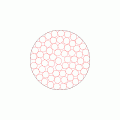
For a toroid it helps to figure out the placement of each turn, although you may require tape between layers. See attachment for an example of the window area of a toroid with as many turns as can fit. With tape between layers there would be less of course. The wire size is of course very important.
You'll probably have to study this subject intently in order to get it right if you design it all by yourself. You may find automated software though too.
Companies that make magnetic materials will sometimes offer help with these problems. There is a lot to consider when making an inductor, and making a high power inductor takes a bit of experience. You have to know how much DC current it can take and a host of other things. You may have to insert a gap, which is something we don't do unless we have a material that is made for gapping like EI laminations or C cores or Pot cores.
Here is a list of some typical things you have to keep track of:
The wire table data has been verified (this had verified that the data stored for inductor designs has not been corrupted over the years).
Core Data:
OD=0.952500 cm ID=0.482600 cm HT=0.330200 cm
Area=0.077580 sq cm Core Mag Path Length=2.254248 cm
Idc Peak=0.200 amps
N=144.0 turns Gap=0.0141 cm L=1396.4uH
Gap percent of core length=0.6
B = 2500 gauss
WireSize=32 AWG heavy enamel
Wire cross section to window area ratio: (38.3 percent of window area)
Actual max turns that fit in window: 324
Total Resistance with 144 turns: 3.92188 ohms
Power lost in winding: 0.0915108 watts
Surface Area: 3.01936 sq inches
Watts per square inch for heat radiation: 0.030308
Surface temperature rise due to winding: 2.03064 degrees C
Total length of wire required: 7.385841 meters (no leads)
Length of last turn: 4.32066 cm
Required number of turns fit ok on the core, with 180 turns to spare.
For a toroid it helps to figure out the placement of each turn, although you may require tape between layers. See attachment for an example of the window area of a toroid with as many turns as can fit. With tape between layers there would be less of course. The wire size is of course very important.
You'll probably have to study this subject intently in order to get it right if you design it all by yourself. You may find automated software though too.
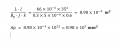
Thanks a lot, I have been studying the subject for the last few days and I landed on The Ap approach but the result I'm getting from the Ap equation is so large that I can't find an equivalent core. Just to recap I'm designing a 66mH, 35 Amp, 0.3 Tesla, 0.6 fill factor, J = 5A/mm2 and getting Ap = 8.9 * 10^7 should I take a different approach with such high inductance and current?
??
by the way I also tried dividing the inductor into 3 parts each at 22mH but also got the same error
Thanks a lot, I have been studying the subject for the last few days and I landed on The Ap approach but the result I'm getting from the Ap equation is so large that I can't find an equivalent core. Just to recap I'm designing a 66mH, 35 Amp, 0.3 Tesla, 0.6 fill factor, J = 5A/mm2 and getting Ap = 8.9 * 10^7 should I take a different approach with such high inductance and current?
??
by the way I also tried dividing the inductor into 3 parts each at 22mH but also got the same error View attachment 314260
You have to realize this is a tall order for an inductor. 66mH is a lot of inductance especially at 35 amps, do you really need that much?
What are you going to use this for?
The larger the inductance value and the larger the required operating current, the higher the cost, and the greater the weight.
You also have to specify the require ESR because that makes or breaks a project design too. 35 amps would take some thick wire too, maybe even #8AWG, which is hard to handle, and you might have to use flat wire not round wire. It's a construction task for the experts, you will need a rubber mallet to flatten the coil layers for example because when you wind the turns the thick wire tends to want to remain in a circular arc which has to be beaten down.
You also need the proper insulation types.
This could also get quite expensive.
A 100uH 35 amp inductor on Digikey weighs in at 0.7 pounds, and that is 660 times less inductance than what you need.
If you note the application there may be a better solution.
Somehow magnetic flux units are related to amp-turns, and using that relationship could be handy for this application.
some information about the application may also help with deciding on margins and materials. Some applications are more flexible than others.

 Facebook
 Google
 GitHub
 Linkedin