Inductor for Filtering Full wave Recitifed output??

Thread Starter

TheticVoyage630

Joined Sep 15, 2024
25
Hello guys, I want to know if anyone can explain to me how they intuitively or visually understadn how an inductor performs. If someone can give me a good visual example or a way for me to understand how inductors behave, that would help me a lot. Coming to my question, I was wanting to design an inductor to use as a filter to the output of my FBR output. Getting into the math, I understand how when (i am using a resistive load btw) the source voltage is higher than the voltage acorss resistor the inductor voltage is positive hence the current rises, causing the voltage across the resitor to grow because current is growing through the inductor; eventually there will come a time when both (source volt and resitor voltage) are equal to each other, thats when voltage across inductor is zero and maximum current is reached and the current starts falling after that..i get the mathematical image. i however am not able to visualise it correctly. if someone could give me some help on how they visualise an inductor behaving in a circuit, that would be very helpful. please try to explain it without going to laplace domain. intuitively how can i understand it best. i hope someone helps me with this. thanks!!
 

drjohsmith

Joined Dec 13, 2021
1,548
basic understanding and designing are opposite ends of the spectrum.
basic idea of electricity is water in a pipe .
its very crude , so dont take it to far. ..
imagine a restriction in the pipe, at low flow it has no effect, as the flow increases , the restriction has more proportional effect and to increase the flow, one needs to increase the pressure.
flow is current, pressure is volts.

designing a filter , is at the opposite end of the spectrum,
you first need to define a few things ,
current flow,
what do you mean by a FBR?
voltages
what do you want to filter out how much ?
I.e. pass band, pass band ripple , stop band, stop band ripple,
 

Thread Starter

TheticVoyage630

Joined Sep 15, 2024
25
basic understanding and designing are opposite ends of the spectrum.
basic idea of electricity is water in a pipe .
its very crude , so dont take it to far. ..
imagine a restriction in the pipe, at low flow it has no effect, as the flow increases , the restriction has more proportional effect and to increase the flow, one needs to increase the pressure.
flow is current, pressure is volts.

designing a filter , is at the opposite end of the spectrum,
you first need to define a few things ,
current flow,
what do you mean by a FBR?
voltages
what do you want to filter out how much ?
I.e. pass band, pass band ripple , stop band, stop band ripple,
im sorry, yes FBR= full bridge rectifier. and what i meant to ask was in a filter, how do i visualise an inductor ..how does it work..
 

Thread Starter

TheticVoyage630

Joined Sep 15, 2024
25
the water analogy not work for you ?
please correct me if im wrong.. i will let you know my understanding...the output of the FBR is a pulsating DC wave..or absolute(sinx). now when this voltage is applied to the inductor and rresisitor.. (initially zero current) the voltage entirely falls on the inductor. due to the property of the inductor it resists the immediate increase in current and increases it slowly..now due to rising current , the voltage also drops across the resistor. the source voltage, what once fell only upon the inductor is now also dropped across the resitor due to the current flowing. as voltage increases the current also rises. (this is where my doubts arise) now when the source volt is max, the current is still rising in the inductor..at one point the voltage of the source equal to voltage drop across resitor..this is when max current is reached..after this resitor voltage dominates over source voltage due to inductor not chaning current immediately..this causes negative vltage across inductor and thus current falls..after a while source volt again dominates over the resistor voltage drop, causing positive voltae across inductor and hence current starts to rise...the cycle keeps repeating..is my understanding flawed? if yes could you please brush it up more. my doubt also has to do with why does the current max come after the voltage source max, is it due to the laggng nature of the inductor? a visual understanding explanation would help me tremendously. if i have made any mistakes in my understanding please help me fix them. thank you!!
 

drjohsmith

Joined Dec 13, 2021
1,548
please correct me if im wrong.. i will let you know my understanding...the output of the FBR is a pulsating DC wave..or absolute(sinx). now when this voltage is applied to the inductor and rresisitor.. (initially zero current) the voltage entirely falls on the inductor. due to the property of the inductor it resists the immediate increase in current and increases it slowly..now due to rising current , the voltage also drops across the resistor. the source voltage, what once fell only upon the inductor is now also dropped across the resitor due to the current flowing. as voltage increases the current also rises. (this is where my doubts arise) now when the source volt is max, the current is still rising in the inductor..at one point the voltage of the source equal to voltage drop across resitor..this is when max current is reached..after this resitor voltage dominates over source voltage due to inductor not chaning current immediately..this causes negative vltage across inductor and thus current falls..after a while source volt again dominates over the resistor voltage drop, causing positive voltae across inductor and hence current starts to rise...the cycle keeps repeating..is my understanding flawed? if yes could you please brush it up more. my doubt also has to do with why does the current max come after the voltage source max, is it due to the laggng nature of the inductor? a visual understanding explanation would help me tremendously. if i have made any mistakes in my understanding please help me fix them. thank you!!
so,
we're jumping right into maths then,

ok,

draw the circuit,
draw on it the waveforms , current and voltage at each point

your looking at a mains type rectifier,
providing dc to a circuit,
where's the capacitance ?
 

Thread Starter

TheticVoyage630

Joined Sep 15, 2024
25
so,
we're jumping right into maths then,

ok,

draw the circuit,
draw on it the waveforms , current and voltage at each point

your looking at a mains type rectifier,
providing dc to a circuit,
where's the capacitance ?
i am not using a capcitor..i am just trying to design this crcuit out of curiosity and to understand the working of an inductor better..would you please explain how an inductor would act as filter if you do know how? without going to the fourier series expansion of the fbr output? an inuitive understanding..also my doubt regading why the current max will appear after the voltage max also is still unclear. if you could shed some light on that too..it will help me a lot. thank you
 

ronsimpson

Joined Oct 7, 2019
4,645
Most of us use LTspice. You can draw the circuit and see what happens. Make changes and look again.
LTSPICE is free. We can help you learn that tool.
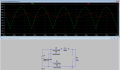
Green is the voltage a point A. Red is the voltage at point B.
Click on the picture to see a larger version.
1754834586514.png
 
Last edited:

crutschow

Joined Mar 14, 2008
38,313
Let's try the basics.
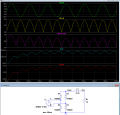
Below is the LTspice sim of the circuit using a FBR, an inductor, and a resistive load:

The mechanical analogy of inductance is inertia.
Inertia tends to keep an object moving, based up the forces acting on it, and inductance tends to keep the current moving, depending upon the voltage across it,
An object's inertia stores kinetic energy, and an inductor's inductance stores magnetic energy.

So, see how the inductor current (blue trace) keeps flowing while increasing when the voltage across it is positive (purple trace), and decreasing when the voltage across it is negative, similar to hitting the accelerator and brakes on a vehicle.

Does that help you see what the inductor does?

1754833712049.png
 

drjohsmith

Joined Dec 13, 2021
1,548
i am not using a capcitor..i am just trying to design this crcuit out of curiosity and to understand the working of an inductor better..would you please explain how an inductor would act as filter if you do know how? without going to the fourier series expansion of the fbr output? an inuitive understanding..also my doubt regading why the current max will appear after the voltage max also is still unclear. if you could shed some light on that too..it will help me a lot. thank you
thank you for the insult.

I can explain to you down to the magnetic spin of the atoms in the inductor , but your not listening to me.

the way we teach this, is as I've mentioned, and you have e failed to do, we'd mark you as an E ..

draw the circuit ,
draw the currents and voltage at each node of the circuit,
then we can discuss .

now days we do that in simulation programs , but as you want the intuitive understanding , then pencil and paper is the best, simulation tends to cloud intuitive understanding
 

crutschow

Joined Mar 14, 2008
38,313
thank you for the insult.
Don't see how what the TS said was an insult (?).
as you want the intuitive understanding , then pencil and paper is the best, simulation tends to cloud intuitive understanding
I find the opposite.
I understand things better visually.
The pencil and paper math of a circuit's operation is not generally intuitive to me.
Math is necessary to accurately determine how the various components interact, but it doesn't necessarily lead to a better understanding of that.

So I let the simulator do the math to display the simulated plots of voltage and current responses in a circuit, which shows how the various components interact as they would in real time.
That's what helps my intuitive understanding.

For example, the simulation of an LC tank circuit oscillations shows the voltage and current amplitude and phases versus time, and plotting the energy of the two elements shows the energy being transferred back and forth between the inductance and the capacitance, which is how/why the tank keeps oscillating.
This makes it clear why there's a 90° phase difference between the capacitor and inductor voltages/currents, due to the alternating transfer of energy between them.
The math may do that for you, but it didn't for me.
 

drjohsmith

Joined Dec 13, 2021
1,548
Don't see how what the TS said was an insult (?).
I find the opposite.
I understand things better visually.
The pencil and paper math of a circuit's operation is not generally intuitive to me.
Math is necessary to accurately determine how the various components interact, but it doesn't necessarily lead to a better understanding of that.

So I let the simulator do the math to display the simulated plots of voltage and current responses in a circuit, which shows how the various components interact as they would in real time.
That's what helps my intuitive understanding.

For example, the simulation of an LC tank circuit oscillations shows the voltage and current amplitude and phases versus time, and plotting the energy of the two elements shows the energy being transferred back and forth between the inductance and the capacitance, which is how/why the tank keeps oscillating.
This makes it clear why there's a 90° phase difference between the capacitor and inductor voltages/currents, due to the alternating transfer of energy between them.
The math may do that for you, but it didn't for me.
apologies, I meant pencil and paper drawings, not the maths.

we found the maths was not "locking" in people's heads,

get them to draw the voltage current graphs by hand, for each part of the circuit.,

I think I said, modern students use simulators,
we found that they end up cutting and pasting answeres , but they are good for investigations
 

wayneh

Joined Sep 9, 2010
18,085
You may already know that a capacitor resists voltage changes, by storing energy as separated charges in an electric field. The basic equation for a capacitor is C = Q/V or, rearranging, V = Q/C. And so dV/dt = dQ/dt = I / C. The rate of voltage change is reduced by increasing capacitance.

An inductor resists changes in current, by storing energy as a magnetic field. The basic equation for an inductor is V = L•dI/dt or dI/dt = V/L. The rate of current change is reduced by increasing inductance.

I'm sure you've seen this before but maybe stating it simply helps to visualize it.
 

drjohsmith

Joined Dec 13, 2021
1,548
How do you do that without the maths?
good point , may be its why it works,

we start at the input,
draw volts and current,
then after the rectifier , etc
simple impedance maths is all thats required
the bit we're looking for is students abilities to know when and where to make approximations,
even existing AI can solve these things easily, we dont want AI, want engineers..
 

MrAl

Joined Jun 17, 2014
13,667
Hello guys, I want to know if anyone can explain to me how they intuitively or visually understadn how an inductor performs. If someone can give me a good visual example or a way for me to understand how inductors behave, that would help me a lot. Coming to my question, I was wanting to design an inductor to use as a filter to the output of my FBR output. Getting into the math, I understand how when (i am using a resistive load btw) the source voltage is higher than the voltage acorss resistor the inductor voltage is positive hence the current rises, causing the voltage across the resitor to grow because current is growing through the inductor; eventually there will come a time when both (source volt and resitor voltage) are equal to each other, thats when voltage across inductor is zero and maximum current is reached and the current starts falling after that..i get the mathematical image. i however am not able to visualise it correctly. if someone could give me some help on how they visualise an inductor behaving in a circuit, that would be very helpful. please try to explain it without going to laplace domain. intuitively how can i understand it best. i hope someone helps me with this. thanks!!
Hi,

There is a very simple way to understand how an inductor works but you do have to already know how a capacitor works and how a voltage source works and how a current source works. Alternately, you just have to accept the "smoothing" analogy.

If you know how a capacitor works then you know that the capacitor tries to keep the voltage constant, which means for a short time the capacitor looks like a battery!
Well, an inductor tries to keep the current constant, which means for a short time the inductor looks like a current source!

HOW THIS AFFECTS FILTERING
Well, if we have a device that tries to keep the voltage constant, that causes a smoothing action of the voltage (aka a voltage filter). That's a capacitor.
If we have another device that tries to keep the current constant, that causes a smoothing action of the current (aka a current filter) . That's an inductor.
Put these two together and we have a smoothing action on both the voltage and the current, and that's a filter. In particular, a low pass filter. This is desirable for a rectifier circuit because the output of the diodes is not smooth it is pulsating. We want a smooth DC output so we use a capacitor and sometimes an inductor with that also so we get good filtering action. It's still not perfect, but it helps a lot.

REAL WORLD EXAMPLES
With a capacitor, if we had 12.4 volts at a node at a certain time, at a very short time later we would still have 12.4 volts. It will decrease later but we don't worry about that just yet.
With an inductor, if we had 1.1 amps flowing at a certain time, at a very short time later we would still have 1.1 amps flowing. It will decrease later but we don't worry about that just yet.
As to the decreases "later", we choose the value of the component so that we do not get too much of a decrease later.

We can go deeper into this with examples or with math. It depends how well you want to understand this.
 
Last edited:
Top