Dc Inductor[Closed]

Papabravo

Joined Feb 24, 2006
22,082
The unit of magnetic flux is the Weber. In SI base units that is:

\( 1\text{ Wb}\;=\;1\; kg \cdot m^2s^{-2}A^{-1} \)

In words that is "one kilogram meter squared per second squared per Ampere.

One Tesla, the unit of Magnetic Flux Desnity is:

\( 1\text { T}\;=\;1\text{ Wb}/\text{m}^2 \)

Now from wikipedia:

The ampere-turn (symbol A⋅t) is the MKS (metre–kilogram–second) unit of magnetomotive force (MMF), represented by a direct current of one ampere flowing in a single-turn loop in a vacuum.
 
Last edited:

Ian0

Joined Aug 7, 2020
13,132
Hi,

I'm designing a Dc inductor
L = 55 mh
I = 35 Amp
freq = 170khz
I have chosen Kool mu material for my core my problem is that how can I know if the chosen core materiel can handle this much current!! and also maintain the inductance?
Going back to the original requirement.
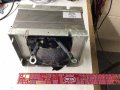
As an example, I have inductors that are rated 30mH at 30A, and they are wound on laminated gapped EI cores and weigh about 15kg. They would not be suitable for 170kHz. but it gives and idea of how big they are.
 

tonyStewart

Joined May 8, 2012
236
L = 55 mh
I = 35 Amp
freq = 170khz

All inductors have a DCR and the ratio L/R =Tau is an indication of the low frequency response time. Small supplies might have L/R=100 to 200 working at RF.

As a sanity check ZL(f)=2pi*f*L= Z(55mH) is almost 0.5 Mohm at 170KHz which wont work with 35 Amps. Even 55 uH is too high.

If you allowed 0.1V drop at 35 A, that's 3.5W so you better be planning 100x more AC. It's also . DCR=3 Ohm and I would start looking around 3 uH for big inductors like 50W resistor size

So consider a Pd of 0.25W @ 35A so what is the DCR and L that makes sense?
 
Last edited:

tonyStewart

Joined May 8, 2012
236
L = 55 mh
I = 35 Amp
freq = 170khz

All inductors have a DCR and the ratio L/R =Tau is an indication of the low frequency response time. Small supplies might have L/R=100 to 200 working at RF.

As a sanity check ZL(f)=2pi*f*L= Z(55mH) is almost 0.5 Mohm at 170KHz which wont work with 35 Amps. Even 55 uH is too high.

If you allowed 0.1V drop at 35 A, that's 3.5W so you better be planning 100x more AC. It's also . DCR=3 Ohm and I would start looking around 3 uH for big inductors like 50W resistor size

So consider a Pd of 0.25W @ 35A so what is the DCR and L that makes sense?
Pd/I^2=R=0.25/35^2=DCR=0.29 so if L/R=100 look for L=2.9uH which is around 20 Ohms and likely still too high at 35A

I suspect you will want a shielded inductor 10 times smaller.
So you started at 55 mH and I predict something around 290 nH < 3 mohm
 
Last edited:

Ian0

Joined Aug 7, 2020
13,132
For a DC output inductor, ΔI is normally about 0.1 Iout. That would give ΔI=3.5A
at 170kHz Δt is about 3us.
V/L=dI/dt.
That would suggest V is about 64000 V.
 

MrAl

Joined Jun 17, 2014
13,704
Magnetomotive force = Amps * turns
Flux = magnetomotive force / Reluctance (Hopkinson's law)
\(
\Phi = \frac{\mathcal{F}}{\mathcal{R}}
\)
Hi,

There is an entire set of analogs between pure electrical circuits and magnetic circuits. You could use a spice simulator to simulate magnetic circuits, using just ordinary components like resistors, capacitors, and voltage and/or current sources. If you use inductors, it would not be the magnetic aspects of it that are being considered, just the electrical aspects such as voltage and current.
 

MisterBill2

Joined Jan 23, 2018
27,519
Without more context we have guesses, which might not come close to reality, nor be very useful. Thirty five amps and 170 KHz sounds like an induction heater or maybe a dielectric heater of some variety.
 

Thread Starter

IBO3252

Joined May 17, 2023
18
Thanu you all for your effort

Sorry for late response whenever a new answer came, I was trying to understand it so again thank you all fo


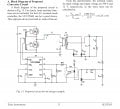
This an LLC circuit which I really don't know much about, but my part of this Lab project is just to make the Inductor noted in white in the picture above. The application of the inductor is to filter the current and minimize its ripples to 1%

Hi,

You have to realize this is a tall order for an inductor. 66mH is a lot of inductance especially at 35 amps, do you really need that much?
What are you going to use this for?

The larger the inductance value and the larger the required operating current, the higher the cost, and the greater the weight.

You also have to specify the require ESR because that makes or breaks a project design too. 35 amps would take some thick wire too, maybe even #8AWG, which is hard to handle, and you might have to use flat wire not round wire. It's a construction task for the experts, you will need a rubber mallet to flatten the coil layers for example because when you wind the turns the thick wire tends to want to remain in a circular arc which has to be beaten down.
You also need the proper insulation types.
This could also get quite expensive.

A 100uH 35 amp inductor on Digikey weighs in at 0.7 pounds, and that is 660 times less inductance than what you need.

If you note the application there may be a better solution.

Where did you get that formula though?
The INDUCTOR value was obtained using Simulink via try & error. The Only value seemed to archive this goal ,1% current ripple, was 55mH which was I changed after knowing that the calculated Inductance isn't what you get duo to losses & pretty much may end at best conditions with 80% of the actual inductance so I added a 20% error margin making the inductance 66mH to obtain the targeted 55mH when losses occur that was my approach

The equations I used to find the suitable Inductor core "Ap approach" I founded this methoed in multiple resources.
1- "Transformer and inductor design handbook" Specifically Chapter 6 which talks about Dc inductors
2- Sam ben-Yaakov videos "HF Power Inductor Design" & "A deeper look at the approximate design of power inductors with gapped ferrite cores"
3- "High frequency Power Inductor Design: DC & AC" by ManKa Power Electronics
 
Last edited:

MisterBill2

Joined Jan 23, 2018
27,519
Based on the image presented in post #31, this is a very interesting application. And the effect of the current ripple at that frequency is probably unknown, and the ripple will be affected by the timing of the active rectifier circuit, which I am guessing is a bit more complex than is shown.
 

MrAl

Joined Jun 17, 2014
13,704
Thanu you all for your effort

Sorry for late response whenever a new answer came, I was trying to understand it so again thank you all fo

View attachment 314419
This an LLC circuit which I really don't know much about, but my part of this Lab project is just to make the Inductor noted in white in the picture above. The application of the inductor is to filter the current and minimize its ripples to 1%


The INDUCTOR value was obtained using Simulink via try & error. The Only value seemed to archive this goal ,1% current ripple, was 55mH which was I changed after knowing that the calculated Inductance isn't what you get duo to losses & pretty much may end at best conditions with 80% of the actual inductance so I added a 20% error margin making the inductance 66mH to obtain the targeted 55mH when losses occur that was my approach

The equations I used to find the suitable Inductor core "Ap approach" I founded this methoed in multiple resources.
1- "Transformer and inductor design handbook" Specifically Chapter 6 which talks about Dc inductors
2- Sam ben-Yaakov videos "HF Power Inductor Design" & "A deeper look at the approximate design of power inductors with gapped ferrite cores"
3- "High frequency Power Inductor Design: DC & AC" by ManKa Power Electronics
Hi,

Ok very good, now what is the output voltage and current supposed to be?
Is it that the output current really has to be 35 amps DC ?

Also, are you shooting for 1 percent ripple because it is a laser diode on the output, or is it just a guess?
 

Thread Starter

IBO3252

Joined May 17, 2023
18
6mH @30A is this big.
View attachment 314484170 x 140 x 110mm
Hi guys,
A very late reply but I just Wanted to close the the thread and thank you all for the useful information you provided me with, especially @Ian0 providing the picture made me realize the magnitude difference.
Also as most of you suggested the calculations for the inductor value were off thus i had a hard time reaching nowhere

Thanks again
 
Top