Current amplifier for an IR sensor

Thread Starter

PsySc0rpi0n

Joined Mar 4, 2014
1,786
Maybe you broke the fuse in your multimeter. You can always measure the voltage across the series resistor with the LED when the led is ON. And use the Ohm's law to find the current.
My multimeter ha 2 fuses. A 200mA one and another of, guess, 630 mA. The 200mA fuse is the one which usually breaks but this fuse is OK. I checked it!

Just to make sure we are all talking the same thing... you break the circuit with the led and put the meter in amps scale into the break, yes?
Yes...


PS: I found that the 200mA fuse was broke. But the wire broke close to one of the edges and not at the middle or so, so it wa hard to spot!

Going to try to measure the LED current again!

But I only get 4.3mA out of 0.155mA (on the sensor output) on the LED branch using a 2.2kΩ resistor! I wanted much more! Why the current gain is so small?
 

Thread Starter

PsySc0rpi0n

Joined Mar 4, 2014
1,786
Ok, I managed to get my DC motor to work with a 100 ohm resistor. But still small current for the motor! I need more...

Wasn't it supposed to have an higher gain from a Darlington transistor?
 

bertus

Joined Apr 5, 2008
22,922
Hello,

Then the current will never be more than the maximum current of the BC548.
Better take a power transistor for the second one, like the BD241.

Bertus
 

Attachments

Last edited:

ericgibbs

Joined Jan 29, 2010
21,439
Psy,
When switching inductive loads, ie: motor, solenoid or relay you must have a clamp diode or some other form of 'snubber' across the inductor.
Cathode to supply, Anode to Collector.
This will protect the transistor from the back emf as the inductor current is switched off.
E
 

Thread Starter

PsySc0rpi0n

Joined Mar 4, 2014
1,786
Hello,

Then the current will never be more than the maximum current of the BC548.
Better take a power transistor for the second one, like the BD241.

Bertus
Ok, I think I don't have transistor like that but I'll get one!

Psy,
When switching inductive loads, ie: motor, solenoid or relay you must have a clamp diode or some other form of 'snubber' across the inductor.
Cathode to supply, Anode to Collector.
This will protect the transistor from the back emf as the inductor current is switched off.
E
Yeah, I think I already saw something like that and I forgot to add it indeed! I'll add one later when I get home...
 

Jony130

Joined Feb 17, 2009
5,598
But I only get 4.3mA out of 0.155mA (on the sensor output) on the LED branch using a 2.2kΩ resistor! I wanted much more! Why the current gain is so small?
With 2.2kΩ resistor at collector and 12V supply you cannot get more then I = (12V - 2V - 0.6V)/2.2kΩ ≈ 4.3mA

Going to try to measure the LED current again!
Don't do it. LED is a "current driven" device, so LED's require current limiting device (resistor/current source) when driven from a voltage source.
Additional your ammeter will have a very low resistance (100Ω...0.1Ω , ideal ammeter will have 0Ω resistance), and this is why you cannot connect a LED in series with ammeter without current limiting device.

What motor do you have ?
 

Thread Starter

PsySc0rpi0n

Joined Mar 4, 2014
1,786
With 2.2kΩ resistor at collector and 12V supply you cannot get more then I = (12V - 2V - 0.6V)/2.2kΩ ≈ 4.3mA
So, what is the purpose of building a Darlington transistor if we are limited by the current of Q2 collector's current?

Don't do it. LED is a "current driven" device, so LED's require current limiting device (resistor/current source) when driven from a voltage source.
Additional your ammeter will have a very low resistance (100Ω...0.1Ω , ideal ammeter will have 0Ω resistance), and this is why you cannot connect a LED in series with ammeter without current limiting device.

What motor do you have ?
I didn't know about this. But I have a resistor in series with the LED (current limiting device) and I opened the circuit in the LED's branch and "inserted" the ammeter there.

The motor is one of those basic ones of 12V or 24V, I'm not sure! I think it's max current is about 200mA.
 

ericgibbs

Joined Jan 29, 2010
21,439
Psy,
You should consider that you are configuring a 'current switch' , not a 'linear amp'.
The output transistor will be fully Off or fully On [ saturated], so the resistor limits the collector/led current.

E
 

Thread Starter

PsySc0rpi0n

Joined Mar 4, 2014
1,786
Psy,
You should consider that you are configuring a 'current switch' , not a 'linear amp'.
The output transistor will be fully Off or fully On [ saturated], so the resistor limits the collector/led current.

E
But is that the normal Darlington transistor purpose? A current switch? My goal was to amplify the IR sensor output current!
 

ericgibbs

Joined Jan 29, 2010
21,439
Morning Psy,
There is no purpose in trying to amplify the PIR output current in a 'linear' mode.
The PIR module outputs a 3V active voltage via an internal 1K resistor.
You need to use the 3V output, via a 470R resistor to Input current into the Base of your transistor.
The transistor, either a single or Darlington should be driven into Collector saturation by this Base current.
When in saturation, allowing for for small Vce sat voltage drop, all the voltage from your power supply will be across the Collector load.

The load can be a series LED/resistor combination , relay or motor etc,

The current required by the load will determine the power rating of the transistor required.

The advantage of a Darlington is it's high current gain, look at the TIP120 series.

Eric
 
Last edited:

ericgibbs

Joined Jan 29, 2010
21,439
Psy,
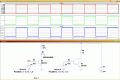
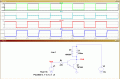
Look at this LTS plot.
Try different values of Base resistor and load currents in both circuits, check the Vce sat voltage and dissipation of the single and Darlington.

E
 

Attachments

Thread Starter

PsySc0rpi0n

Joined Mar 4, 2014
1,786
So, what you mean is that a single Darlington won't result in great current amplification?

Or that the setup I have with 1k resistor at the base is too much impedance?

I'm not sure what you mean by linear mode!

I understand the rest of the explanation about to ensure a Vsat voltage. The lower the voltage here the higher the voltage across the load, thus, higher current at the load by ohm's law. V = R*I. Higher V, constant R, higher I!

But I'm not sure about the 'linear mode' subject.
 

ericgibbs

Joined Jan 29, 2010
21,439
hi,
So, what you mean is that a single Darlington won't result in great current amplification?
No, I mean a Darlington will have a higher current gain than a standard transistor, due to its higher hFE.

Or that the setup I have with 1k resistor at the base is too much impedance?
A 1K will be OK in the Base, I would prefer a 470R in order to ensure Vce sat,

I'm not sure what you mean by linear mode!
Linear mode is where you want to 'amplify' the current by fixed value, say 1mA Base current will give say 100mA collector, a Base current of 2mA gives 200mA Collector current.
[gain of 100]


I understand the rest of the explanation about to ensure a Vsat voltage. The lower the voltage here the higher the voltage across the load, thus, higher current at the load by ohm's law. V = R*I. Higher V, constant R, higher I!
Its also important to saturate the transistor when its used as a 'switch', in order to minimise the dissipation within the transistor [ self heating]

But I'm not sure about the 'linear mode' subject.
As above

E
 

Thread Starter

PsySc0rpi0n

Joined Mar 4, 2014
1,786
Ok...

One other question about Darlington:

The typical usage of such transistor is always to ensure that Q2 is in FULL ON state (saturation) no matter the application? I mean, is that the way they are supposed to be used? To saturate Q2?


About the tiny project, I already understood that using a lower resistor value for Q1 base is advisable to make sure Q2 will be between OFF and FULL ON, right?

What else should I do to get more current out of the setup?
 

ericgibbs

Joined Jan 29, 2010
21,439
psy,

The typical usage of such transistor is always to ensure that Q2 is in FULL ON state (saturation) no matter the application? I mean, is that the way they are supposed to be used? To saturate Q2?
Consider that the voltage source had a high impedance output and was only able to supply a low output current, say 1mA.
Say the load you wanted to switch required say 500mA, this means that the transistor would need to have a gain of at least 500.
So you normally use a Darlington, with say a gain of at least 500+


About the tiny project, I already understood that using a lower resistor value for Q1 base is advisable to make sure Q2 will be between OFF and FULL ON, right?
Yes, check the transistor datasheet you will see that the hFE is greatly reduced when working in saturation, say as low as 10 to 20.!

What else should I do to get more current out of the setup?
Do you mean a higher current load requirement.?
 

Thread Starter

PsySc0rpi0n

Joined Mar 4, 2014
1,786
psy,

......

What else should I do to get more current out of the setup?
Do you mean a higher current load requirement.?
Let's say I have a need for 200mA to be able to use my load! A motor, for instance, that might be able to absorb that current! That's why I said that I would like to get about 60mA up to 200mA of current at the output of the current amplifier (Darlington transistor)!
 

ericgibbs

Joined Jan 29, 2010
21,439
hi,
If a motor requires 200mA to run, it could require 1Amp or more to start up, so the transistor switch must be able to sink the motor start current .
So use a Darlington power transistor , rated at Ic= 2Amps, with a hFE of say 1000, so a Base current input of ~2mA.
The Vbe of a Darlington is approx 1.4v, so from a 3V source, a Base resistor of 470R would ensure saturation.
Note: run a LTS sim for this and note the Vce sat of a Darlington also the Base current.
Use an inductive/resistive load for the motor simulation.

Measure the Darlington's dissipation.
Post what you find
E
 
Top