2N2222A Transistor as Current Amplifier

Thread Starter

Vish Ram

Joined Apr 25, 2017
21
Hi All,

I'm using 0.9V to 5V DC DC booster module with Female USB module as output, now when I'm connecting +ive(5V) of USB module with base of 2N2222A NPN transistor via 500 ohm resistor & -ive to emitter, also +ive of Load with collector of transistor & -ive of Load to emitter of transistor & trying to use transistor as current amplifier but I'm not getting any output while checking with multimeter,
Kindly suggest if there is any changes in connection required, to make transistor works as a current booster
 

Papabravo

Joined Feb 24, 2006
22,058
Every time you "amplify" or "boost" something there is a price to pay. In simple terms the price you pay is represented by the following:
Power out will always be less than power in. Sometimes it will be a great deal less. You will do well to remember this.

For example, suppose you want 5v @ 100 mA for an output power of 500 mW. Suppose the process is 80% efficient. In actual practice it could be more or less, but experience has shown this is a good initial goal to aim for. So, the input power will need to be 625 mW which means 0.9V @ 694 mA or about 7 times the output current.

If you thought there was some kind of "free lunch", I can assure that it is an illusion.
 

BobTPH

Joined Jun 5, 2013
11,466
How much current does your booster supply at 5V? How much current and at what voltage you wanting?

Do you realize you cannot boost the current of a power supply without lowering the voltage proportionally?
 

Thread Starter

Vish Ram

Joined Apr 25, 2017
21
Hi,
What are the different configurations, in which 2N2222A transistor can be used as booster/amplifier like common collector, emitter, etc.

Kindly explain with diagram for all possible configuration
 

BobTPH

Joined Jun 5, 2013
11,466
Hi,
What are the different configurations, in which 2N2222A transistor can be used as booster/amplifier like common collector, emitter, etc.

Kindly explain with diagram for all possible configuration
That is an answer to get from a textbook.

We are not a replacement reading a text. We are enthusiasts who are glad to help when you have a specific question.
 

panic mode

Joined Oct 10, 2011
4,868
some devices have 4 terminals (simple transformer, an optocoupler, etc.) - two terminals are input, two termals are output, and they are isolated from each other... what is not to like?
with such devices it is possible to device input and output circuits independently and use some parameter that creates relatinship beteen the two. this may be called coupling effect, transfer ratio or whatever...

but some devices like BJTs have only three terminals. so we cannot make complete galvanic separation of inputs and output circuits.

what is left is to use that device in such a way that one of the three terminals is common or shared between input and output circuit.

this leads to three scenarios:

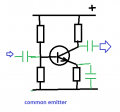
common emitter
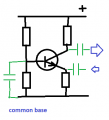
common base
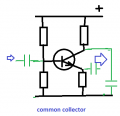
common collector.

in each of them transistor internally works the same way:
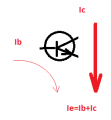
small input current flows from base to emitter
this small input current enables large current to flow from collector to emitter.

1731959369755.png
above is the most important thing to understand. because we are interested in "amplifying" signals. small signal (Ib) is the input and large signal (Ic) is the output. but if you look closer, you will see that Ib is also present at the emitter. so "input" terminals can be either base or emitter (because that is where input current Ib is present). the "output" terminals is either collector or emitter (because that is where large current Ic is). collector can NEVER be an input terminal. and base can NEVER be an output terminal.


but depending on which common mode is used, there are notable and measurable differences in external circuits (input and output).

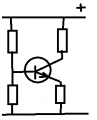
basic circuit that shows BJT with biasing resistors looks something like this... in all three scenarios...

1731959383082.png

what is not shown is choice of input and outputs. the "common" terminal is grounded (through capacitor or low impedance of the power source).

so now we can ground terminal that is common and bring signals to input and output: following examples show AC coupled input and output but this is only to showcase the most generic case (with most parts). if application does not need it some of the parts can be omitted.
1731959906564.png
1731959983894.png
1731960066092.png

for example if DC coupling is needed, capacitors can be removed.
if using common collector, Rc can be omitted
if using common emitter, Re can be omitted.
if using common base Rb1 and Rb2 can be omitted and replaced by DC source. of suitable voltage.

the next part is to understand what gains are in each case, input and output impedance etc. and for that you better get the textbook or tutor..
 

sparky 1

Joined Nov 3, 2018
1,218
It is safe to use the term current amplifier with the 2N2222A because the desired current out is larger than the current in.
Within the limitations of the USB source that should be fine. You can measure the current to the base and the current out.

Modifying an existing NPN DC current amplifier generally involves the resistors for setting the current to the base of the 2N2222A
This is good starting point. We notice the 2 base resistors make a voltage divider. The practical resistor ratio use nominal values on hand.
Since this is not a homework assignment, we can use a voltage divider calculator. Lowering the resistance while maintaining the resistor ratio
needs to give a minimum required voltage, that is:
The center node voltage of the voltage divider must be greater than 0.7Vdc to overcome the PN junction, we informally call the diode drop).
Finding the 2 base resistor values and finding the amplifier gain is useful information for determining a quantified answer.
Finding the correct worksheet has to do with how familiar you are with the text book and how it is arranged. The work sheet will
show a schematic. Understand that the procedures must be followed, first do this then do this ect. In this way they are happy to help if you get stuck.

Simply, the idea is that with the new resistors in place, a little more current in will increase the current out.
The discipline of terminology is important to find the correct simulation. You can have this tool below.

The Ltspice simulation that an AI system might interface might look like, please choose the operating point?
 
Last edited:

panic mode

Joined Oct 10, 2011
4,868
if i read carefully (correctly?) post #1, BJT is in common emitter mode,
emitter is on 0VDC, base is connected to +5V via 500 Ohm resistor.
there is also load resistor between +5V and collector.

so far so good...

what is not clear is how the DMM is used. what the load is etc.

to see current, DMM would need to be set as ammeter and
1. DMM connected in series with base resistor to measure input current, this should be some 9mA. depending on internal resistance of the meter, value could be smaller too.
2. DMM connected in series with load resistor to measure output current. this would depend on the load.

if measuring not current but voltage at the output, it should be low (in saturation, transistor Vce is low).
 

sparky 1

Joined Nov 3, 2018
1,218
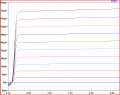
NPN curve tracer, sometimes referred to as an IV operating point chart. The LTSpice file attached.
The simulation current probe is placed over the collector. You can configure the analysis with the values in the video above.
This analysis uses 80uA increments and 0.5V up to 6V, You can change the transistor. You can mouse over for a specific IV values.

curve trace NPN 800uA.png
 

Attachments

Last edited:
Top