CTE throttle pot wiring identification

Thread Starter

ElectricHorsemen

Joined Aug 3, 2019
5
This wig-wag throttle pot has 5 wires - three of which are connected to the POT (hall sensor) as usual, but the other two wires (red and black) I'm not sure of.

I've run 4.5v through the pot (leaving the red and black wires out for now) and returned a center voltage (@ 1.4V... lower than I would expect) - but there is no response from the signal when the lever is rotated. There is voltage present at the black wire @ 1.4V and at the red wire about 0.7V when the pot is supplied with 4.5V.

I could find no wiring diagram to adequately explain the situation. If someone could enlighten me on the RED and BLACK wires.... or way to test. As this is from a mobility scooter, these wires may be used to moderate the throttle (speed) with another pot (the rabbit/turtle knob).
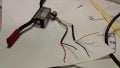
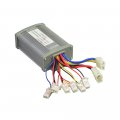
CTE throttle.jpg
 

Wolframore

Joined Jan 21, 2019
2,619
0.7v sounds like a diode drop (1.4 is two). It’s possible you might have to power it with the black and white and it outputs on the other wires. It may have transistors. Looks like it would be easy to remove the cover to take a look. On the other hand it looks like it’s potted.

It also looks like it’s not just a throttle but also reverse control.

Might be some sort of H bridge circuitry to reverse the voltage through the potentiometer on reverse. I would try putting power on the back and red and see what the three witres output.
 
Last edited:

Alec_t

Joined Sep 17, 2013
15,117
This wig-wag throttle pot has 5 wires - three of which are connected to the POT (hall sensor) as usual, but the other two wires (red and black) I'm not sure of.
How do you know which way the yellow, blue and white connect? Do you have a wiring diagram?
I would have expected black and red to be power supply wires for something, as that is a common convention.
 

Thread Starter

ElectricHorsemen

Joined Aug 3, 2019
5
I don't have a wiring diagram, which is the problem.

I powered up the red and black - but no output from the other wires. Wolframore I think you are right about the forward/reverse thing - either that or the red and black wires are for throttle modulation with a second pot.
 

MisterBill2

Joined Jan 23, 2018
27,507
First of all, what are you wanting to accomplish? Was this control part of the control circuit? Do you have any way of seeing what the wires were connected to on that scooter? Connecting a voltage to a device that you have no ideas as to how the voltages should be connected is a fast and effective way to cause damage that will make it completely useless. It is quite likely that somebody watching this forum has an answer that will be useful, but so far none of them have responded.
So the very first thing is what are you hoping to achieve?
 

Wolframore

Joined Jan 21, 2019
2,619
What’s the voltage? Maybe you’re getting the correct output since it may be designed for higher voltage. Just guessing since I can’t find a schematic but the black and red may be for an indicator for the dashboard.

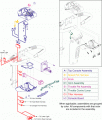
0749E521-70E6-4DE9-B0C9-1160BF55A744.jpeg 60DB913C-D929-458C-ABF3-89373723F719.gif
 

MisterBill2

Joined Jan 23, 2018
27,507
I see only one 3-wire connector, and I see no white wires. I also do not see the module shown as being in that wiring picture. So a lot of information is still missing. Are you wanting to repair the thing, or just use the drive package for something else? Do you have access to the rest of the system?
 

Thread Starter

ElectricHorsemen

Joined Aug 3, 2019
5
I am prototyping a robotic mobility scooter - not repairing one, and this POT operates the forward/reverse throttle. There is another standard POT (3 wire) operating the steering.

^^that diagram shows the 2 plugs coming from E1 - throttle pot assembly. I will try to communicate with the manufacturer.
 

LesJones

Joined Jan 8, 2017
4,511
Have you measured the resistance between the red and black wires with and without the lever moved from it's static position ?
I suspect that it could be open in the static position ans closed if moved away in either direction from the static position. I think this is to switch off the power when the lever is not operated.
You description of the tests is very poor. When you say "I've run 4.5v through the pot" you do not say which wires you have connected the supply to or the polarity and you do not sat which wire you are treating as the output of the pot and which wire it is referenced to. Are you sure that is a hall effect device ?

Les.
 

MisterBill2

Joined Jan 23, 2018
27,507
The simple way to determine what signals are required for control will be to connect the system back together and measure the voltages at the connections as the control is operated.
A robotic mobility scooter certainly does bring to mind a whole lot of interesting possibilities and possible applications. It could be similar to some of the robotic delivery systems presently being demonstrated elsewhere, that deliver groceries or food.
 

Thread Starter

ElectricHorsemen

Joined Aug 3, 2019
5
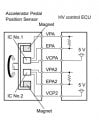
It may be something like this - which is from an accelerator pedal. (non-contact throttle)
looks like 2 hall sensors for 2 outputs - fwd and rev.

have written to the manufacturer, hope they respond.

throttle pot.jpg
 

LesJones

Joined Jan 8, 2017
4,511
Guessing what it might be like does not help. MisterBill2's suggestion (Post #10) seems a good way to proceed. Have you considered taking the item apart to see how it works. If it has hall effect devices they will probably have part numbers so you can look for the data sheet.

Les.
 

Thread Starter

ElectricHorsemen

Joined Aug 3, 2019
5
Guessing what it might be like does not help. MisterBill2's suggestion (Post #10) seems a good way to proceed. Have you considered taking the item apart to see how it works. If it has hall effect devices they will probably have part numbers so you can look for the data sheet.

Les.
There is no system to plug in back into - this is a from-scratch design and build. It's fully potted and there is no way to get into it....and I still can not find a wiring diagram or documentation.
 

MisterBill2

Joined Jan 23, 2018
27,507
Guessing what it might be like does not help. MisterBill2's suggestion (Post #10) seems a good way to proceed. Have you considered taking the item apart to see how it works. If it has hall effect devices they will probably have part numbers so you can look for the data sheet.

Les.
It may not be a good idea to take the assembly apart if it is one of those snap-together assemblies. I find a lot of them are made from plastic that becomes brittle quite rapidly and by the time I get a product the plastic will break if it is deflected enough to take apart. But if it unscrews then it may be useful to open the assembly, if only to see what the connections are.
 
Top