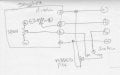
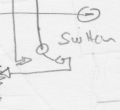
12VDC Switch and diagram for 2 separate potentiometers used for a trolling motor throttle control

Thread Starter

aksman

Joined Jul 8, 2024
5
Hello all. New member doing research for a 12VDC trolling motor project. I came across a thread that may have helped me but unfortunately I didn't understand everything completely. Basically, I have a 12VDC trolling motor controlled by a 2 axis joystick potentiometer and 2 servo control boards to control both the throttle (Y) and steering servo motor (X). Since the joystick requires hands on to use the throttle, I am unable to set a constant cruise speed in a hands off mode. What I would like to do is add a throttle pot with a knob to set a constant speed separate from the joystick throttle pot by switching between each pot. Only one pot would be powered at a time. I was thinking I could connect the 2 pots in parallel with a SPDT to switch between the two. If this would work, how would I wire the 2 pots with the switch? If I am way off then I could use some suggestions. TIA.
 

dendad

Joined Feb 20, 2016
4,634
The switch is on the wiper contacts. The + and - are always connected together on all pots.
At least, that is what I would think it would be.
How many wires are there between the joystick and the controller?
 

Thread Starter

aksman

Joined Jul 8, 2024
5
The switch is on the wiper contacts. The + and - are always connected together on all pots.
At least, that is what I would think it would be.
How many wires are there between the joystick and the controller?
Each pot on the joystick is connected to a separate servo controller board with a +,-, and S wire. the extra pot would only be used on one joystick pot (throttle).
 

dendad

Joined Feb 20, 2016
4,634
If the pot power is through a resistor, and not direct from a regulator, you may have to switch the + as well as the signal wire between pots.
To find the pot value, with the joystick disconnected, measure the resistance from the - to the S at each end of the travel. It may be 0R and 10K, or something like that. Then get a linear pot for the value measured.
 

Thread Starter

aksman

Joined Jul 8, 2024
5
If the pot power is through a resistor, and not direct from a regulator, you may have to switch the + as well as the signal wire between pots.
To find the pot value, with the joystick disconnected, measure the resistance from the - to the S at each end of the travel. It may be 0R and 10K, or something like that. Then get a linear pot for the value measured.
The servo board supplies power using +,-,S wires to the joystick pot. It is a 10k and I have some extra pots. So I just need to break the S wire and install the switch. I will double up the +,- wires then at the board.
 

LowQCab

Joined Nov 6, 2012
5,101
We need a Schematic,
a word-salad just won't do,
there are too many points of mis-communication possible
which could render the whole project a complete waste of time.
.
.
.
 

Thread Starter

aksman

Joined Jul 8, 2024
5
The servo board supplies power using +,-,S wires to the joystick pot. It is a 10k and I have some extra pots. So I just need to break the S wire and install the switch. I will double up the +,- wires then at the board.
Thank you dendad for your help. I finally figured it out. Part of my problem was "assuming" the supplemental pot could be used to reverse the signal. I found another 10K pot with a center detent and it worked as it should. I also realized I needed to double up the servo board +,-, S output wiring for the extra pot at the CB and not at the pot connections. I'm sure these are silly mistakes but considering how much time it took me to figure it out I won't be forgetting that lesson. I will post a pic when finished in case somebody else comes across this thread. Thanks again!
 

schmitt trigger

Joined Jul 12, 2010
2,027
You aren’t pedantic. It is a perfectly reasonable observation. One must accustom oneself to describe components accurately, otherwise the project can become confusing.
 

MisterBill2

Joined Jan 23, 2018
27,159
Some of us are quite able to visualize a COHERENT words description in text format. But in most video presentations the speaker is in a rush and understanding is a challenge.
 
Top