Price gouging may help to regulate supplies and thus more people can appear to get what they need, but it also locks some people out of that supply completely.
You've got that backward. Price caps lock everyone out of the supply. I need not go back as far as the 70s (gas rationing) to prove this. Just look at the great covid toilet paper famine of 2020.
Actually for the forthcoming generations that their mind is bombarded and blown by huge informations and medias there must be nothing called Drama or Tragedy,they'd see everything (such as Corona) on behalf of Comedy.
You've got that backward. Price caps lock everyone out of the supply. I need not go back as far as the 70s (gas rationing) to prove this. Just look at the great covid toilet paper famine of 2020.
You've got that wrong, considering only part of the story.
All you have to do is instantiate quantity limits which only some stores did and when they did it was effective.
I like the way you called it "the great toilet paper famine" though that's funny It also shows how unprepared we were for this kind of thing even though several experts believed it could happen some years ago.
You've got that wrong, considering only part of the story.
All you have to do is instantiate quantity limits which only some stores did and when they did it was effective.
I like the way you called it "the great toilet paper famine" though that's funny It also shows how unprepared we were for this kind of thing even though several experts believed it could happen some years ago.
It's impossible to be prepared for every contingency. That'd require "experts" who know everything, all the time. The magic of the free market is that, while no one or no group has even a marginal amount of knowledge of everything, everyone has just enough information to govern themselves to utilize their own resources in the most efficient and effective way possible. A large part of this information is: what do I need and how much am I willing to pay for it? The flip side is: what do I have, and what do I want for it? This is the "Economizing Problem", and only free markets can derive the optimal solution all of the time.
"If there is a shortage of something, the price is too low. "
While I agree with 99% of the philosophy behind letting free markets remain free... the landscape changes when people's lives depend on the price of things and abusive suppliers step in... the infamous case of "Pharma Bro" Shkreli comes to mind.
While I agree with 99% of the philosophy behind letting free markets remain free... the landscape changes when people's lives depend on the price of things and abusive suppliers step in... the infamous case of "Pharma Bro" Shkreli comes to mind.
Where you are mistaken is that it is government intervention (i.e. insurance regulations, FDA, etc.) in free markets that make people like Shkreli possible.
Where you are mistaken is that it is government intervention (i.e. insurance regulations, FDA, etc.) in free markets that make people like Shkreli possible.
I would've thought it was patents that make people like Mr Shkreli possible. Don't get me wrong, I'm all for the protection of intellectual property and all. I just think that there are weaknesses inherent to the system that can't be easily fixed.
I would've thought it was patents that make people like Mr Shkreli possible. Don't get me wrong, I'm all for the protection of intellectual property and all. I just think that there are weaknesses inherent to the system that can't be easily fixed.
The "theory" of patents is that an inventor gets a limited-time monopoly on the exercise of his idea in exchange for adding to the human knowledge base (i.e. disclosure of the idea to the public). The idea is his property, and (theoretically) he should be able to dispose of it at his pleasure. This includes: a) charging as much as he wants for it, b) licensing/selling it to whomever he desires, c) not exercising it at all.
I won't discuss the "reality" of patents.
Remember: there is an alternative to inventing life-saving products. Not inventing them.
When you ask your government to deprive one of the benefits of his own ideas (i.e. depriving him of his own property), don't expect such great ideas in the future.
Unintended consequences are always more numerous, and more deadly, than intended consequences.
Ok, let's go back to your argument about government intervention (regarding patents, as I said, I'm all for them, I just don't think them perfect, the discussion would be too long).
Why do you say that it's regulations that make people like Shkreli possible?
Where you are mistaken is that it is government intervention (i.e. insurance regulations, FDA, etc.) in free markets that make people like Shkreli possible.
I would've thought it was patents that make people like Mr Shkreli possible. Don't get me wrong, I'm all for the protection of intellectual property and all. I just think that there are weaknesses inherent to the system that can't be easily fixed.
Only 12% of new drugs end up actually being approved for market, and post market expenses are not trivial either:
Furthermore, the estimated cost of post-approval research and development of $312 million “boosts the full product lifecycle cost per approved drug” to close to $3 billion. R&D costs include studies to test new indications, new formulations, new dosage strength and regimens, and to monitor safety and long-term side effects in patients” as required by the FDA as a condition of approval.
A good part of those costs is to satisfy regulations. Of course, once a drug is approved, it gets copied and sold in markets that do not recognize international patents.
Finally, no one can predict the market life of a drug once it is approved. Schering-Plough spent a lot to get netilmicin approved (an improved form of gentamicin). Approval was delayed several years by the FDA for reasons that are unclear. Once that drug was cleared for release, the market had moved on. That was a huge loss for the drug company.
Let's consider the current SARS-CoV-2 vaccines. Can anyone say with certainty they will still be needed in 5 years or maybe even 3 years?
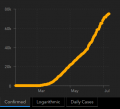
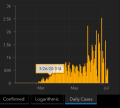
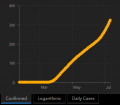
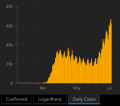
They correlate mainly to two things -- the big thousands and thousands of people with protesting, sharing megaphones, screaming. That's a setup to spread cases," Atlas said. "And also when you look at the analysis of the border counties, there's a tremendous amount of cases coming over the border and exchanging with families in the northern Mexico states.
Yeah it is interesting how this spreads. It is like a huge set of domino's that have not only the tendency to be knocked down by those close to it but also there is a unique timing for when each one gets knocked down due to it's proximity to others that get knocked down and their timing. So there is always a head count but there is also a timing factor. Mexico lagged the US by some time so we can see their infections now instead of before this. Once that is over maybe we will see the infection rate fall abruptly with some persistence.
On the other side of the world, India seems to be having a big surge in cases.
It was said early on that lockdowns would only "flatten the curve." They were not expected to decrease the long-term impact. It will be months before we know which was right.

 Facebook
 Google
 GitHub
 Linkedin



 It also shows how unprepared we were for this kind of thing even though several experts believed it could happen some years ago.