Convert LED Lamp to Dimmable

Thread Starter

ruvee

Joined Dec 17, 2018
9
Hello,

How would I go about converting a non-dimmable LED pendant ceiling light to a dimmable one?

It is using a single 5W (500 lumen) LED attached to a DONE LED POWER SUPPLY MODEL DL -5W250 -L.

I have attached the pictures.

Can I use a dimmable driver along with this LED or do I have to swap out both? Can I fit a dimmable bulb inside as the internal width of the pendant is 0.7 inches.

Thank you so much in advance!
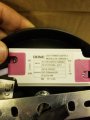

20181217_083727.jpg 20181217_083713.jpg
 

Thread Starter

ruvee

Joined Dec 17, 2018
9
I don't think there's any practical way to add dimming to that LED driver. You might completely replace the driver with one that supports dimming. You need a constant-current driver with a maximum of 250mA on the output, something like this:
https://www.ebay.com/itm/ERP-ESS010...h=item2f22237e9d:g:K3wAAOSwM9xbmqtT:rk:4:pf:0
Hi wayneh.

Thank you for taking the time to reply to my thread.

Can I keep the same LED and use this new driver or will I have to swap that out too?

There is no data sheet on the LED itself. It just surface-mounted onto a heatsink.

Also I see the input voltage is 120+ AC on that driver. I am using 110VAC input. Don't you vary the AC input to make output dimmable?
 

Audioguru

Joined Dec 20, 2007
11,248
A triac dimmer varies the AC pulse widths that reduces the average power. The ebay dimmable current source is dimmed with a triac AC dimmer or with 0V-10VDC on the 3 colored wires.
 

Thread Starter

ruvee

Joined Dec 17, 2018
9
A triac dimmer varies the AC pulse widths that reduces the average power. The ebay dimmable current source is dimmed with a triac AC dimmer or with 0V-10VDC on the 3 colored wires.
Hi,

Wouldn't I need a 0-24V dimmable current source for that LED as the current driver is outputting 24 volts directly to the LED.
 

wayneh

Joined Sep 9, 2010
18,104
Hi,

Wouldn't I need a 0-24V dimmable current source for that LED as the current driver is outputting 24 volts directly to the LED.
Actually it’s putting out 250mA and can go up to 24V to achieve that if it needs to. You need a variable current up to 250mA and probably the same capability of reaching 24V. You could measure the voltage being supplied by your controller and get a better idea of what that maximum voltage needs to be. There’s no need to go above whatever it actually is right now.
 

ElectricSpidey

Joined Dec 2, 2017
3,334
Can I keep the same LED and use this new driver or will I have to swap that out too?
Only the controller, but you will still need another circuit to control the dimming, depending on the controller you choose.

Also looks like that DONE controller is 6 to 18 volts not 24. Did you measure 24?
 

wayneh

Joined Sep 9, 2010
18,104
Yes, I didn't understand either. It was under no load of the LED but I did not expect 24Volts.
I would. The controller does its job by raising the voltage until 250mA flow, up to the 24V limit. With no load, it's trying desperately to drive the current up to 250mA but cannot. The voltage I asked you to measure is the voltage it has to go to in order to drive 250mA thru your LED. That measure will tell you if you really need 24V. It's more likely well under that, maybe 18V. No way to know without measuring it.
 
Last edited:

ian field

Joined Oct 27, 2012
6,536
I don't think there's any practical way to add dimming to that LED driver. You might completely replace the driver with one that supports dimming. You need a constant-current driver with a maximum of 250mA on the output, something like this:
https://www.ebay.com/itm/ERP-ESS010...h=item2f22237e9d:g:K3wAAOSwM9xbmqtT:rk:4:pf:0
There are off the shelf PFC chips that are sometimes found in dimmable LED units - adding the appropriate circuitry would do it, but doing the modification safely is a big task. buying one that already does that is the best way to go.

There's some app notes on various manufacturer site that explain what goes on.

Some early ATX PSUs had a dirty great choke in series with the AC line instead of an active PFC front end - no idea whether it would do any good for an LED driver.
 

Thread Starter

ruvee

Joined Dec 17, 2018
9
I don't think there's any practical way to add dimming to that LED driver. You might completely replace the driver with one that supports dimming. You need a constant-current driver with a maximum of 250mA on the output, something like this:
https://www.ebay.com/itm/ERP-ESS010...h=item2f22237e9d:g:K3wAAOSwM9xbmqtT:rk:4:pf:0

Hi There,

What happens if I use something like the attached data sheet. Would I be able to use for one LED or can I use for multiple (which i'm intending).

Part ESS040W-0900-42
 

Attachments

bertus

Joined Apr 5, 2008
22,922
Hello,

The ESS040W-0900-42 is intended for 31 to 40 Watts.
In your openings post you state that the led is 5 Watt.
The driver in the openings post is 250 mA, as the ESS you show is 900 mA.
Do you have a datasheet of the led?

Bertus
 

wayneh

Joined Sep 9, 2010
18,104
Would I be able to use for one LED or can I use for multiple (which i'm intending).
And we learn this in post #14?

It's likely that the linked controller can reach a voltage high enough to drive 2 and maybe 3 LEDs in series. You might get more with a parallel arrangement but you'll need a resistor in series with each LED to help balance the current.
 

Thread Starter

ruvee

Joined Dec 17, 2018
9
And we learn this in post #14?

It's likely that the linked controller can reach a voltage high enough to drive 2 and maybe 3 LEDs in series. You might get more with a parallel arrangement but you'll need a resistor in series with each LED to help balance the current.

No I'm still using one light at a time I figured if I tried a higher output driver I could use multiple because I have multiple lamps for a restaurant.
 

Thread Starter

ruvee

Joined Dec 17, 2018
9
Hello,

The ESS040W-0900-42 is intended for 31 to 40 Watts.
In your openings post you state that the led is 5 Watt.
The driver in the openings post is 250 mA, as the ESS you show is 900 mA.
Do you have a datasheet of the led?

Bertus
I wish I had a data sheet on the LED>
 

wayneh

Joined Sep 9, 2010
18,104
No I'm still using one light at a time I figured if I tried a higher output driver I could use multiple because I have multiple lamps for a restaurant.
The trouble is that each and every LED has to have controlled current. Putting them in series solves this because the current in the circuit is the same everywhere. But the required voltage goes up with each LED. Putting LEDs in parallel allows using a lower voltage, but then you lose control over the current passing through each one. You have to hope it balances out, and it won't without adding a resistor for each one, which causes an efficiency loss. But that loss is not huge and probably not a big concern for your application.

Since you're talking about a commercial installation, you really should involve a professional that is familiar with local codes and so on. You don't want your restaurant shut down by a code violation.
 

Thread Starter

ruvee

Joined Dec 17, 2018
9
The trouble is that each and every LED has to have controlled current. Putting them in series solves this because the current in the circuit is the same everywhere. But the required voltage goes up with each LED. Putting LEDs in parallel allows using a lower voltage, but then you lose control over the current passing through each one. You have to hope it balances out, and it won't without adding a resistor for each one, which causes an efficiency loss. But that loss is not huge and probably not a big concern for your application.

Since you're talking about a commercial installation, you really should involve a professional that is familiar with local codes and so on. You don't want your restaurant shut down by a code violation.
Thank you very much for your time!
 
Top