continuity tester

Reloadron

Joined Jan 15, 2015
7,891
You can use a simple solution like posted above or make things as complicated as you wish using a uC like an Arduino. If all you care about is continuity the diodes in the above can be substituted for LEDs making them all green. Any fail open circuit the LED will not light.

You can also get complicated and use an Arduino as I explained above. There are several ways to go about this using an Arduino. It's entirely up to you how you go about it.

Ron
 

bertus

Joined Apr 5, 2008
22,928
Hello,

I would make a scanning voltage at the input, like with a johnson counter as the 4017.
That way, you can also see shorts between the conductors.

Bertus
 

Reloadron

Joined Jan 15, 2015
7,891
Overkill, On/Good, Off/Fail... But if he has to have that...
I figure it this way, we humor the thread starter. While I can't speak for other members I figure between you and I there is over 80 years of experience. You and I as well as and several other forum members know this is never going to come to fruition the way the thread starter wants it unless someone does it for him. Maybe it's school work as I can't imagine a project like this less any parameters or better descriptors than continuity. Sometimes something "just ain't right". :)

Ron
 

SamR

Joined Mar 19, 2019
5,491
Sounded to me like an arduino looking for something to do instead of making a cable tester or a school assignment project to use an arduino in the solution for a cable tester. I've gone about as far as I care to without a consulting fee for the work.
 

BobaMosfet

Joined Jul 1, 2009
2,211
IT IS LARGE, IT HAS 10 WIRES.
I NEED TO USE AN ARDUINO, SO THAT IF I START TO CHECK THE CONTINUITY IT NEEDS TO CHECK THE WIRES FROM 1 TO 10 ONE BY ONE. AND IT NEEDS TO DISPLAY USING LED GREEN FOR OKAY AND RED FOR FAIL
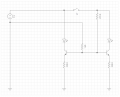
Here is an example circuit for one conductor. You can use the arduino to control shift-registers to switch which conductor gets tested into a single ended circuit like this:

1588353400953.png
The SPST switch above represents a single 'conductor. The LED on the left is RED, the one on the right is GREEN. Switch OPEN = broken conductor, RED LED lights. Switch CLOSED = unbroken conductor, GREEN LED lights. Two BJTs, NPN and PNP, as well as 2 resistors for current through LEDs, and 2 resistors for appropriate pull-up and pull-down on the bases of the transistors based on conductor continuity.

This circuit registers only that there is, or is not conductivity, and not the resistance. Just one example. Uses ~12 to 13mA.
 
Top