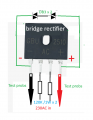
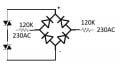
This is a DIY LED TV backlight tester. I found this on the internet. Could you please tell me the purpose of the two serially connected DIACs placed between the + and − terminals of the bridge rectifier?
It is hard to tell what the internal connections might be, but it is possible that the internal connections might be different than the picture. If you search for the datasheet, it comes back as a bridge rectifier. I rest my case.
It is hard to tell what the internal connections might be, but it is possible that the internal connections might be different than the picture. If you search for the datasheet, it comes back as a bridge rectifier. I rest my case.
Thanks for the explanation.
With this setup, once the voltage reaches 64V, + and − will be shorted, and the DIACs may heat up, correct? and can I connect an electrolytic capacitor (10u, 400V) between + and - ?
hi ranatung,
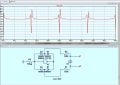
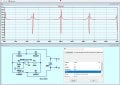
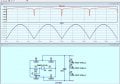
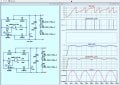
Sorry about the previous circuit error, this is a corrected version.
R3 is for the simulator operation, also the simulator uses the Peak voltage of the 230Vrms
What are the details of the LED types being tested??
hi ranatung,
Sorry about the previous circuit error, this is a corrected version.
R3 is for the simulator operation, also the simulator uses the Peak voltage of the 230Vrms
What are the details of the LED types being tested??
Note: I assume you are aware of the risks when using this test device, as there is no mains isolation. Using an isolation transformer is always the best option to ensure your safety.
Note: I assume you are aware of the risks when using this test device, as there is no mains isolation. Using an isolation transformer is always the best option to ensure your safety.
With this setup, once the voltage reaches 64V, + and − will be shorted, and the DIACs may heat up, correct? and can I connect an electrolytic capacitor (10u, 400V) between + and - ?
Not exactly shorted, but a low impedance with a minimum DC voltage across them. Because these are DIACs, there is no (or very little) current conducted through them until the voltage across them is greater than their trigger voltage.
DIAC power dissipation is limited by the two 120K resistors. Worst case (dead short) current is 960 uA (0.98 mA) RMS. If there is, say, 10 V across each DIAC when conducting, that is around 9 mW per DIAC.

 Facebook
 Google
 GitHub
 Linkedin