CLOSED

MrAl

Joined Jun 17, 2014
13,704
Do you know how to calculate the power output from an amplifier?
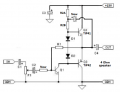
(Vrms squared)/speaker impedance. The amplifier you show uses a +3V supply and output transistors that drive the output capacitor up to about +2.7V with the bootstrapping shown and down to about +0.9V. Then the peak-to-peak voltage swing is 2.7V - 0.9V= 1.8V. The RMS voltage is 1.8V/2.828= 0.64V (almost nothing) then the power in a 4 ohm speaker is (0.64V squared)/ 4 ohms= 0.1W! The power is less as the battery runs down.
The peak output current is (1.8V/2)/4 ohms= 225mA so the transistors shown cannot be used since their maximum allowed current is only 100mA and their datasheet shows that they work poorly below 50mA.

For 5W into 4 ohms you need 4.5V RMS which is a peak-to-peak output swing of 12.7V so the power supply must be about 15V and produce 5W for the output power and about 5W for heating. The 10W at 15V is a power supply current of 667mA.

I simulated your amplifier and corrected it:
Hi,

You sure you want to get rid of R4?
That looks like it helps filter the DC a little, in both directions ... into and out of the amplifier ... and possibly limit current into the amplifier.

Isnt there a better alternative to the two diode bias scheme? I'd have to look around but i am sure there is a transistor circuit that gets the biasing better than the two diodes. There's a name for it too, cant remember right now.
 

Audioguru

Joined Dec 20, 2007
11,248
Using a TIP41 and TIP42 for the output transistors, they can output fairly high power but their inputs also need more power than the circuit with the low power transistors and low supply voltage.
This is your project so you should do the calculations and select a more powerful first transistor.
A problem with the circuit is that the DC current in the first transistor flows in the speaker causing its cone to be pulled to one side causing distortion when the speaker coil hits that close side of its magnet structure. So your resistor R2 should be two resistors in series and connected to the positive supply with a new capacitor from their junction to the emitters or the output transistors, and the speaker R3 should be connected to C4 and ground, and the polarity of C4 should be reversed.

Calculate the peak current needed for the bases of the output transistors, calculate a new value for the pair of R2's, select a new input transistor that can produce the current need, calculate a new value for R1 and calculate a vale for the new input resistor. Please put parts values on the schematic. Here is how the schematic will be if the new first transistor can produce enough current by itself:
 

Attachments

Audioguru

Joined Dec 20, 2007
11,248
Hi MrAl,
Audio amplifiers never use R4, but sometimes it is a fuse. You want full power for the peak levels of sounds.
The two diodes can be replaced by a biased transistor bolted to the heatsink of the output transistors for thermal control of their idle current. The bias current of this new transistor can be adjusted for the nominal idle current of the output transistors.
 

MrAl

Joined Jun 17, 2014
13,704
Hi MrAl,
Audio amplifiers never use R4, but sometimes it is a fuse. You want full power for the peak levels of sounds.
The two diodes can be replaced by a biased transistor bolted to the heatsink of the output transistors for thermal control of their idle current. The bias current of this new transistor can be adjusted for the nominal idle current of the output transistors.
Hi,

Well ok but i saw this as a headphone amp not a high power amp, and the filtering action is a tradeoff of power vs power input ripple filtering and the like. No big deal though, just thought i would mention it in passing.
I also would not expect it to be a very large value either, maybe 1 ohm, 2 ohms, etc.
 

Audioguru

Joined Dec 20, 2007
11,248
Well ok but i saw this as a headphone amp not a high power amp
In post #14 when he showed the schematic of the headphones amplifier that produced distortion, he said, "This is the schematic of the circuit I'm talking about, I just seen it on the internet and try it on a breadboard. It can't power my 5watt 4ohm speaker since it's a schematic for a Headphone Amplifier. Anyway, can you teach me how to edit this schematic so that it can power my speaker?".
 

MrAl

Joined Jun 17, 2014
13,704
In post #14 when he showed the schematic of the headphones amplifier that produced distortion, he said, "This is the schematic of the circuit I'm talking about, I just seen it on the internet and try it on a breadboard. It can't power my 5watt 4ohm speaker since it's a schematic for a Headphone Amplifier. Anyway, can you teach me how to edit this schematic so that it can power my speaker?".
Hi,

Oh wow, 5 watts, and 4 ohms? That's not a headphone anymore. Now i see why you want to eliminate the resistor entirely.

I would say then that if we want some filtering action we have to use a lower value then. With 4 ohms i would probably would go with 0.1 ohms or maybe 0.22 ohms. If you want to eliminate it all the way thought that's fine with me too.

One fo the other problems in power amps is the 60 or 120Hz hum from the power supply. How much we have here i dont know either because we dont see the power supply schematic. If run on batteries though it probably would not do as much unless there were other devices connected to the batteries also.
 

Audioguru

Joined Dec 20, 2007
11,248
I don't think this simple amplifier will produce much power supply hum because its input is not biased from the power supply.
 
Top