CLOSED

Thread Starter

Charlie Magne Aguda Ü

Joined Oct 24, 2017
33
Good Day! I'm trying to build an amplifier for my final project in Electronics. Our teacher wants us to design a Multistage Transistor Audio Amplifier. I have been doing research lately about multistage amplifiers. My problem now is I don't know where to start. I have tried some amplifier circuit on breadboard and most of it can power my speaker but it can't drive to it's maximum because of distortion. My speaker is a 4ohms 5 watt type speaker. I just want to make my Own circuit rather than depending on other's schematics. I have some good knowledge regarding different types of Amplifiers like Class A, B and AB. I just need a guide to help me how to start, what to do next and explain the purpose of such stages in my circuit. Hope someone will guide me. Thanks!
 

MrAl

Joined Jun 17, 2014
13,702
Hi,

Basically you design separate stages and then sort of connect them together using coupling capacitors.
There's more to that and more if you want DC coupling, but that's a start.
 

LesJones

Joined Jan 8, 2017
4,511
Start from the output stage. Work out what peak to peak voltage you requre to drive the speaker to the required power level. You will then know what power supply voltage you need.

Les.
 

Thread Starter

Charlie Magne Aguda Ü

Joined Oct 24, 2017
33
Start from the output stage. Work out what peak to peak voltage you requre to drive the speaker to the required power level. You will then know what power supply voltage you need.

Les.
I have found a formula
so putting my parameters i got an output power of 5 Watts with a maximum voltage at the speakers = 6.3 V.
What's next?
 

MrChips

Joined Oct 2, 2009
34,807
Why multi-stage?

Suppose you want to get high power sound out of a weak signal from a microphone or guitar pickup. Think in terms of stages and what each stage has to do.

Stage 1 - FET input preamp - provides high impedance low noise amplification
Stage 2 - Amplifier - provides gain, volume and tone control
Stage 3 - Driver - boosts the power output in preparation for the final stage
Stage 4- Power output - very low output impedance, high power output, with feedback to the driver stage for improved linearity (low distortion), short circuit and over-current protection

Work on each stage separately and then add negative feedback between Stage 3 and 4.
 

Thread Starter

Charlie Magne Aguda Ü

Joined Oct 24, 2017
33
Why multi-stage?

Suppose you want to get high power sound out of a weak signal from a microphone or guitar pickup. Think in terms of stages and what each stage has to do.

Stage 1 - FET input preamp - provides high impedance low noise amplification
Stage 2 - Amplifier - provides gain, volume and tone control
Stage 3 - Driver - boosts the power output in preparation for the final stage
Stage 4- Power output - very low output impedance, high power output, with feedback to the driver stage for improved linearity (low distortion), short circuit and over-current protection

Work on each stage separately and then add negative feedback between Stage 3 and 4.
Ok, I will try this. Thanks!
 

Audioguru

Joined Dec 20, 2007
11,248
Why don't you show us the circuit you made that produces distortion? Then we can see how much or how little you learned and we can give reasons for the distortion.
You said that you know class-A, class-B and class-AB amplifiers but did not say which one you want.
 

MrAl

Joined Jun 17, 2014
13,702
Hi,

Looks like a well written book on audio amplifiers. Audio Guru is going to love that one :)

I used to build my own audio amplifiers too some years ago. Last one was for a TV set that had no earphone jack and i wanted to add one. Turned out i needed to build an amp with audio transformer so i could get electrical galvanic isolation.
I bet that was 20 years ago.
 

Audioguru

Joined Dec 20, 2007
11,248
Yes, Douglas Self has (had?) some good ideas about reducing distortion. I looked to see if he is still kicking and see that he updated his website 4 days ago.
 

Thread Starter

Charlie Magne Aguda Ü

Joined Oct 24, 2017
33
Why don't you show us the circuit you made that produces distortion? Then we can see how much or how little you learned and we can give reasons for the distortion.
You said that you know class-A, class-B and class-AB amplifiers but did not say which one you want.

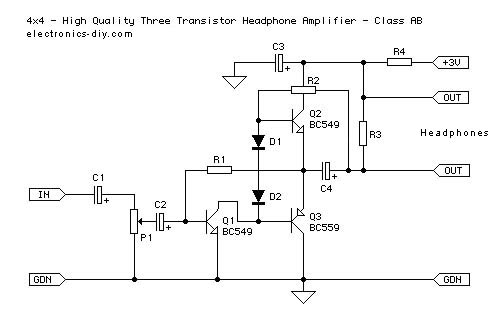
This is the schematic of the circuit I'm talking about, I just seen it on the internet and try it on a breadboard. It can't power my 5watt 4ohm speaker since it's a schematic for a Headphone Amplifier. Anyway, can you teach me how to edit this schematic so that it can power my speaker? Thanks!
 

MrAl

Joined Jun 17, 2014
13,702

This is the schematic of the circuit I'm talking about, I just seen it on the internet and try it on a breadboard. It can't power my 5watt 4ohm speaker since it's a schematic for a Headphone Amplifier. Anyway, can you teach me how to edit this schematic so that it can power my speaker? Thanks!
Hi,

That might be a good place to start but you need to show the component values. Resistor values, cap values, etc.
 

Audioguru

Joined Dec 20, 2007
11,248
Do you know how to calculate the power output from an amplifier?
(Vrms squared)/speaker impedance. The amplifier you show uses a +3V supply and output transistors that drive the output capacitor up to about +2.7V with the bootstrapping shown and down to about +0.9V. Then the peak-to-peak voltage swing is 2.7V - 0.9V= 1.8V. The RMS voltage is 1.8V/2.828= 0.64V (almost nothing) then the power in a 4 ohm speaker is (0.64V squared)/ 4 ohms= 0.1W! The power is less as the battery runs down.
The peak output current is (1.8V/2)/4 ohms= 225mA so the transistors shown cannot be used since their maximum allowed current is only 100mA and their datasheet shows that they work poorly below 50mA.

For 5W into 4 ohms you need 4.5V RMS which is a peak-to-peak output swing of 12.7V so the power supply must be about 15V and produce 5W for the output power and about 5W for heating. The 10W at 15V is a power supply current of 667mA.

I simulated your amplifier and corrected it:
 

Attachments

Thread Starter

Charlie Magne Aguda Ü

Joined Oct 24, 2017
33
Hi,

That might be a good place to start but you need to show the component values. Resistor values, cap values, etc.
R1 - 100K
R2 - 330
R3 - 100
R4 - 22 (2 - 4.5V)
R4 - 100 (5 - 12V)
C1 - 4.7uF
C2 - 4.7uF
C3 - 100 - 1000uF
C4 - 220uF

P1 - 100K
D1, D2 - 1N4148
Q1, Q2 - BC549
Q3 - BC559

Those are the parts list.
 

Thread Starter

Charlie Magne Aguda Ü

Joined Oct 24, 2017
33
Do you know how to calculate the power output from an amplifier?
(Vrms squared)/speaker impedance. The amplifier you show uses a +3V supply and output transistors that drive the output capacitor up to about +2.7V with the bootstrapping shown and down to about +0.9V. Then the peak-to-peak voltage swing is 2.7V - 0.9V= 1.8V. The RMS voltage is 1.8V/2.828= 0.64V (almost nothing) then the power in a 4 ohm speaker is (0.64V squared)/ 4 ohms= 0.1W! The power is less as the battery runs down.
The peak output current is (1.8V/2)/4 ohms= 225mA so the transistors shown cannot be used since their maximum allowed current is only 100mA and their datasheet shows that they work poorly below 50mA.

For 5W into 4 ohms you need 4.5V RMS which is a peak-to-peak output swing of 12.7V so the power supply must be about 15V and produce 5W for the output power and about 5W for heating. The 10W at 15V is a power supply current of 667mA.

I simulated your amplifier and corrected it:
Thank you! I'm gonna study this circuit to understand it better. Thank you so much!
 

Thread Starter

Charlie Magne Aguda Ü

Joined Oct 24, 2017
33
Do you know how to calculate the power output from an amplifier?
(Vrms squared)/speaker impedance. The amplifier you show uses a +3V supply and output transistors that drive the output capacitor up to about +2.7V with the bootstrapping shown and down to about +0.9V. Then the peak-to-peak voltage swing is 2.7V - 0.9V= 1.8V. The RMS voltage is 1.8V/2.828= 0.64V (almost nothing) then the power in a 4 ohm speaker is (0.64V squared)/ 4 ohms= 0.1W! The power is less as the battery runs down.
The peak output current is (1.8V/2)/4 ohms= 225mA so the transistors shown cannot be used since their maximum allowed current is only 100mA and their datasheet shows that they work poorly below 50mA.

For 5W into 4 ohms you need 4.5V RMS which is a peak-to-peak output swing of 12.7V so the power supply must be about 15V and produce 5W for the output power and about 5W for heating. The 10W at 15V is a power supply current of 667mA.

I simulated your amplifier and corrected it:
If I want to edit your schematic so that it can power my speaker, what values should I change so that it can power my speaker?Since I have a TIP41 and TIP42 in my kit ,Is it possible to change the 2N4401 and 2N4403 on the output side with a TIP41 and TIP42?
 
Top