Self powered Normally Closed 24 Hour Switch

Thread Starter

Fib

Joined Sep 29, 2025
5
I have a circuit that is connected to a solar panel that goes to sleep during the night. At that point it does not allow current to flow even when the sun comes up. The only way to “wake it up “ is to disconnect and reconnect the solar panel. I am looking for a self powered (9 volt or AAA batteries) that can be programmed that at a specific hour of the day momentarily break the connection and make again.Totally self contained with leads for proper connector installation.
Retired Technician and Sales Engineer
 

AnalogKid

Joined Aug 1, 2013
12,081
Please post a wiring diagram of your setup, including where you want the disconnect to happen. Make sure each component or assembly has a unique reference designator so we can discuss things without confusion.

ak
 

Thread Starter

Fib

Joined Sep 29, 2025
5
Is it circuit you can modify?
Unfortunately no. The manufacturer has it locked down and will not modify, so I am looking for an external solution. I have verified that opening the connection for a few seconds when solar panel is providing voltage wakes up the internal circuit. To clarify, this is a rechargeable power unit that I need to automatically recharge.
 

MisterBill2

Joined Jan 23, 2018
27,277
What portion of the circuit, if any, do you have access to?? Another option could be a small solar sensor that could generate a short pulse when it became illuminated.
 

crutschow

Joined Mar 14, 2008
38,391
How about using the solar panel voltage to power the circuit, and generate a short disconnect pulse to a switch when voltage above a certain value is detected in the morning?
That should be fairly simple to do.

How much current and voltage will the switch need to control?
 
Last edited:

Thread Starter

Fib

Joined Sep 29, 2025
5
It’s possible 200 watts at 20 volts. I like your thinking of using voltage from the panel. It would be zero volts and as soon as the voltage increases open the circuit momentarily, or maybe better make the circuit for the entire daylight. 10 amp unlikely but possible and that is substantial at that voltage. Thoughts?
 

crutschow

Joined Mar 14, 2008
38,391
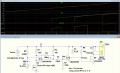
Below is the LTspice sim of a circuit that should do what you want:
It uses two comparators (one IC), a MOSFET, a voltage reference, and a relay, plus a few resistors and capacitors.

U1a acts as a level detector that switches at a solar panel voltage (top trace) determined by the 2.5V voltage reference U3 and the setting of pot U4.
U1a switching high triggers U1b (middle trace), configured as a one-shot, to generate a ≈1s pulse (determined by C2*R7 value) to turn on MOSFET M1 and thus relay U2 to momentarily interrupt the output voltage (bottom trace).

The sim shows the pulses for three settings of the pot wiper position.

Does that look feasible to you?

1759334392448.png
 
Last edited:

sghioto

Joined Dec 31, 2017
8,634
10 amp unlikely but possible and that is substantial at that voltage. Thoughts?
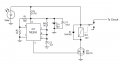
NE555 version.
Operation:
RL1 is a 5 pin automotive relay and depending on the specs can activate as low as 8 volts.
As the solar panel voltage begins to rise the output pin3 of the 555 is low because reset pin4 is low.
When the solar panel reaches appx 10 volts the voltage on the reset pin4 determined by the R1-R2 divider circuit will be high enough to bring the 555 out of the reset mode and pin3 will go High and activate the relay.
R2 may need to be adjusted depending on the actual chip used.
C2 now begins charging through R4 and after appx 1 second resets the 555 deactivating the relay.
Zener diode ZD1 limits the voltage at the 555 to a safe level as the solar panel rises to 20 volts or more.

1759355140815.png
 

crutschow

Joined Mar 14, 2008
38,391
Just to note: A 555 circuit's turn-on point depends upon the Reset input's Vbe threshold voltage of an internal transistor, so will be rather temperature sensitive, thus may not be a good circuit if it's not in a reasonably stable indoor temperature environment.

The LM339's circuit is quite temperature stable.
 

Thread Starter

Fib

Joined Sep 29, 2025
5
I have on order male and female jacks with pigtails attached. This will allow me to insert between the solar panel and battery charging circuit without modifying any existing equipment. I realized that having an open circuit all night and connecting in the morning after the panel provides power works as a reset. So I am going to try a low draw relay with the coil triggered by the panel and use the normally open contacts to route + to the charging circuit when the relay closes when panel power reaches a triggering level. KISS if it works. Comments?
 

MisterBill2

Joined Jan 23, 2018
27,277
I have on order male and female jacks with pigtails attached. This will allow me to insert between the solar panel and battery charging circuit without modifying any existing equipment. I realized that having an open circuit all night and connecting in the morning after the panel provides power works as a reset. So I am going to try a low draw relay with the coil triggered by the panel and use the normally open contacts to route + to the charging circuit when the relay closes when panel power reaches a triggering level. KISS if it works. Comments?
THAT seems like a quite reasonable scheme that will be more reliable and much less complex.
 

sghioto

Joined Dec 31, 2017
8,634
Just to note: A 555 circuit's turn-on point depends upon the Reset input's Vbe threshold voltage of an internal transistor, so will be rather temperature sensitive,
I don't think it would vary more then a couple hundred millivolts.
Idea is the relay will activate somewhere between appx 8 to 10 volts.
 

sghioto

Joined Dec 31, 2017
8,634
I realized that having an open circuit all night and connecting in the morning after the panel provides power works as a reset. So I am going to try a low draw relay with the coil triggered by...........Comments?
Now that the parameters of the "reset" have changed I agree with your approach.
 

AnalogKid

Joined Aug 1, 2013
12,081
I don't think it would vary more then a couple hundred millivolts.
But that voltage is in the middle of a 13:1 divider, so a change of 200 mV reflects to a 2.6 V change at the "input" (Vcc). The zener diode certainly helps to reduce that variance, but that doesn't change the fact that the Reset input makes for a very poor analog comparator.

ak
 

Thread Starter

Fib

Joined Sep 29, 2025
5
Now that the parameters of the "reset" have changed I agree with your approach.
Absolutely. I did some testing and re- evaluating and that absolutely changes the parameters. But if it does not work I have a couple of circuits to try thanks to all of you. Thank you
 
Top