Circuit to emit three beeps when triggered

Thread Starter

Kim Sleep

Joined Nov 6, 2014
391
1723865845768.png
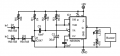
This circuit was designed by the helpful people on this forum. Its purpose is to turn on LED1, and the buzzer for 3 seconds when a specific LED on 2 separate 4017 outputs match.
The circuit works really well, but I would like an additional circuit on the output of the 555, replacing the buzzer, and LED1, that activates a relay 3 times for 1 second each activation (these times are very approximate). Is this possible? I no longer need the activation of LED1, and the buzzer of the original circuit at this time.
EDIT: Maybe a 4017 being driven by a 555 at 1 pulse per second, and 3 outputs driving a 2n222??
Thanks for any assistance.
 
Last edited:

WBahn

Joined Mar 31, 2012
32,706
Yes, it is very doable, but there are some considerations that you should take a moment to, well, consider.

Your description makes it appear like the output of this first timer, which is three seconds, is intimately tied to the total of three seconds of your new relay output.

A common approach that novices would take would be to have a circuit that pulses the relay continuously when enabled and then use the output of this timer to enable that circuit for three seconds.

If that is the way you are thinking about it, I'd recommend a rethink. There are more demons in those waters than you want to contend with.

Instead, think of your approach as detecting a triggering event (both In1 and In2 being HI at the same time) that starts a sequence of events consisting of three pulses to your relay.

At this point, some of the things to consider is whether it is acceptable to have the system run to completion any time the triggering event is detected. I'm guessing the answer is yes since your current circuit behaves that way.

Another consideration is whether it is important for all three pulses to the relay to be the same? If not, that opens up some doors.

Yet another consideration is if you are willing to consider switching over to an MCU-based approach. What you are trying to do is trivial to achieve with just about any cheap 8-pin microcontroller and the complexity of the resulting circuit will be greatly diminished, more reliable, cheaper (not counting any one-time costs if you don't already have a programmer and such), and consume less power.

If you aren't willing to consider that, then there are still a number of approaches, each with pros and cons, to evaluate.

My recommendation -- take this opportunity to learn how to do simple things with simple MCUs. The payoff down the road will probably be well worth the time and money (both of which are quite tame) invested up front.
 

Thread Starter

Kim Sleep

Joined Nov 6, 2014
391
Another consideration is whether it is important for all three pulses to the relay to be the same?
they should be the same, but accuracy is not terribly important in this case.
I would rather stick to Analogue at this moment, I do have a training kit that I purchased a few months ago, but no time to crack it open and learn, at this time. Thank you for all your considerations of this design.
Anyone have any ideas for the actual schematic??
 

Thread Starter

Kim Sleep

Joined Nov 6, 2014
391
Yes, it can be done. However, the simplest solution is a small MCU.
I absolutely understand that, and unfortunately I have to go the analogue way at this time.
Maybe a 4017 being driven by a 555 at 1 pulse per second, and 3 outputs driving a 2n222??
 

AnalogKid

Joined Aug 1, 2013
12,045
So, to re-write the requirement:

1. When single input signal is high, the circuit is activated.

- Question - Is a low input signal allowed?

2. When activated, the circuit drives a small load with three, 1-second pulses. The time can be approximate.

- Question - Do the pulses have to be exactly identical? Or can the first pulse be approx 30% longer than the next two pulses?

If yes, what is the load current? This sets the size of the output transistor.

If all of that is correct, then I have a circuit from another thread.

Also, is the input signal high during the entire output sequence,
OR - does it always go low before the sequence is done,
OR - could be either?

Depending on the answers, this can be done with a single logic chip as a gated oscillator.

ak
 

Thread Starter

Kim Sleep

Joined Nov 6, 2014
391
- Question - do the pulses have to be exactly identical? Or can the first pulse be approx 30% longer than the next two pulses?
The time of these pulses does not need to be accurate.
-If yes, what is the load current? This sets the size of the output transistor.
If you include a driving transistor, or Mosfet, I will choose one that is appropriate, as Im not exactly certain what I will be driving at this time.
-Also, is the input signal high during the entire output sequence,
OR - does it always go low before the sequence is done,
OR - could be either?
To be honest, I dont know exactly what you are saying. I THINK that it should go once the sequence is done.

I still need the function of the initial circuit that triggers when the 2 LEDs are illuminated by 2 4017s

Thank you!!
 

MrChips

Joined Oct 2, 2009
34,629
Im not exactly certain what I will be driving at this time.

I still need the function of the initial circuit that triggers when the 2 LEDs are illuminated by 2 4017s
I think you need to think this through completely. Don't assume that using 4017 is the only solution.
 

crutschow

Joined Mar 14, 2008
38,323
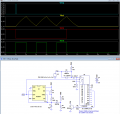
Below is the LTspice sim of an example 555 and a 4017 circuit to get three output pulses from the 555 when the two trigger inputs both go high (blue trace):
R2 and R3 are to prebias the timing circuit so that the first pulse is not significantly longer than the rest.
The 4017 is triggered on the 555 pulse falling-edge to eliminate an output glitch at the end of the third pulse.

1723916317294.png
 

AnalogKid

Joined Aug 1, 2013
12,045
This circuit from another thread is similar to crutschow's - it is a free-running oscillator gated on for a fixed period by a timer. The ON time sets the number of output pulses. In his case, the oscillator is a part of its enabling timer (through the 4017).

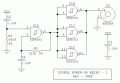
In this case, the ON time is set by another R-C timer. This was originally a power-on pulser. In your case, the circuit is powered continuously by the 9 V source, and a high enable signal drives the input at C2. When it goes high, the oscillator is enabled while C2 charges. Eventually the voltae at pin 1 goes below the input threshold level, and the oscillator is disabled. R1-C1 set the oscillator frequency. Adjust R1 for the desired output pulse width/frequency, and then adjust R2 for the number of output pulses. In your application, the three paralleled gates would be replaced by a single n-channel MOSFET.

That leaves three unused gates, and this leads to the question about the timing of the enable signal. This circuit is very simple with only one gate, but the enable signal must be stable for the entire output sequence of pulses. If the signal returns to its "off" (low) condition, the output stream ceases immediately. If that is a problem, then . . .

Two of the unused gates can be turned into a true monostable. This replaces the simple R2-C2 timer with a fixed-width pulse that completely ignores the input signal once triggered. It also makes the circuit triggered by a low signal. If this is an issue, the third unused gate can invert the input signal. This is now functionally equivalent to circuit #9, with everything still fitting in one logic chip.

Schematic later.

ak


Double-Pulses-7-c.gif
 
Last edited:

MrChips

Joined Oct 2, 2009
34,629
I absolutely understand that, and unfortunately I have to go the analogue way at this time.
Maybe a 4017 being driven by a 555 at 1 pulse per second, and 3 outputs driving a 2n222??
4017 and 555 are digital chips too.

Many people shy away from MCU solutions for lack of knowledge and experience using MCUs.
That is a shame because in the long run, MCUs offer the simplest and lowest priced solution.

Almost anyone of us can send you a programmed MCU chip that cost under $1.
 

AnalogKid

Joined Aug 1, 2013
12,045
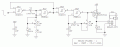
First pass at a full solution. This circuit replaces the 555 in post #1, and adds the requested triple pulse output to a relay.

R1-R2-C1 set the oscillator enable period. With the values shown it is approx. 1 s to 11 s. R3-C3-R4 set the oscillator period, which sets the relay ON time. Adjust this first to get the On time you want, then adjust R2 for the number of pulses. Of course, adjust the Q1 and K1 part numbers to ones that fit your application.

This is a work in progress. Note the polarity of the input signal. It is inverted from your diode-AND circuit. I'm trying to come up with a way around this without the additional transistor.

ak


!!Multi-Pulser-1-c.gif
 
Last edited:

AnalogKid

Joined Aug 1, 2013
12,045
Below is the LTspice sim of an example 555 and a 4017 circuit to get three output pulses from the 555 when the two trigger inputs both go high
Using the output oscillator to clock its own enable timer - nice.

Hey - in my circuit I could replace the monostable with a staircase comparator. That could save one gate, and make it more analog -y . . .

ak
 
Last edited:

eetech00

Joined Jun 8, 2013
4,704
Below is the LTspice sim of an example 555 and a 4017 circuit to get three output pulses from the 555 when the two trigger inputs both go high (blue trace):
R2 and R3 are to prebias the timing circuit so that the first pulse is not significantly longer than the rest.
The 4017 is triggered on the 555 pulse falling-edge to eliminate an output glitch at the end of the third pulse.

View attachment 329444
I guess I'm not understanding this circuit.

What is holding inh (U2-Q3) high at startup?
When inh (U2-Q3) is low, what keeps U1 out of reset?
 

Thread Starter

Kim Sleep

Joined Nov 6, 2014
391
Below is the LTspice sim of an example 555 and a 4017 circuit to get three output pulses from the 555 when the two trigger inputs both go high (blue trace):
R2 and R3 are to prebias the timing circuit so that the first pulse is not significantly longer than the rest.
The 4017 is triggered on the 555 pulse falling-edge to eliminate an output glitch at the end of the third pulse.

View attachment 329444
I guess I'm not understanding this circuit.

What is holding inh (U2-Q3) high at startup?
When inh (U2-Q3) is low, what keeps U1 out of reset?
Thank you very much Sir. I was sort of thinking of the 4017 way to go as well. This is a simple, eligant design, that you have taken a lot of time to make for me,. and I appreciate it
 

Thread Starter

Kim Sleep

Joined Nov 6, 2014
391
First pass at a full solution. R1-R2-C1 set the oscillator enable period. With the values shown it is approx. 1 s to 11 s. R3-C3-R4 set the oscillator period, which sets the relay ON time. Adjust this first to get the On time you want, then adjust R2 for the number of pulses. Of course, adjust the Q1 and K1 part numbers to ones that fit your application.

This is a work in progress. Note the polarity of the input signal. It is inverted from your diode-AND circuit. I'm trying to come up with a way around this without the additional transistor.

ak


View attachment 329468
 

Thread Starter

Kim Sleep

Joined Nov 6, 2014
391
Thank you so much Analogue Kid. You truly are amazing, this is the second schematic that you have designed for me, and I truly appreciate your skill, and help.
 

AnalogKid

Joined Aug 1, 2013
12,045
When inh (U2-Q3) is low, what keeps U1 out of reset?
A missing pull-up resistor to Vdd.

A mini-micro-minor nit - this is why I'm not a fan of using net names to make a signal net connection. Drawing the connection might be messy, but is saves having to scour the entire schematic to see if the pull-up resistor is somewhere else, and helps to prevent this type of error.

My approach to this, which I know others think is wrong, is to re-work the 555 decal so that the pin locations untangle the signal flows. My schematic library has almost a dozen different 555 decals, each with different pin arrangements.

ak
 
Last edited:

crutschow

Joined Mar 14, 2008
38,323
A missing pull-up resistor to Vdd.
It doesn't need a pull-up.
The 555 Rst input is the base of a PNP transistor which requires sinking about 0.5mA to ground for reset.
An open circuit at the 555 Rst input thus enables it.
But if it makes you feel better, a pull-up resistor can be added.
 
Last edited:
Top