Facebook
 Google
 GitHub
 Linkedin

Consider the following circuit : 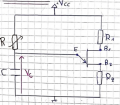
Working in power electronics, we considered the JFET as a voltage controlled resistance, our professor said this is the equivalent circuit :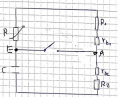
Initially the transistor is blocked, thus the capacitor is charging, when \( v_c = v_E > v_A \) the JFET is conducting thus its transformed into a short-circuit and its resistances are \( r_{b_1}, r_{b_2} \), nonetheless, my confusing is when the the transistor is turned into a short-circuit why would the current coming from the branch R_1, go through the node A and to the bottom resistances, also another question how would the capacitor discharge, another question shouldnt the gate source voltage be negative to not damage the transistor? if you have any other ideas about this circuits or any intuition or hidden idea in it please enlighten me infinite thanks
Working in power electronics, we considered the JFET as a voltage controlled resistance, our professor said this is the equivalent circuit :
Initially the transistor is blocked, thus the capacitor is charging, when \( v_c = v_E > v_A \) the JFET is conducting thus its transformed into a short-circuit and its resistances are \( r_{b_1}, r_{b_2} \), nonetheless, my confusing is when the the transistor is turned into a short-circuit why would the current coming from the branch R_1, go through the node A and to the bottom resistances, also another question how would the capacitor discharge, another question shouldnt the gate source voltage be negative to not damage the transistor? if you have any other ideas about this circuits or any intuition or hidden idea in it please enlighten me infinite thanks
Attachments
-
 95.3 KB Views: 0