In other words poor design practice. Since it is not critical for your use, you could just leave it as is until it fails. Chinese designs do this all the time (Harbor Freight for example) it is still not a good idea. Just keep what you have and consider this a learning experience.
But to avoid using parallel strings of LEDs, I'll have to have like a 30v power supply or more to power like 10 LEDs in series. Or how would one do to counter the voltage drop of each lead in series?
Create parallel LED series to match the power supply voltage you have.
I go into great detail in this article on how to do that and more. LEDs, 555s, Flashers, and Light Chasers
Create parallel LED series to match the power supply voltage you have.
I go into great detail in this article on how to do that and more. LEDs, 555s, Flashers, and Light Chasers
You may have missed a point. It’s bad to put them in parallel without some additional current limiting circuitry. Such as a resistor per LED string in parallel. A “string” of one LED is the simplest case and I’m sure you’ve heard about the necessity of a current limiting resistor for one LED.
Leds in parallel work fine when their forward voltages are matched.
I bought a very bright flashlight that has 60 surface-mount LEDs all matched and in parallel. It costed $3.99CAN in The Dollar Store and Amazon sells it for $9.99CAN.
To design a flasher to order it is important to understand how these parts work. LEDs are simple enough, but they have been around for a long time, and have changed quite a bit from their first commercial release. The old parts were fairly dim, and couldn't use much current. It is now possible to buy LEDs that will use over an amp and easily outshine most light bulbs. This article will deal with the dim to medium 5mm type of LEDs, since that is the majority simple ICs can easily power.
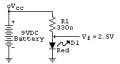
LEDs are current devices. This means they operate on current once a minimum voltage is provided. Like conventional diodes, they do not limit this current, another component has to do this. Connect an LED to a power source without a resistor and it will be damaged, probably burned out. Figure 1.1 shows the conventional scheme to light up an LED.
..................Figure 1.1
The forward dropping voltage, or Vf, of an individual LED is very stable. Go below this voltage and the LED stops conducting. This LED is assumed to be 2.5V, pretty standard for a modern red unit. The target current is 20ma. Going though the math (using Ohm's Law) the resistor is 325Ω. Since 330Ω is the nearest standard resistor value 330Ω it is.
Here is the approximate Vf of most LEDs:
......... Older Generation ... Newer Generation
Current ....... 10ma ................... 20ma
Red ............ 1.5V ..................... 2.5V
Yellow ......... 2.0V .................... 3.0V
Green ......... 2.0V .................... 3.0V
Blue ........................................ 3.5V
White ...................................... 3.5V
For the Vf of a specific device you need to refer to the datasheet, and also understand there will be some variation even within a family. Part of the reason LEDs have changed so much is their efficiencies have gone way up. A modern LED at full power can damage your eyes if held directly next to the eyeball with the light shining in. Obviously these are not toys for children. Older LEDs didn't come close to these power levels.
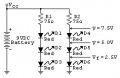
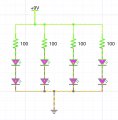
LEDs can also be chained to share the same current to light more than one LED. Since this current is being used twice the apparent efficiency to light these LEDs is increased. Given that the LEDs can vary their Vf it is a really bad idea to parallel LEDs directly. Figure 1.2 shows a fairly typical example of how to do both for increased lighting.
.........................Figure 1.2
The reason it is such a bad idea for parallel LEDs to share their current limiting resistor is normal variations in Vf can cause one leg to draw more current than the other. This can result in the failure of one chain over time, leaving the second chain to absorb all the current. If you have a lot of LEDs in parallel this can lead to a progressive cascade failure, with LEDs popping like corn. You might be able to get by with it, but it is definitely not good design practice.
You may have missed a point. It’s bad to put them in parallel without some additional current limiting circuitry. Such as a resistor per LED string in parallel. A “string” of one LED is the simplest case and I’m sure you’ve heard about the necessity of a current limiting resistor for one LED.
Leds in parallel work fine when their forward voltages are matched.
I bought a very bright flashlight that has 60 surface-mount LEDs all matched and in parallel. It costed $3.99CAN in The Dollar Store and Amazon sells it for $9.99CAN.
I have built many LED items and I have matched the parallel LEDs in them.
One was a nightlight with 36 matched white LEDs all in parallel with no resistors and powered from a 0.72A current source.
The 2.3W of total power in the LEDs made a lot of heat that caused the clear plastic case to turn yellow.
That article has several ideas along with explanations. Ever hear of a joule thief? It is a way of keeping an LED lit when the battery voltage will no longer sustain it.
Hello.
Following @AnalogKid suggestion here, at post #46, I want to ask if I have to make any changes in order to have 9 leds, in the same arrangement as the other one I did in the link above, 3 parallel branches of 3 leds in series.
Meaning:
...............|--------- LED --------- LED --------- LED ...............|.........................................................|
Vcc ------ |--------- LED --------- LED --------- LED -------- GND ...............|.........................................................| ...............| --------- LED --------- LED --------- LED
And I want to ask a few questions.
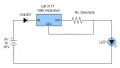
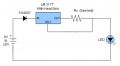
I have this suggestion for a LED driver:
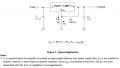
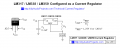
And then I also see this typical application circuit from a datasheet:
So, I'm not sure how to proceed. Which circuit to use? I already know about potential problems due to voltage mismatches and etc, so I just want to discuss about the best circuit to use without going into crazy details.
The first is a constant current configuration which makes sense for LEDs. LEDs are non-linear with respect to current so it requires a power supply that will control the current.
The second is an adjustable voltage configuration, which is a nice arrangement for other things, but not for LEDs.
If you have a fairly stable 9v supply, you'll have a stable ~30mA current from a simply resistor current limiter.
it Is unlikely that you can put three in series since the forward voltage of a UV LED is usually more than 3v. You can do something like this. Add a fourth path for the ninth one and use a 330 ohm resistor for that loner if you want.
The first is a constant current configuration which makes sense for LEDs. LEDs are non-linear with respect to current so it requires a power supply that will control the current.
The second is an adjustable voltage configuration, which is a nice arrangement for other things, but not for LEDs.
Ok, so focusing on that first one and the one @AnalogKid suggested, which one should be better:
1 --
2 --
I see the circuits are almost the same other than the absence of the capacitor C1 in circuit 1 and the absence of the diode in circuit 2.
So, which would be better?
I saw your post, but I'm not there yet. I'm still trying to figure out if I should use the circuit with the cap (C1) or the circuit with the diode or maybe a combination of both!
In sch #1, the input diode is there for reverse-polarity protection in case the battery is connected backwards. If you don't need that protection, it can be deleted.
Also, the first circuit should have C1 at its input. The input capacitor prevents positive feedback through the ADJ pin from turning the circuit into an oscillator. Just about anything will work. I have tested this with capacitances down to 4.7 nF.
With those two changes, the two circuits are identical.
So, from a datasheet I found for 5mm UV Leds, the continuous current is stated at 20mA. So, if I want to have 20mA for each of the 3 branches, I would need 60mA overall, right?
Knowing that the Vref = 1.25V, I need a 1.25 / 60mA = ~22Ω resistor at the output pin of the voltage regulator. Then, I split this point into the 3 branches and eventually, these 3 branches will have approximately 20mA each, right?
Edited
However, with my power supply set to 12V, I can only measure a not very steady overall current of like 7mA. If I raise the power supply voltage to 14V, then, yes, I get a current of around 50mA (still a bit under the 60mA) and if I raise the voltage to 16V, then I already get 71mA. But wasn't this circuit supposed to be a constant current source?

 Facebook
 Google
 GitHub
 Linkedin