Facebook
 Google
 GitHub
 Linkedin
Greetings.
I am a computer science major, but I recently started a Circuit-related course. I have only basic knowledge of the field, and I fear I might be in a bit over my head. I hope I can get some good pointers from you all!
The problem I'm asking for help with in this post is worded as follows:
Obtain the transfer function Vout / Vin of the circuit shown in Fig. 1 where R1 = R2 = 1KOhm, C1 = C3 = 1 / 2 000 000 pi) microFarad, and L2 = 1 / 2pi H.
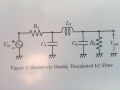
What I've tried so far:
I figured the main gist of this problem is to apply regular techniques like Kirchofs circuit and voltage laws. So I did:

V1 = V2 - Vin
V2 = I2 / s*C1
V3 = V4 - V2
V4 = I4 / s*C2
Vout = V4
I1 = V1 / Rs
I2 = I1 - I3
I3 = V3 / s*L2
I4 = I3 - I5
I5 = V4 / R2
Given this set if equations I started solving for V4, as that would give me the desired Vout. But either I'm bad or it's hard, because it took me an unreasonable amount of steps to get there. I eventually ended up with an answer, but a very ugly one containing many factors containing s, up to the 4th power. It's been a while since I learned about Laplace transform and I haven't gone to check how hard the reverse transform would be, but I have a feeling it's harder than this assignment was supposed to be. To be honest, I don't even know if a "transform function" is supposed to be in the s-realm or not.
Where I tried to find the answer on my own
I first checked the learning materials on this site. What I was able to find was this: https://www.allaboutcircuits.com/textbook/alternating-current/chpt-5/series-parallel-r-l-and-c/
However, I am not sure if regular circuits and the ones in my problem with everything grounded are equivalent, so I didn't dare follow the same pattern.
After some google, I found this slide: https://inst.eecs.berkeley.edu/~ee247/fa05/lectures/L4_f05.pdf
Page 5 of that has essentially the same problem, and I used it as a reference when applying KCL and KVL. However, it doesn't finish the calculations, and I struggled with even that much.
I know we aren't supposed to say "Newbie needs help!" and such, but I would like to emphasize that I feel slightly out of my depth here, and I would really appreciate it if any explanations you'd be so kind as to offer would assume that I knew very little more advanced than KCL / KVL and how the different components work.
I am a computer science major, but I recently started a Circuit-related course. I have only basic knowledge of the field, and I fear I might be in a bit over my head. I hope I can get some good pointers from you all!
The problem I'm asking for help with in this post is worded as follows:
Obtain the transfer function Vout / Vin of the circuit shown in Fig. 1 where R1 = R2 = 1KOhm, C1 = C3 = 1 / 2 000 000 pi) microFarad, and L2 = 1 / 2pi H.
What I've tried so far:
I figured the main gist of this problem is to apply regular techniques like Kirchofs circuit and voltage laws. So I did:
V1 = V2 - Vin
V2 = I2 / s*C1
V3 = V4 - V2
V4 = I4 / s*C2
Vout = V4
I1 = V1 / Rs
I2 = I1 - I3
I3 = V3 / s*L2
I4 = I3 - I5
I5 = V4 / R2
Given this set if equations I started solving for V4, as that would give me the desired Vout. But either I'm bad or it's hard, because it took me an unreasonable amount of steps to get there. I eventually ended up with an answer, but a very ugly one containing many factors containing s, up to the 4th power. It's been a while since I learned about Laplace transform and I haven't gone to check how hard the reverse transform would be, but I have a feeling it's harder than this assignment was supposed to be. To be honest, I don't even know if a "transform function" is supposed to be in the s-realm or not.
Where I tried to find the answer on my own
I first checked the learning materials on this site. What I was able to find was this: https://www.allaboutcircuits.com/textbook/alternating-current/chpt-5/series-parallel-r-l-and-c/
However, I am not sure if regular circuits and the ones in my problem with everything grounded are equivalent, so I didn't dare follow the same pattern.
After some google, I found this slide: https://inst.eecs.berkeley.edu/~ee247/fa05/lectures/L4_f05.pdf
Page 5 of that has essentially the same problem, and I used it as a reference when applying KCL and KVL. However, it doesn't finish the calculations, and I struggled with even that much.
I know we aren't supposed to say "Newbie needs help!" and such, but I would like to emphasize that I feel slightly out of my depth here, and I would really appreciate it if any explanations you'd be so kind as to offer would assume that I knew very little more advanced than KCL / KVL and how the different components work.
Last edited: