Chaser w/off LED

eetech00

Joined Jun 8, 2013
4,705
I am used to building novelty led chaser kits and diy circuits that chase. It’s usually a single led lighting up and moving through a line or circle as one on then off next on then of etc around or down a line of LEDs. I want a circuit to control 16 LEDs in a chaser effect that has the reverse going on. All LEDs are on and the moving effect is one led in turn goes off while it moves down the line or in my case around the circle.
Any help or direction would be helpful. Thank You
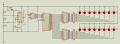
Here's a version for 16 leds:

LED-16 Chaser.gif

It is designed for 6v-15 but should be ok to operate at 5v.
I didn't know if you wanted a reset but that can also be added.
 
Last edited:

Thread Starter

Icanmakeit67

Joined Sep 23, 2018
210
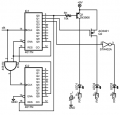
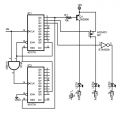
Here's a schematic for 16 LEDs. The 16 counter outputs being used will have one on at a time. The inverters on the output will implement the moving dark dot you want.

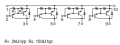
I show several options for driving the LEDs. The two transistors won't limit LED current, but the CD4049 can only sink about 8mA with a 9V supply (drops to 3mA at 5V).
View attachment 310458
Outputs Q0-8 from the first counter and Q1-7 from the second are used.

Decoupling capacitors omitted for clarity.
 

Thread Starter

Icanmakeit67

Joined Sep 23, 2018
210
I was thinking yes on the reset. Continuing operation around a square configuration of the LEDs. Speed of the chasing effect is fixed I see. Very kind to do this!
The 4515 and 4520? Not sure about part number. I’m getting many options. Maybe CD4520BE? Not having luck with 4515?
 

eetech00

Joined Jun 8, 2013
4,705
CD4515BE is obsolete and two suppliers have no stock?
The CD4515B (T.I.) is not obsolete. It is available from T.I, Digikey, Mouser...
Onsemi version is MC14515B also available.

In addition, a TLC555 (CMOS) can be used instead of NE555 is desired.

The clock speed used in animation post #21 is approximately 1 clock pulse per sec.
Did you want the chaser speed to be variable? If so, what is the range of speed?

Also, how do you want the reset to work? Manual reset (press reset button restart count)? Auto stop after 16th clock?
 
Last edited:

Thread Starter

Icanmakeit67

Joined Sep 23, 2018
210
The CD4515B (T.I.) is not obsolete. It is available from T.I, Digikey, Mouser...
Onsemi version is MC14515B also available.

In addition, a TLC555 (CMOS) can be used instead of NE555 is desired.

The clock speed used in animation post #21 is approximately 1 clock pulse per sec.
Did you want the chaser speed to be variable? If so, what is the range of speed?

Also, how do you want the reset to work? Manual reset (press reset button restart count)? Auto stop after 16th clock?
I’d like the timing cut in half, or twice present speed and i just want the chase to start on power up and continue until power down. I’ll look for those part numbers. Thanks so much. I want to get to the point I can better understand and design my own but people willing to help on this platform is very appreciated!
 

Thread Starter

Icanmakeit67

Joined Sep 23, 2018
210
I’d like the timing cut in half, or twice present speed and i just want the chase to start on power up and continue until power down. I’ll look for those part numbers. Thanks so much. I want to get to the point I can better understand and design my own but people willing to help on this platform is very appreciated!
CD4515BEG4 is available from DigiKey, ok?
 

eetech00

Joined Jun 8, 2013
4,705
I’d like the timing cut in half, or twice present speed and i just want the chase to start on power up and continue until power down. I’ll look for those part numbers. Thanks so much. I want to get to the point I can better understand and design my own but people willing to help on this platform is very appreciated!
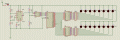
Here is modified version.

LED-16 Chaser-1.gif

In the simulation above, a blue square represents a logic low value and a red square represents a logic high value.

Here is a short description of how the circuit works.
1. U11 is a 555 timer configured as a clock generator. It outputs a clock pulse every 0.5 seconds. The clock signal is fed to U1:A.
2. U1:A (U1:B is not used) is a binary up-counter. It outputs a binary representation of the clock pulse count on every rise of the clock signal. The binary output is fed to U2.
3. U2 is a 4-16 Line Decoder but we are using like a 1-of-16 selector. For each binary value read at the input of U2, only one output is activated. Outputs 1-8 are fed to U4, outputs 9-16 are fed to U3.
4. U4,U3 are Darlington arrays. Each of its input controls its corresponding output. U2 doesn't have the output current capacity to drive the LED's, so U4,U3 provide the necessary drive current to light each LED.
5. RN1,RN2 are resistor packs each containing 8 individual resistors of the same value (1k). U4,U3 are capable of providing 500mA of output current. So RN1,RN2 limit the current to each LED. The value should be chosen based on the desired LED drive current.
6. R1/C2 ensure U1 starts count at 0 on power on.

Hope this all makes sense.
 

Thread Starter

Icanmakeit67

Joined Sep 23, 2018
210
if its available, its ok.

But most of these and other chips not available in PDIP anymore. Mostly available in surface mount SOIC.
If PDIP needed for breadboarding the CD4515, you could buy a SOIC-24 to PDIP-24 adapter.
I found “HEF4515B” from Jameco electronics
Here is modified version.

View attachment 310496

In the simulation above, a blue square represents a logic low value and a red square represents a logic high value.

Here is a short description of how the circuit works.
1. U11 is a 555 timer configured as a clock generator. It outputs a clock pulse every 0.5 seconds. The clock signal is fed to U1:A.
2. U1:A (U1:B is not used) is a binary up-counter. It outputs a binary representation of the clock pulse count on every rise of the clock signal. The binary output is fed to U2.
3. U2 is a 4-16 Line Decoder but we are using like a 1-of-16 selector. For each binary value read at the input of U2, only one output is activated. Outputs 1-8 are fed to U4, outputs 9-16 are fed to U3.
4. U4,U3 are Darlington arrays. Each of its input controls its corresponding output. U2 doesn't have the output current capacity to drive the LED's, so U4,U3 provide the necessary drive current to light each LED.
5. RN1,RN2 are resistor packs each containing 8 individual resistors of the same value (1k). U4,U3 are capable of providing 500mA of output current. So RN1,RN2 limit the current to each LED. The value should be chosen based on the desired LED drive current.
6. R1/C2 ensure U1 starts count at 0 on power on.

Hope this all makes sense.
Thank You. I look forward to breadboarding the circuit. I very much appreciate help. I’ll update when I get the IC’s
 
Top