There are current ratings for capacitor so if you try to discharge too fast you might damage some caps. There's also ESR so that may help slow the discharge.
As Kermit said, if you apply a reverse voltage through a resistor you can discharge in just about any time you want, as long as you dont damage the cap in the process. You need some resistance and the discharge must be halted at 0v or else the cap becomes reversed charged or destroyed.
Hi,
There are current ratings for capacitor so if you try to discharge too fast you might damage some caps. There's also ESR so that may help slow the discharge.
Next time try a little trick I learned.
It's a secret to most people posting here.
It's called GOOGLE. They have this website where you type in a word or phrase and it gives you a list of sites that have info on that word or phrase. Give it try. It's cool!
Next time try a little trick I learned.
It's a secret to most people posting here.
It's called GOOGLE. They have this website where you type in a word or phrase and it gives you a list of sites that have info on that word or phrase. Give it try. It's cool!
Hard to say without any of the required specifications.
Years ago I built a Zener tester and figured that 640V would cover any Zener I was ever likely to see.
A big electrolytic was involved to make the voltage rise slow and gentle - seriously dangerous if it ever got fully charged.............
A shorting switch was the obvious way to make it safe between tests............but the contacts were completely destroyed on the first activation.
An NTC thermistor in series with the switch solved the problem, at room temperature it has a few tens of Ohms - the discharge current heats the thermistor and it drops to about 1 Ohm. My application has the inrush limiting thermistor from a scrap consumer product.
You may have to experiment a bit to find an NTC thermistor that best dissipates the charge your capacitor holds.
Hard to say without any of the required specifications.
Years ago I built a Zener tester and figured that 640V would cover any Zener I was ever likely to see.
A big electrolytic was involved to make the voltage rise slow and gentle - seriously dangerous if it ever got fully charged.............
A shorting switch was the obvious way to make it safe between tests............but the contacts were completely destroyed on the first activation.
An NTC thermistor in series with the switch solved the problem, at room temperature it has a few tens of Ohms - the discharge current heats the thermistor and it drops to about 1 Ohm. My application has the inrush limiting thermistor from a scrap consumer product.
You may have to experiment a bit to find an NTC thermistor that best dissipates the charge your capacitor holds.
The intention is to get more energy in the discharge it must be gone directly to a inductor to see if the magnetic fields grows, for that I think it must be discharged in the less time possible, and I would like to try using capacitors about 10v and 100uf with this voltage and capacitance it can not be dangerous at all.
The intention is to get more energy in the discharge it must be gone directly to a inductor to see if the magnetic fields grows, for that I think it must be discharged in the less time possible, and I would like to try using capacitors about 10v and 100uf with this voltage and capacitance it can not be dangerous at all.
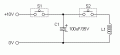
The normal capacitor discharge through the RL as this.
If you want to discharge the capacitor just through coil then you will meet the problem is the current will be delay 90 degree after voltage, so this may against what you trying to do.
Probably the discharge times only it depends about the capacitor features, a capacitor with more voltage and less capacitance will be discharged in less time than one with less voltage and high capacitance, right? a ne555 mono stable circuit it is about to control the discharge about the capacitor, but it can not change the natural discharge of one capacitor faster according with his feature, and also according with Kermit this has to keep in mind as well.
Magnetic field strength is proportional to current.
Resistance to any changes of current flow in a solenoid is due to its inductance.
The faster you try to make the cap discharge the harder the inductance will fight against it.
To make the cap discharge into the solenoid faster, you must figure out how to decrease it's inductance.
Next time try a little trick I learned.
It's a secret to most people posting here.
It's called GOOGLE. They have this website where you type in a word or phrase and it gives you a list of sites that have info on that word or phrase. Give it try. It's cool!
If you google "ESR" you get a lot of responses besides the capacitors reference. You could get a better response if you googled "CAPACITOR ESR", but you would have already know the answer to the question to do that.

 Facebook
 Google
 GitHub
 Linkedin