High ESR on ceramic disk capacitors

Thread Starter

oh_uh_okay

Joined Aug 24, 2025
48
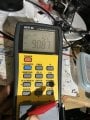
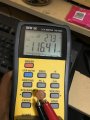
I'v'e tested a few ceramic disk caps of. e.g., 100nF value , using various meters, and I am getting pretty high ESR results. Above 20 ohms at least. None of these caps have been abused (ttbomk), and some are brand new. A sample size of 10 or so tested is not large but when I test the same 100nF value of, say, film caps i have, the ESR value drops to almost zero. Not sure these measurements are unusual for ceramic disc caps???
IMG_0231.jpg
A 100 nF cap, tested at 1khz.
 

wayneh

Joined Sep 9, 2010
18,096
Look up a few datasheets. This will give you an idea of what to expect. A more typical frequency for specifying ESR is 100kHz but you'll find different values used.
 

MisterBill2

Joined Jan 23, 2018
27,358
The higher losses for ceramic disk capacitors is probably why they are sometimes relegated to bypass applications by some designers.
There are a wide variety of capacitor types available, and so the type of capacitor selected will depend on the application.
 

crutschow

Joined Mar 14, 2008
38,423
Too low a frequency. The reactance is probably swamping the ESR giving an inaccurate reading.
Yes.
The reactance of a 100nF cap at 1kHz is about 1.6kΩ, thus the meter likely cannot read a low ESR accurately.
The ESR of a 100nF ceramic should be <1Ω but that typically occurs near 10MHz.

Try the highest frequency (100kHz) you meter can use.
That may give a value in the order of 1 ohm for the 100nF cap.
 

Thread Starter

oh_uh_okay

Joined Aug 24, 2025
48
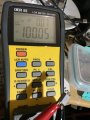
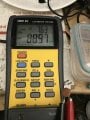
100k will get me to about 1 to 8 ohms—I tested this on two separate 104 disks. But even at 1k, a film is almost zero. Not sure why my phono preamp used the 104 disks in the signal path (see my other thread for schematic).
D0E89881-1465-493A-A662-76EBD793DCEC.jpeg
09C5E6EC-0E39-47DD-ABE6-3ED637705B57.jpeg
BA82980F-131A-4839-8ED3-F844411BF89C.jpeg
 

crutschow

Joined Mar 14, 2008
38,423
A few ohms of ESR resistance in series with likely many kΩ of load resistance in the signal path is unlikely to have any audible or measurable effect on the audio signal.
 

Thread Starter

oh_uh_okay

Joined Aug 24, 2025
48
That high ESR for disks is just plain weird. I don’t have many disks to play with.
Maybe some of you can confirm my results.
 
Last edited:

sparky 1

Joined Nov 3, 2018
1,218
The ESR of the first capacitor seems very high. possibly replace it with a cap with a higher voltage rating.
DER is a good meter, even so the smaller are more difficult to measure. If milli ohms is working your meter is probably ok.
Ceramic Capacitor Failure: What Causes and How to Prevent

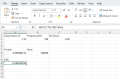
The data below is for making spreadsheet that calculates ESR. The example B1 is 100kHz, compare it to Murata.
dissipation factor DF is C1

Column A = capacitance in nF (from 1 to 150)
Cell B1 = frequency (100000 for 100 kHz)
Cell C1 = tan δ (e.g., 0.02 typical for ceramics)
Then in Column B (ESR in ohms):

Enter this in spreadsheet

1763181720676.png

produce a spice graph showing ESR over a frequency range
.param freq=100k
R_ESR N001 N002 {0.02/(2*pi*freq*112n)}
.step param freq list 10k 20k 30k 40k 50k 60k 70k 80k 90k 100k

B1 N001 0 V=table(V(f), 10000, 0.28421, 20000, 0.14210, ..., 100000, 0.02842)

R_ESR N001 N002 {0.02/(2*pi*frequency*112n)}
C1 N002 0 112n
.ac dec 10 10k 100k
 
Last edited:

Thread Starter

oh_uh_okay

Joined Aug 24, 2025
48
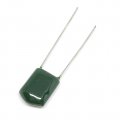
After ditching the ceramic disks, I have to replace the green polyester-ceramic "candy" caps. They ain't measuring much better. And don't belong in phono circuits.
H8815ed190ca64d8faf932c0a4580a8a7j.jpg
 
Last edited by a moderator:

Thread Starter

oh_uh_okay

Joined Aug 24, 2025
48
The DER works just fine. I do have other, modern instruments for compare and contrast. None of these devices are high end, lab-grade, of course. Also in my lab (not shown) are older Eico and Micronta and Simpson units.


Top