Is my first attempts for high power SMPS from mains.

Thread Starter

djb

Joined May 17, 2008
33
Hello everyone,

Is my first attempts for high power SMPS from mains.

I'm looking for a relatively symmetric trangle wave generator circuit to be used for PWM through an LM311 comparator and feedback reference voltage.

I found some challenges for a real implementation and i could use some suggestions:

- correct referencing : i see that in reality the reference voltage for the comparator must not go below the triangle, because the PWM pulse will go over 100% duty cycle, meaning if the circuit relies on switching for operation (like flyback or forward) will cause the primary coil of tranformer and primary switch to stay ON. (this is short circuit on the source through the main switch)

- power supply from mains. Since this would be a control circuit for a power supply, we can't have a power supply to build a power supply. We need to run this from mains after Full wave bridge. in my country we have 240V 50Hz, so i need to run this circuit from about 350V DC.

- is it worth investigating a similar triangle wave generator with only transistors ? or the shape will be much worse? i'm wondering about this, because we can choose 400V transistor versions and resolve the previous point issue.

Any comments appreciated !
 

schmitt trigger

Joined Jul 12, 2010
2,027
I sometimes hesitate to answer questions from a newbie who is attempting to cross a bridge too far. I have been dissed too many times.
But I am a glutton for punishment. This is my only advice:

Fully integrated off-line SMPS chips which offer not only all the necessary building blocks but protection schemes as well, have been available since the 1980s.
Unless you really, really, really want to learn the fundamentals, I would consider instead one of the many low cost and ubiquitous ICs in the market.
Believe me, designing them into a functional SMPS will still be a significant challenge.
 

ronsimpson

Joined Oct 7, 2019
4,645
There are many ICs that do most of the work. Back when I started these parts were not available. It was very hard to build the PWM building blocks.
If you have to do this, start out with a simple DC to DC PWM using an IC. We can get you schematics and parts lists.
If you are working of the power line, you need safety. This will kill you if it can. I use an isolation transformer to help protect me. Start out small like a 5V cellphone charger. Then move up.
 

MrAl

Joined Jun 17, 2014
13,667
thank you for your comment. i really want to learn the fundamentals !!
Hi,

I'd be happy to help as well as the other members, but I need to know what you already know and have done in the past, and what test equipment you have on hand or can get easily.

Maybe you can write up a little description of yourself as to your studies so far (electrical, mathematical) and what test equipment you have and what equipment you can use. The better you can describe this stuff, the faster myself and other members will be able to help.

Also, do you have any experience working with mains line circuits (120vac, 230vac, etc.).

I should also mention that DC to DC converter circuits are for a little more advanced studies, and mains line converters are for experts. Normally you would learn some prerequisite circuits and analysis first so you can deal with the complications that come up.
 
Last edited:

Ian0

Joined Aug 7, 2020
13,097
Most flyback supplies these days are current mode, which means that they don't need a triangle-wave reference, as the triangle wave is provided by the current flowing through the inductor. dI/dt=V/L, V is fixed (the power supply voltage). L is fixed, so I=Vt/L which is a ramp. Place a resistor in the source of the switching transistor and you have a triangle wave across it.
All you have to do is compare that voltage with the output of the error amplifier, and switch the transistor off when the voltage on the source resistor exceeds the output voltage of the error amplifier.
That should trigger a monostable (a 555 will do) to time about 10 or 20us, after which it switches the power transistor back on.
 

vandveuser16776

Joined Feb 21, 2026
121
As @schmitt trigger put it clearly and frankly, I too, believe it is a very long shot to start your learning journey from the SMPSs. It is like "I get a grasp of chemistry by reading organic chemistry." All terminologies will fly high above your head.
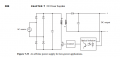
An oversimplified diagram of SMPS is in the link that @Papabravo posted 1774729042464.png
 

MrAl

Joined Jun 17, 2014
13,667
Yes and there are many kinds of topologies also. Some are easier to manage than others. Some would be wayyyy too difficult for someone just getting into the field unfortunately, but that's the way it is with everything. You start small, then build on that. Over time you get up to speed on a lot of ideas and concepts that have been known since the beginning of electricity.
 

drjohsmith

Joined Dec 13, 2021
1,549
to add @djb
smps are somethink that looks simple , but its in reality
a. dangeous
b. one of the more difficult circuits to design from scratch .

If you want to explore smps
start building using off the shelf controler switches.
this will let you learn things like inductor capacitor diode fet pcb desgn / selection with a fair safety net
 

MrAl

Joined Jun 17, 2014
13,667
Yeah or even just a linear regulator circuit :)

We don't know anything about the past experience or studies of the original poster so it is hard to judge what they can handle and can't handle yet.

[How about a resistive voltage divider] :)
 
to add @djb
smps are somethink that looks simple , but its in reality
a. dangeous
b. one of the more difficult circuits to design from scratch .

If you want to explore smps
start building using off the shelf controler switches.
this will let you learn things like inductor capacitor diode fet pcb desgn / selection with a fair safety net
First things first and safety always comes first. And that brings me the 240 mains which will give about 360v dc after full bridge and capacitor! Experimenting in a simulator's environment is unlikely to cause any hazard. If I were to begin with convertors, I would go for some buck convertor that turns 12v to 5v, so the highest at stake would be a few components, not a life!
 

atferrari

Joined Jan 6, 2004
5,001
Hi,

When it comes to switching converters, I always recommend starting with the Buck circuit it's the simplest to get going and the simplest to understand.
In theory the output voltage is proportional to the duty cycle. That alone makes it easier to understand.
And the hardest to master when you are already an experienced designer? Chuk maybe?
 

Ian0

Joined Aug 7, 2020
13,097
And the hardest to master when you are already an experienced designer? Chuk maybe?
No Čuk is easy. If you need a negative supply same voltage as your positive supply, a 555, one R, one C, one MOSFET, one schottky and a dual winding inductor and it works!
[edit] make that 2 Caps.
How about dual active bridge? That looks tricky to me.
 

MrAl

Joined Jun 17, 2014
13,667
And the hardest to master when you are already an experienced designer? Chuk maybe?
Hi,

I would say the Cuk is by far the more complex circuit, but it's also more well behaved than the Boost. The Boost is a much simpler circuit though.

The Cuk has a smooth energy transfer, while the Boost has a control singularity as well as a right hand plane zero. The singularity can never be reached, so without proper duty cycle limiting the output voltage could actually drop, which then tells the control circuit to increase the duty cycle even more, which causes the output to drop even more. The RHP zero causes an out-of-sync duty-cycle to output-voltage-change, which means when the duty cycle increases, the output drops momentarily before it can start to increase.

So the Cuk has a more complex circuit but smoother behavior than the Boost, but the Boost has a much simpler circuit.
So one is more complicated but easier to control, and the other is very simple but harder to control.
 

MisterBill2

Joined Jan 23, 2018
27,159
Certainly DJS is totally correct in that switcher power supplies are one of the most difficult systems to design to have working correctly and efficiently, and to even have work at all. The commercial products make it look deceptively simple, but it isn't!!
AND, switchers don't us a triangle wave, but rather a ramp wave.
THAT is the main reason I never designed a switcher for a machine built for a customer or a client. It is not cost effective!!
AND with mains powered supplies things can go bad in just a very few milliseconds.
The TI website used to have a section on switcher design, but it has been ten years since I saw it so it may have changed a lot. But at the time it was educational.
 

MrAl

Joined Jun 17, 2014
13,667
Hi,

I've used the National Semi line of "Simple switchers" for various projects. That's about as simple as you can get, and they work pretty well.
The only drawback with some of them is the efficiency is still 1980's-ish which is not that modern anymore. The root cause is the use of a bipolar output.
 
Top