Can Someone help with Homework?

LDC3

Joined Apr 27, 2013
924
Since R6 and R7 are in parallel, Req67=1/(1/R6+1/R7).
The same for R2 and R3: Req23=1/(1/R2+1/R3).
Now the outer circuit has R5, Req67 and R8 in series: Req5678 = R5 + Req67 + R8.
With this, there is now Req23 and Req5678 in parallel: Req235678 = 1/(1/Req23 + 1/Req5678).
This is in series with R1 and R4: Req = R1 + Req235678 + R4.
 

Thread Starter

DOREENT

Joined Oct 26, 2014
17

Thread Starter

DOREENT

Joined Oct 26, 2014
17
Since R6 and R7 are in parallel, Req67=1/(1/R6+1/R7).
The same for R2 and R3: Req23=1/(1/R2+1/R3).
Now the outer circuit has R5, Req67 and R8 in series: Req5678 = R5 + Req67 + R8.
With this, there is now Req23 and Req5678 in parallel: Req235678 = 1/(1/Req23 + 1/Req5678).
This is in series with R1 and R4: Req = R1 + Req235678 + R4.
Is this how to solve for Figure 6-19?
 

Thread Starter

DOREENT

Joined Oct 26, 2014
17
Thanks. Do you know about this subject? Im looking for a tutor. If you know this subject how much do you charge for tutoring.
So I can use that formula that you did for figure 6-18? If not can u work it out for me so I can have a better understanding of it.
 

LDC3

Joined Apr 27, 2013
924
This would be the equation for 6-18:

R7, R8 and R9 are in series, so you add them together.
R5 and Req789 are in parallel, so you take the inverse sum of the inverse:
.
R4, Req5789 and R6 are in series, so you add those together.
R2 is in parallel with Req456789.
R1, R3 and Req2456789 are in series.
 

JoeJester

Joined Apr 26, 2005
4,390
You need to look at your circuit, redraw the circuit with each reduction that you do, so you can track what you are doing.

You will end up with just one Req for the whole string.

Then apply KVL and KCL to work your way back up to the full circuit to identify the voltages, currents, and power of each resistor.

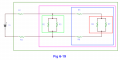
Each Req is a separate colored box in the below diagram.
 

Attachments

atferrari

Joined Jan 6, 2004
5,012
Has the OP shown own work yet? No that I can see.

17 posts already asking for somebody to solve each problem. Not a single attempt shown.

How many more to come?
 

JoeJester

Joined Apr 26, 2005
4,390
I went about as far as I can without work from the OP.

I will confirm answers from this point forward on problem in Fig 6-19. I did work out E, I, and W for each resistor in scientific notation in excel.

I'm awaiting to see the OP's work before proceeding any further.
 

JoeJester

Joined Apr 26, 2005
4,390
Do you know about this subject? Im looking for a tutor. If you know this subject how much do you charge for tutoring.
The tutoring fees around here are paid in sweat equity. You show your work, the members will assess it and point out where you made an error. You will be giving all sorts of "self-checking" rules so your need for paying the sweat equity will diminish.

There are fee based tutoring sites out there in internet land. I don't have a clue on their pricing.
 

WBahn

Joined Mar 31, 2012
32,852
It seems like you are looking for magic formulas and then want to know if you can throw formula X at circuit Y. That's not how to do circuit analysis.

So let's see if we can walk YOU through the work -- meaning that we will give you leading questions, but YOU need to then show the work you've done at each stage. Don't worry about getting it right -- if you make a mistake we can much better help you overcome it by seeing your work and what it tells us about your approach, right and wrong.

So for Figure 6-18:

Q1) Can you identify an combinations of resistors that are either in parallel or in series? Remember, to be in series whatever current passes through one of the resistors must be the exact same current that flows through the other. To be in parallel, the two resistors must have the exact same voltage across them. A simple test for being in parallel is to put your two index fingers on opposite sides of one resistor and if you can move your fingers along that wire to the opposite sides of the other resistor without going through any other components then they are in parallel.

For this step, just identify the sets of resistors that are in series, if any, and the sets of resistors that are in parallel, if any. For each set, determine the effective single resistor that could replace them, and then redraw the circuit with those sets replaced by their single resistor equivalents.
 
Top