Facebook
 Google
 GitHub
 Linkedin

Hello everyone,
I'm currently studying Crosstalk and trying to get a better understanding of how it manifests in coupled interconnects using a lumped element model.
The circuit I'm looking at represents two coupled lines—an aggressor line and a victim line—modeled as lumped elements. In this model:
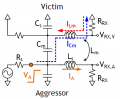
Could someone kindly help me understand qualitatively what happens at each node when the aggressor voltage VA transitions (e.g., from low to high)?
It would be great if you could explain it in two parts:
Also, I’ve read that the current IA in the aggressor line generates a changing magnetic flux, which in turn induces a current ILm in the victim line. This induced current flows in the direction that opposes the change in magnetic flux—meaning it's in the opposite direction to IA. Could someone please elaborate more on how this coupling through mutual inductance works and how the direction of the induced current is determined?
I'm currently studying Crosstalk and trying to get a better understanding of how it manifests in coupled interconnects using a lumped element model.
The circuit I'm looking at represents two coupled lines—an aggressor line and a victim line—modeled as lumped elements. In this model:
- Rs is the driver resistance on the aggressor side.
- Cs is the capacitance between each line and the return plane (ground).
- Cm is the mutual capacitance between the two lines.
- Ls is the self-inductance of each line.
- Lm is the mutual inductance between the aggressor and victim lines.
Could someone kindly help me understand qualitatively what happens at each node when the aggressor voltage VA transitions (e.g., from low to high)?
It would be great if you could explain it in two parts:
- During the transition of VA
- After the transition, when the system reaches steady state.
Also, I’ve read that the current IA in the aggressor line generates a changing magnetic flux, which in turn induces a current ILm in the victim line. This induced current flows in the direction that opposes the change in magnetic flux—meaning it's in the opposite direction to IA. Could someone please elaborate more on how this coupling through mutual inductance works and how the direction of the induced current is determined?