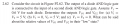
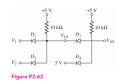
You calculate the voltages for the inputs in their stated states, which seems straight-forward.
What difficulty are you having with that?
Have you not studied Ohm's law and basic circuit analysis?
obviously someone needs serious help. the circuit is two separate AND gates.
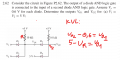
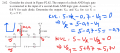
KVL ass applied in initial post is wrong. it assumes Vf=0.7V even before determining if there is a current through D1 or not.
then results get out of proportion. one should always check if there are any storage elements in the circuit (capacitor or inductor) or additional sources, and if levels are observed at steady state or not. if no storage elements or additional sources, then voltage levels can ONLY be within shown supply limits (0V and 5V). any result outside that range is supposed to be IMMEDIATE red flag.
in other words -0.7V and 5.7V values are a clear signs of wrong analysis.
next one need to observe and analyse individual circuit (gate), not the entire thing. And this better be generic... so it can be applied to the next gate.
in digital world, signals are true or false ( logic 0 / logic 1)
range for levels are defined for each logic family and they are NOT fixed...
so
generic case would be to describe what happens when V1 is at one of the logic levels. simple way to ignore the other input is to connect all inputs together ( V1 =V2).
If V1 is 0V, output Vo1 is _____
If V1 is 5V, output Vo1 is _____
If V1 is undefined (such as 1.785194V), the output Vo1 is ______
this is short and simple and this is what is needed to analyze entire circuit (which could have MANY gatees)

 Facebook
 Google
 GitHub
 Linkedin