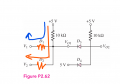
in this problem diode conducts if Va-Vk>=0.6V but for the sake of analysis of this problem, we only need to solve what happens when diode(s) are forward biased. that is when Vi<=5V-0.6V or more specifically when Vi is in range [0V,5V-0.6V)
in this problem diode conducts if Va-Vk>=0.6V but for the sake of analysis of this problem, we only need to solve what happens when diode(s) are forward biased. that is when Vi<=5V-0.6V or more specifically when Vi is in range [0V,5V-0.6V)
since Vf=0.6V, diodes are not conducting when Vi is in range [4.4,5.0]. supply [0V,5V] so all that is left to solve is subset of that range, which is when Vi is [0V, 4,4V). singe gate has at least two inputs (and generally it could be more), Vi input that matters is the lowest one.
when inputs are high, output is simply 5V (no current through resistor)
and if one of more inputs are low, then we only need to look at one with the lowest voltage.
for example
V1 = 2V
V2= 1.7V
since V2 <V1, we only need to see what is happening with V2.
Vo1 in this case is
Vo1 = Min(V1,V2) + Vd = 1.7V + 0.6V = 2.3V
then we apply the same on the next gate and so on... you can solve 500 gates in 10min. to do that by applying giant KVLs would take lifetime..
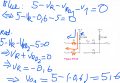
Replaced the diodes D1 and D2 with very large resistances and solve the loop equations. Then do the same for the other gate.
And, yes, using KVL makes the solution more tedious; but you need to start somewhere. It's easier/faster to just look at the input voltages and determine what the output voltage is.
Replaced the diodes D1 and D2 with very large resistances and solve the loop equations. Then do the same for the other gate.
And, yes, using KVL makes the solution more tedious; but you need to start somewhere. It's easier/faster to just look at the input voltages and determine what the output voltage is.
Why replace them with very large resistances ? Can I let D1, D2 open circuit?
If I replace them with resistances like below, which loop should I write, blue one or red one? tks
since Vf=0.6V, diodes are not conducting when Vi is in range [4.4,5.0]. supply [0V,5V] so all that is left to solve is subset of that range, which is when Vi is [0V, 4,4V). singe gate has at least two inputs (and generally it could be more), Vi input that matters is the lowest one.
when inputs are high, output is simply 5V (no current through resistor)
and if one of more inputs are low, then we only need to look at one with the lowest voltage.
for example
V1 = 2V
V2= 1.7V
since V2 <V1, we only need to see what is happening with V2.
Vo1 in this case is
Vo1 = Min(V1,V2) + Vd = 1.7V + 0.6V = 2.3V
then we apply the same on the next gate and so on... you can solve 500 gates in 10min. to do that by applying giant KVLs would take lifetime..
As usual, you need to go back and put in some effort at learning the fundamentals.
Because you won't, you are once again blindly assuming that the voltage across a diode is 0.6 V regardless of whether that makes any sense whatsoever. As a result, you get a nonsensical answer and have no ability to spot that it makes no sense. Consequently, you just keep digging yourself deeper and deeper into that hole you seem so fond of.
Getting a result that the voltage anywhere in this circuit is 5.6 V should have thrown up all kinds of red flags. How can a circuit like this, that has nothing greater than 5 V anywhere, produce a voltage at V01 that is 5.6 V? If it did somehow do that, what direction would current be flowing in all of those resistors? Where would that current be coming from?
If all the supplies are 5V, where is the extra 0.6V coming from? Does a diode GENERATE voltage? No, it has an innate voltage drop when current flows through it.
If all the supplies are 5V, where is the extra 0.6V coming from? Does a diode GENERATE voltage? No, it has an innate voltage drop when current flows through it.

 Facebook
 Google
 GitHub
 Linkedin