Can someone help me with the technique for removing SMD Capacitors After unsuccesful trials

Thread Starter

denni

Joined Jul 18, 2023
65
Hello everyone,

I’m having trouble unsoldering the SMD capacitors circled in red in the photo. Despite trying different soldering iron tips (as shown in the photo) and setting the temperature to 400°C, I haven't had any success. I don't want to increase the temperature further.
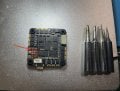
IMG_5486.jpg

I tried applying desolder one side, but the other side remains stuck. I also attempted using hot air at around 350°C, but it didn't work either.

This component is part of the flight controller of a drone, specifically the GEP-F7 AIO 45A. I'm not sure what I'm doing wrong and how to remove these capacitors without risking damage to other components.

I tried aplying no clean flux on the areas where soldering is supposed to be, but no success (using A no clean flux pen).

Any tips or ideas on how to do this properly would be greatly appreciated. The soldering iron tips seem too big even though I consider one of them to be really thin, and even the ones I tried didn’t help.

Thanks in advance!
 

ericgibbs

Joined Jan 29, 2010
21,419
Hi denni,
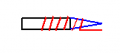
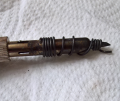
If you have a short length of bare copper wire, about 2mm Diameter?
Wrap approx 6 turns tightly round the main part of the iron bit or body, so that it can heat up.
The copper wire end near the solder tip, bend straight, so the end of the copper wire is the same length as the solder tip, about 0.2inch away from the tip.
Power up the iron, when hot, tin the tip of the copper wire.
To de-solder a small SMT component, touch one end of the iron tip and the other end of the component with the tinned copper tip.
In that way you can de-solder SMT small components.

I have successfully used that simple method for a long time.

E
Excuse rough sketch.
EG57_ 1969.png
 
Last edited:

MrChips

Joined Oct 2, 2009
34,700
How do you manage to use two soldering irons with only two hands? Once the solder melts, how do you pull the component off? You would need an extra hand, but that's not always an option.
Two or three ways.
1) Use the two irons as tweezers. Just grab the SMD between the two iron tips.
2) Surface tension alone will allow you to pick up the SMD with one iron.
3) If the SMD is ferromagnetic, it tends to cling to the iron tip.
 

Lo_volt

Joined Apr 3, 2014
370
With any of the three big tips, you should be able to apply extra solder and heat both sides at once. Tweezers to grap the cap and cleanup with solder wick.
 

MrChips

Joined Oct 2, 2009
34,700
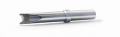
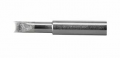
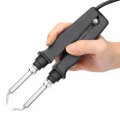
If you have to do this often you can buy a two-pronged tip.
1721672277056.png

You can buy a wide tip and file away the center portion.
1721672373958.png
You can also make your own tip from a piece of copper rod or tubing.
Or you can buy desoldering tweezers.

1721672523769.png
 

BobTPH

Joined Jun 5, 2013
11,487
I use a normal iron and alternate between the two sides until both remain melted long enough to push it iff the pads.
 

Ian0

Joined Aug 7, 2020
13,114
I use hot air at 350°C, with a nozzle of about 6mm on the rework tool.
Trying to use a soldering iron often results in the metallisation coming off the capacitor (but if you're just going to dispose of it afterwards, that doesn't matter)
As that is near a solder terminal, heating the solder on the terminal first, then applying the hot air will speed things up.
 

panic mode

Joined Oct 10, 2011
4,940
copper wire or copper sheet/tubing are easy way out even if one is without access for proper lab tools.

btw. if the part is known defective, there is not much reason in saving it or being particularly gentle. in emergencies, solder wick can be used to heat up both sides. or even blob of solder... those are crude options but can work on stubborn parts. once the solder is melted just move the part to a free space.
 

MrChips

Joined Oct 2, 2009
34,700
If the PCB was assembled by a PnP (pick and place) machine, the SMD was glued to the PCB. You need extra heat and force to dislodge the SMD. Try practicing on a scrap PCB to get your technique right.
 

Ian0

Joined Aug 7, 2020
13,114
What about boards assembled before "these days"?
They were glued on then wave soldered, but the aeon called "these days" commenced before the invention of drones.

However, my expertise only extends as far as surface mount boards with components on one side. We can only see one side of the board, and don't know if there are SMD components on the other side. If so, I don't know how it's done, it is probably some super-sticky solder paste, but for all I know, they could be held on by magic - hence "Most".
 
Top