Doubt there's anything wrong with the PCB here and it just looks like a half wave rectifier like you said and a LDR/BJT switch, so it should work like..
Vmax = 120Vrms*1.414 = 169.68V
169.68/Pi = 54.01VDC equivalent
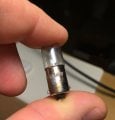
Just make sure that bulb is the right wattage Think it is 2.4W though, that's what my money's on
You can clearly see; "4W" stamped on the bulbs shown in the OP.
I'm wondering if they've used half wave rectification to halve the power in a bulb running on double the voltage! It makes for short bulb life, but some manufacturers have been known to do it!
I'm wondering if they've used half wave rectification to halve the power in a bulb running on double the voltage! It makes for short bulb life, but some manufacturers have been known to do it!
The TS has stated that the unit runs from 120V and the general consensus seems to be that its a 60V bulb.
Just to be absolutely sure (even my mental arithmetic isn't that bad) I grabbed a calculator and divided 120 by 2, surprise surprise - the answer was 60.
The TS has stated that the unit runs from 120V and the general consensus seems to be that its a 60V bulb.
Just to be absolutely sure (even my mental arithmetic isn't that bad) I grabbed a calculator and divided 120 by 2, surprise surprise - the answer was 60.
It's a half wave recitifier. I supplied the maths earlier. please don't lead the OP down the wrong street with misinformation.
"The current on the DC side of the circuit flows in one direction only making the circuit Unidirectional. As the load resistor receives from the diode a positive half of the waveform, zero volts, a positive half of the waveform, zero volts, etc, the value of this irregular voltage would be equal in value to an equivalent DC voltage of 0.318 x Vmax of the input sinusoidal waveform or 0.45 x Vrms of the input sinusoidal waveform."
It's a half wave recitifier. I supplied the maths earlier. please don't lead the OP down the wrong street with misinformation.
"The current on the DC side of the circuit flows in one direction only making the circuit Unidirectional. As the load resistor receives from the diode a positive half of the waveform, zero volts, a positive half of the waveform, zero volts, etc, the value of this irregular voltage would be equal in value to an equivalent DC voltage of 0.318 x Vmax of the input sinusoidal waveform or 0.45 x Vrms of the input sinusoidal waveform."
No one said peak voltage was reduced? Did they? No? Didn't think so lol. You seem to think p-p and rms are the same thing you are referring to both as your point.
Anyway whatever lets just see what the bulb rating is.
No one said peak voltage was reduced? Did they? No? Didn't think so lol. You seem to think p-p and rms are the same thing you are referring to both as your point.
Anyway whatever lets just see what the bulb rating is.
The TS has stated its 60V and the picture shows no sign of the top of a 2 above the blemish, so its very likely 4W.
Obviously expressing the equation; 1.414x120V was too subtle for your comprehension. You should be advised that it is the difference between PP and RMS.
Please stop trying to antagonise me and troll this thread, Your initial sarcasm was unwarranted and just not necessary. No one has mentioned P-P except you with the exception of me mentioning it in the mathematics I used. The OP has asked about the bulb and you are dragging this thread off topic with your trolling. Like I have already said lets just wait until the OP responds after he has removed the solder from the bulb. Until then I suggest you re-evaluate your behaviour and refrain from making insulting and unprovoked sarcastic remarks.
Please stop trying to antagonise me and troll this thread, Your initial sarcasm was unwarranted and just not necessary. No one has mentioned P-P except you with the exception of me mentioning it in the mathematics I used. The OP has asked about the bulb and you are dragging this thread off topic with your trolling. Like I have already said lets just wait until the OP responds after he has removed the solder from the bulb. Until then I suggest you re-evaluate your behaviour and refrain from making insulting and unprovoked sarcastic remarks.
The TS has stated that the unit runs from 120V and the general consensus seems to be that its a 60V bulb.
Just to be absolutely sure (even my mental arithmetic isn't that bad) I grabbed a calculator and divided 120 by 2, surprise surprise - the answer was 60.
Of Course I am lol. It was at this point it became clear you were not clued into my point. Why you keep replying when I have asked you to stop I do not know. I assume it is your ego. Now this thread has a page of **** just because you can't articulate a point without having to insult someone
Of Course I am lol. It was at this point it became clear you were not clued into my point. Why you keep replying when I have asked you to stop I do not know. I assume it is your ego.
Well, desoldering ribbon/braid came in the mail today. For all those curious.... the verdict's in:
60V 2.4W --
Good call Marcus2012
Now if someone could point me to a source... that would be grand. I've scoured the web and clearly life as a professional parts buyer just isn't in the cards for me.
Well, desoldering ribbon/braid came in the mail today. For all those curious.... the verdict's in:
60V 2.4W --
Good call Marcus2012
Now if someone could point me to a source... that would be grand. I've scoured the web and clearly life as a professional parts buyer just isn't in the cards for me.
What are you even looking up that you can't find it ??? The whole thread has answered almost every possible out come and has already answered the type and now you have the ratings . So please use the information giving instead of ignoring it and still asking for help..
I looked up "60V 2.4W bayonet bulb". I quickly scanned the thread once more. If you could point out the information in the thread that points to where I could source (or search for) this specific bulb I would be most obliged.
edit: the 2.4w bulb -- NOT the 4w which would be hotter & brighter.

 Facebook
 Google
 GitHub
 Linkedin



 Think it is 2.4W though, that's what my money's on