A search on Google couldn't get me an answer. I need to switch two and a half amps at five volts. The 2n2222's are failing. What's the next size up so to speak transistor that might handle that?
Generally speaking, you want to move from the TO-92/TO-18 case outline to the TO-220 case outline, there you will find plenty of options to handle 2.5 Amps.
In the TO-220 maybe something like the TIP31C, NPN, 100V, 3A, 40W, MEDIUM POWER SWITCHING with a hefty heat sink is just marginal for 2.5A continuous but within spec. Maybe a power MOSFET in the TO-220 like the IRF510, MOSFET, 5.6A, 100V, 0.540 Ohm, N-Channel Power? Also, with a hefty heat sink and same for any TO-220 to dissipate heat from that kind of power through them. Someone here should be able to put a finer point on it.
A search on Google couldn't get me an answer. I need to switch two and a half amps at five volts. The 2n2222's are failing. What's the next size up so to speak transistor that might handle that?
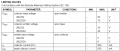
A quick look at the data sheet explains the issue:
The absolute max collector current is 800 mA. Try to switch 2.5 A with it and it's not surprising that you are letting the magic smoke out.
Instead of trying to get Google to tell you the answer, use Google to look up the data sheet for the part of interest and then look in the data sheet for the answers you seek.
As for finding other alternatives, a good place to start is using the product selector tools at places like DigiKey or Mouser.
Well a 2N2222 NPN transistor has a max current of 800 mA or 0.8 Amp and you are switching 2.5 Amps. No clue what you are trying to do but if possible my first choice would be a N Channel logic level MOSFET. Please better define your project.
Well a 2N2222 NPN transistor has a max current of 800 mA or 0.8 Amp and you are switching 2.5 Amps. No clue what you are trying to do but if possible my first choice would be a N Channel logic level MOSFET. Please better define your project.
That's good, and a factor of two is a reasonable starting point. Of course, that means that your actual current is still nearly twice what the transistors are rated for.
It always amazes me when someone tries to use a component where the data sheets limits are severely exceeded (by a factor of over 3 here).
Why did you not read the data sheet where it says the max 2N222's collector current is 800mA?
Note that a BJT requires a control base current of 1/10 of the collector current to turn on with minimum voltage drop, so that would be 130mA for a 1.3A load.
To reduce the control current to zero with low power dissipation, use a logic-level type MOSFET as a switch with an on-resistance of <0.1Ω, which will keep the dissipation well below 1W, so it won't require a heatsink.
It always amazes me when someone tries to use a component where the data sheets limits are severely exceeded (by a factor of over 3 here).
Why did you not read the data sheet where it says the max 2N222's collector current is 800mA?
Note that a BJT requires a control base current of 1/10 of the collector current to turn on with minimum voltage drop, so that would be 130mA for a 1.3A load.
To reduce the control current to zero with low power dissipation, use a logic-level type MOSFET as a switch with an on-resistance of <0.1Ω, which will keep the dissipation well below 1W, so it won't require a heatsink.
I was in a pinch and wanted to keep the project momentum going. I was well aware of the 800ma limitation and the 50 cent transistors did last long enough to prove the circuit out. I ordered what Samr suggested. Today I'll put two in parallel I was in a rush yesterday, my girl calling me up from the basement to mow the lawn and all.
Note that a BJT requires a control base current of 1/10 of the collector current to turn on with minimum voltage drop, so that would be 130mA for a 1.3A load.
You also want to handle a stall current if you are driving a motor. Anyway a 1.3 amp load will need about a 130 mA base drive current. If you plan to use a uC like an Arduino you better start thinking MOSFET, like a FQP30N06L or similar.
A search on Google couldn't get me an answer. I need to switch two and a half amps at five volts. The 2n2222's are failing. What's the next size up so to speak transistor that might handle that?
From the “burn the transistor first, ask questions later” school of thought.
It is a common mistake that many rookies make. I certainly smoked a few components myself in the early days.
But one has to learn quickly from the mistake. And an essential knowledge is how to read datasheets.
I know, I know. At first all that information may be overwhelming. But if one wants to design anything beyond an Arduino flashing an LED, reading and understanding datasheets is a must.
In this vein, using a Mosfet is superior because you use voltage to switch current with a MosFET, not current to switch current (like a BJT). How much current a device handles is a function of how hot it's internals (junction temperature) can get (and be dissipated). Use a heatsink.

 Facebook
 Google
 GitHub
 Linkedin