MOSFET (TSM3401) Burning in Field – Unable to Reproduce in Lab

Thread Starter

Sai@21

Joined Feb 3, 2026
3
In the attached schematic, MOSFET T51 (TSM3401) Customers report that this MOSFET is failing in the field, but I am unable to reproduce the issue under laboratory conditions. (Not all but approxiamately 30-40% of the PCBs have same error)

The Alarm_Ext (T51 drain) is connected to the anode of the S1M diode, while the cathode of the diode is connected to the clamp.
The clamp is then connected to a wire approximately 100 meters long, which is connected to ground, either with or without a resistor.

The same MOSFET and topology are used in same and another application in another PCBS without problems. In the lab, the circuit works perfectly.

I would appreciate any insights or recommendations to improve robustness and prevent field failures.

Thank you in advance.
 

Attachments

Irving

Joined Jan 30, 2016
5,070
I don't see the S1M diode or the 'clamp' in the schematic. I can see that T17 & T26 form a constant current feed of around 240mA @ 24v so if T51 drain was shorted to ground it would dissipate around 6W... which would definitely fry it. That would possibly fry the diode too. What is the 'clamp'?
 

Irving

Joined Jan 30, 2016
5,070
Another possibility, given that the TMS3401 is a 30v part, is an induced voltage spike on the 100metre cable is causing a breakdown of the channel and frying it that way. That may not be easily reproducible in the lab.
 
Last edited:

Irving

Joined Jan 30, 2016
5,070
Thank you. It is the smoke ventilation Control Panel. It has 10 sheets of the schematic
Can you simplify it to a single sketch for that circuit? From your explanation so far, unless I've missed something, the drain of T51 goes to a diode and a resistor (which may be 0 ohms) and then to ground 100m away. That doesn't sound like it has a practical use. Given this is smoke ventilation related, is there some sort of actuator arrangement at the far end as well?
 

Alec_t

Joined Sep 17, 2013
15,112
Grounding via a 100m long cable sounds like an accident waiting to happen. That cable would make a good antenna for all sorts of interference. Can't a good ground be provided more locally?
 

Irving

Joined Jan 30, 2016
5,070
Grounding via a 100m long cable sounds like an accident waiting to happen. That cable would make a good antenna for all sorts of interference. Can't a good ground be provided more locally?
Not if the signal is required 100m away! Though you're right in that some additional precautions might be required.
 

MisterBill2

Joined Jan 23, 2018
27,362
What would help a lot more than completing the schematic is explaining how the circuit is intended to be working, which does not make any sense to me. What currents are intended to be flowing thru which components to develop what voltages??
Having an explanation of what is intended to be happening is very useful in trying to discern what actually is happening instead.
I am asking for a DETAILED explanation, not just a very short generalized explanation.

What it looks like to me is that even if the NPN transistor is put into full saturation, that the mosfet is stillin the linear region, and thus, with excessive resistance, is dissipating way too much power.
 

sghioto

Joined Dec 31, 2017
8,634
I would appreciate any insights or recommendations to improve robustness and prevent field failures.
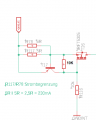
Not related to T51 but should add a 10K resistor between the gate and source of T26.
When the current is below the threshold the Vgs exceeds the 20 volt rating.

1770146352351.png
 
Last edited:

sghioto

Joined Dec 31, 2017
8,634
I can see that T17 & T26 form a constant current feed of around 240mA @ 24v so if T51 drain was shorted to ground it would dissipate around 6W...
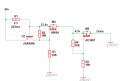
I tested the circuit below with an AO3401 and got these voltages when the Drain is grounded
I measured 4.9 volts across M2 at 223ma.
Dissipation at 1.09 watts, which is below or above the specs depending on the temp.
1770151947016.png
 

panic mode

Joined Oct 10, 2011
4,947
to me this looks like the goal was to create PLC compatible outputs, "PNP style" (high side switching) - either for signaling or to operate loads up to some 50-150mA.

designer then implemented current limit to protect the outputs in case of short circuit (miswiring) which is common when handling long wires. the trouble is that used current limit is not actually protecting the circuit since failure is not due to excessive voltage or current values but their product (power limit exceeded).

if the protection had latch that kill power to the outputs when overcurrent is sensed, this would likely work but it would require manual reset or automated but time delayed reset.
 
Last edited:

sghioto

Joined Dec 31, 2017
8,634
As I mentioned in post #12 exceeding the mosfet Vgs could have caused damage that no longer provides current limiting.
This could have gone unnoticed.
 
Top