Facebook
 Google
 GitHub
 Linkedin

This is a learning project more than anything. It all started when I saw a You Tube video (this is how I usually get into trouble) featuring a vintage home-made spark plug sparking machine. I wondered if I could build one. I looked into buzz boxes, and autotransformers, and several schematics around the internet that look something like this:
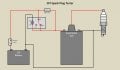
I suppose I could build one like this, but I don't have an ignition coil laying around, and I'd rather not buy one. I also don't really understand what the capacitor is for. I've read different reasons for having one, but I don't know if they're all correct, or none, or somewhere in between:
I also read that air pressure makes a big difference in how much voltage is needed to make a spark. In several sources it has been said that 3kV are needed to make a spark jump 1mm through air at sea-level. But inside an engine, with compressed air and fuel, more than 20kV are needed. If this is true, a store-bought ignition coil would be overkill to make a spark plug tester.
I have wound my own AC transformers before, once I understood the math behind them. I use this formula:
T/V = 1 / (4.44 *0.0001 * ca * B * f)
So right away, I see potential problems with a DIY ignition coil.
Anyway, what I'm getting at is that I'd like to make my own ignition coil with around 5kV output. Though I'm not entirely sure how to go about it. I'm not sure the equation I usually use applies here.
One thought I had was to replace the relay in the above diagram with a small motor with a lever that pushes on a momentary switch X number of times per second. Then I could fine-tune and predict the frequency for the transformer. I imagine such a contraption might look something like this:
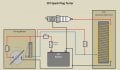
I added a fuse because melting stuff is only fun when I do it on purpose.
To actually build this thing I'll need to source a core and some wire. I'll also need to figure out what type of capacitor to use, as well as it's capacitance and voltage rating. I'll need to know the Amps traveling through each wire so I can size them appropriately. I'll need a momentary switch robust enough to be switched on and off several times per second, at whatever Amps I'll need. I'll have to find a motor that can do the correct RPMs, and also find out what frequency I want to use. So I know what RPMs are correct.
I read somewhere that current from a 12V primary source could be between 2 and 10A, depending on who you ask. Though 12V is just a starting point because most engines run with 12V these days.
So what do you all think? I think if I do this I'll either learn a lot about ignition coils or else maybe set my hair on fire. (Or both.)
I suppose I could build one like this, but I don't have an ignition coil laying around, and I'd rather not buy one. I also don't really understand what the capacitor is for. I've read different reasons for having one, but I don't know if they're all correct, or none, or somewhere in between:
- The capacitor is there to keep the points from arcing.
- The capacitor is there to stop fly-back current.
- The capacitor is there to make the spark "hotter".
I also read that air pressure makes a big difference in how much voltage is needed to make a spark. In several sources it has been said that 3kV are needed to make a spark jump 1mm through air at sea-level. But inside an engine, with compressed air and fuel, more than 20kV are needed. If this is true, a store-bought ignition coil would be overkill to make a spark plug tester.
I have wound my own AC transformers before, once I understood the math behind them. I use this formula:
T/V = 1 / (4.44 *0.0001 * ca * B * f)
- T/V is turns per volt.
- 4.44 is a constant derived from some kind of calculus I don't understand. Though it's meant to be used for low frequency transformers, like around 50-60 Hz. Transformers in the kHz range use a constant of 4 for some reason.
- 0.0001 is a conversion factor to make all the units cancel out properly.
- ca is the core area. That is, the cross-section of whatever the wire is actually wrapped around. This is measured in sq. cm.
- B is the measurement of magnetic flux, or saturation. Something like that. From what I've read, it can be measured in Gauss, or Webbers per square meter. In the above equation it's W/sq m, and for iron with silicon in it, the measurement is usually around 1.2.
- f is the AC frequency going through the transformer. Where I live, that's 60 Hz.
So right away, I see potential problems with a DIY ignition coil.
- First, it's not operating on AC. Its running on switched DC. While AC has two points per cycle where the voltage is 0, a single DC cycle has only one 0v point. So would I double the frequency to compensate?
- Second, I don't know the frequency of the on/off voltage. In a car that would be whenever a spark plug fires, which is variable with the RPMs of the engine, and how many plugs there are. In the diagram above, I have no idea how many times per second that relay is switching on and off.
- Third, if the frequency is really high, I may need to use the constant 4 instead of 4.44. Not sure how big of a difference that would make.
- Fourth, I've read in different places that a DC transformer doesn't use turn ratios to determine the output voltage. But everyone is quite vague as to what is used instead. How can that be true.
Anyway, what I'm getting at is that I'd like to make my own ignition coil with around 5kV output. Though I'm not entirely sure how to go about it. I'm not sure the equation I usually use applies here.
One thought I had was to replace the relay in the above diagram with a small motor with a lever that pushes on a momentary switch X number of times per second. Then I could fine-tune and predict the frequency for the transformer. I imagine such a contraption might look something like this:
I added a fuse because melting stuff is only fun when I do it on purpose.
To actually build this thing I'll need to source a core and some wire. I'll also need to figure out what type of capacitor to use, as well as it's capacitance and voltage rating. I'll need to know the Amps traveling through each wire so I can size them appropriately. I'll need a momentary switch robust enough to be switched on and off several times per second, at whatever Amps I'll need. I'll have to find a motor that can do the correct RPMs, and also find out what frequency I want to use. So I know what RPMs are correct.
I read somewhere that current from a 12V primary source could be between 2 and 10A, depending on who you ask. Though 12V is just a starting point because most engines run with 12V these days.
So what do you all think? I think if I do this I'll either learn a lot about ignition coils or else maybe set my hair on fire. (Or both.)