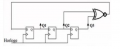
Im tasked to plot the chronogram (evolution in-time) of this circuit in terms of \( Q_1, Q_2, Q_3 \) but i dont know the initial conditions of D
Is it really possible to do such task?
Im tasked to plot the chronogram (evolution in-time) of this circuit in terms of \( Q_1, Q_2, Q_3 \) but i dont know the initial conditions of D View attachment 309607
Is it really possible to do such task?
Yes.
True. You don't know D, but for a first attempt assume that your D-latches have a power-on reset (so Q1, Q2 and Q3 all start at zero).
When you have done that, are there any of the eight possible states for which you don't know the next state?
If so, repeat the exercise starting at any states for which you don't know the next state.
Im tasked to plot the chronogram (evolution in-time) of this circuit in terms of \( Q_1, Q_2, Q_3 \) but i dont know the initial conditions of D View attachment 309607
Is it really possible to do such task?
Study how a D flip flop works. Here's a truth table.
And remember, the DFF you show is a positive clocked device, so it will only change state on the RISING edge of the clock.
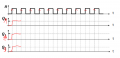
Then, go back and re-think your graph in post#7.
Study how a D flip flop works. Here's a truth table. View attachment 309619
And remember, the DFF you show is a positive clocked device, so it will only change state on the RISING edge of the clock.
Then, go back and re-think your graph in post#7.
On the rising edge of the first clock, the input to FF1 is 1, but the inputs to the other 2 are still 0. You show all outputs changing to 1 at the first clock. That's wrong.
On the rising edge of the first clock, the input to FF1 is 1, but the inputs to the other 2 are still 0. You show all outputs changing to 1 at the first clock. That's wrong.

 Facebook
 Google
 GitHub
 Linkedin