Building a sensitive pickup

Thread Starter

cmartinez

Joined Jan 17, 2007
8,765
You can try to use OPAx340 (opa340 in LTspice) device:
(10pcs) New OPA2340U $ 0.99, shipping $ 3.36
Features:
• Rail-to-Rail Input
• Rail-to-Rail Output (Within 1 mV)
• MicroSize Packages
• Wide Bandwidth: 5.5 MHz
• High Slew Rate: 6 V/μs
• Low THD + Noise: 0.0007% (f = 1 kHz)
• Low Quiescent Current: 750 μA/Channel
• Single, Dual, and Quad Versions
• Supply voltage from 2.5 V to 5 V

View attachment 363233
Danko! ... thanks for joining in. I'll take a look at it. In the meantime, take a look at post #91, that's pretty much what I want to accomplish. Simply put, I'd like to make a circuit that could amplify a pickup used to detect extremely small oscillations in its magnetic field. The pickup is made with 4680 turns of 42 ga magnet wire wrapped around a 4mm dia x 10mm length neodymium magnet, that has an inductance of 107.5 mH, and a resistance of 772 Ω
 

Danko

Joined Nov 22, 2017
2,169
I'd like to make a circuit that could amplify a pickup used to detect extremely small oscillations in its magnetic field. The pickup is made with 4680 turns of 42 ga magnet wire wrapped around a 4mm dia x 10mm length neodymium magnet, that has an inductance of 107.5 mH, and a resistance of 772 Ω
Fast experiment:
Bring pickup to aluminum or copper rotating disk,
measure signal for different rotation speed,
then divide results, roughly speaking, by a million.
Such signal you will have, using flowing water instead metal.

How they use magnetic field to determine flow speed, see PDF.
 

Attachments

MisterBill2

Joined Jan 23, 2018
27,530
IF the signal out is required to be a linearly scaled replica of the input amplitude, then the distortion of the #2 output shown in post #91 will not allow that to be.
If any amount of amplitude accuracy is part of the requirements then both clipping and cutoff distortion need to be avoided. If only the frequency matters, not amplitude that is a different case.
I went back to the start of the thread and it seems to me that amplitude does matter. That might have changed, or been over-looked.
 

skstrobel

Joined Nov 29, 2023
28
Is there a simple way accomplish that, starting from +3.6V source?
Unless I am missing something, a simple 1:1 voltage divider between the battery terminals feeding an op amp follower will provide a low-impedance reference voltage centered between the battery positive and negative terminals. Call that ground and the battery terminals +/-1.8V. Then you can use DC coupled circuits to handle low frequencies without big coupling capacitors.
 

Ian0

Joined Aug 7, 2020
13,132
Unless I am missing something, a simple 1:1 voltage divider between the battery terminals feeding an op amp follower will provide a low-impedance reference voltage centered between the battery positive and negative terminals. Call that ground and the battery terminals +/-1.8V. Then you can use DC coupled circuits to handle low frequencies without big coupling capacitors.
0V is already connected to ground, as far as I can tell.
 

Thread Starter

cmartinez

Joined Jan 17, 2007
8,765
Here's a funny circuit. If a couple of nFets configured as diodes are added to the OpAmp's feedback loops, the circuit's output amplitude is noticeably improved. But I can't think of an economical way to transform said output into a useful binary signal.

1771247491223.png
 

Thread Starter

cmartinez

Joined Jan 17, 2007
8,765
Can you define what you mean by that? You've probably said it above but I want to be sure I understand.
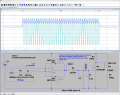
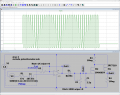
Take a look at this. The first graph is without the diode-nFets and the second one is with them. The voltage peak-to-peak of the first one is almost 10% larger than the first. But the offset voltage jumps from 0.65V to 2.45V approximately.

On the other hand, I've just contacted Peak, and they'll be sending me the Spice model for the TP5591-TR. I just hope I can make it work in LTSpice.

1771260646170.png


1771260668587.png
 

MisterBill2

Joined Jan 23, 2018
27,530
Probably what this thread needs at this point is for the TS to tell us exactly what a "useful output" would actually consist of. I seem to have missed that part.
 

Thread Starter

cmartinez

Joined Jan 17, 2007
8,765
Probably what this thread needs at this point is for the TS to tell us exactly what a "useful output" would actually consist of. I seem to have missed that part.
The most "useful" (or ideal) output I could wish for would be a waveform such as the one shown above, but with a rail-to-rail voltage (from 0 to 3.6V) with the lowest possible voltage as the input signal. In the sim above, a 100 µV sinewave is being used as the input of a single stage circuit ... in a letter to Santa Claus I'd ask for a rail to rail output when the input signal is 1 µV
 

wayneh

Joined Sep 9, 2010
18,104
That's the role of a comparator, to produce a binary output. But you need a voltage gain of ~10,000X to get that input signal up into the 1-10mV range, at least for the typical LM339 (quad) comparator. There may well be comparators designed for smaller inputs but you'll still need to amplify up out of the single µV range.
 

MrChips

Joined Oct 2, 2009
34,817
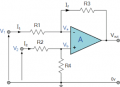
TS needs to go back to the basic difference op amp circuit.

1771262669113.png

R1 = R2
R3 = R4

Vout = -(V1 - V2) x R3 / R1

If you are using a split power supply, R4 is referenced to 0V.
If you are using a single supply, R4 is referenced to Vs/2.

For maximum gain, R3 >> R1
For starters, try R1 = R2 = 1 kΩ and R3 = R4 = 1 MΩ.

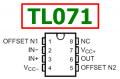
This will give a voltage gain of 1000. You might have to add some DC offset to trim the output to be balanced around the reference voltage. Single amp ICs such as TL071 have Offset Null adjustment pins.

1771263297886.png
 

Ian0

Joined Aug 7, 2020
13,132
There's only one sensible way to accomplish this. Amplify as linearly as possible, with minimum offset, then use a comparator to create a squarewave from the output of the amplifier.
Using MOSFETs connected as diodes isn't going to get you anywhere. You could just replace them with. . . . diodes, and you still wouldn't have a predictable amplifier circuit.
Does the transducer require a differential input? Is one side naturally connected to earth, or are the two outputs similar to each other?
If you do require a differential input, then the op-amp-and-four resistors circuit isn't going to do the job if it is working in a noisy environment, because the common mode impedance on the two inputs are not equal, so common mode noise will not be eliminated. If an differential input is required then the three-op-amp instrumentation amplifier is necessary to separate signal from noise.
 

Thread Starter

cmartinez

Joined Jan 17, 2007
8,765
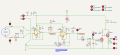
Thanks for your observations, Ian. A differential input is not a requirement per-se. All I want is to find the best possible configuration at the lowest possible price and number of components. For that purpose, I'm putting together another test board that will hopefully help me get closer to my goal. Have a look:

1771266239498.png
All those jumpers are there so I can test different "what if" scenarios, and to measure the total power being drawn. I have several LM2903 DIP comparators with me that I could breadboard and connect to this circuit's output to also test their feasibility.

This device will be battery powered, and will be embedded in a plastic enclosure. Do you think noise would be an issue?
 

Thread Starter

cmartinez

Joined Jan 17, 2007
8,765
Yes, teasing a 1µV signal out of background noise is likely a challenge. I'd look for shielding on the sensor wires and perhaps around your PCB.
the distance between the sensor and the PCB is only a couple of inches btw. And shielding (and twisting) the cable is perfectly doable. Shielding the PCB itself is a different matter, but I'll take your advice into account.
 
Top