Buck converter based LED power supply

SgtWookie

Joined Jul 17, 2007
22,230
Ghar,
Try reducing L1 to the 100uH-200uH range. You're operating at 50kHz, so 100uH should be just about right.

Increase C1 to roughly 200uH to reduce your ripple current.

I'm not certain why you included D3; it should not be necessary.

You should limit the Vgs of your MOSFET so that it doesn't exceed about -10v. Most MOSFETs have a Vgs limit of +/-20v, and you are almost at the -20v limit. The easy way to fix that would be to put a 10v Zener in parallel with R4, and decrease R6 to ~500-1k Ohms to get 20mA to 10mA through the Zener to ensure proper regulation.
 
Last edited:

Thread Starter

tom66

Joined May 9, 2009
2,595
For my model plane, I want to add some lights to it (3W power LEDs) so I'm considering putting one of these circuits on stripboard. I might simulate it to see how it goes. I'd need two LEDs: red and green, and I want to turn them on and off, but with the same current flowing through each and with the same power supply (reduce cost + weight). I've got an idea on how to do this... I'll be back.
 

Thread Starter

tom66

Joined May 9, 2009
2,595
Yep, 2S LiPo 7.4V 300mAh (not much at the moment... its a small plane.)

3W LED: pretty much any LED I can find which is bright enough. I haven't settled on a particular component.
 

Ghar

Joined Mar 8, 2010
655
Ghar,
Try reducing L1 to the 100uH-200uH range. You're operating at 50kHz, so 100uH should be just about right.

Increase C1 to roughly 200uH to reduce your ripple current.

I'm not certain why you included D3; it should not be necessary.

You should limit the Vgs of your MOSFET so that it doesn't exceed about -10v. Most MOSFETs have a Vgs limit of +/-20v, and you are almost at the -20v limit. The easy way to fix that would be to put a 10v Zener in parallel with R4, and decrease R6 to ~500-1k Ohms to get 20mA to 10mA through the Zener to ensure proper regulation.
Thanks for the comments.

The values of L and C are from the 'mosfet' thread, I didn't pick them. I'm just toying with this load detection idea, I'm not designing the whole converter.

The FET gate sees either Vcc or 1/2Vcc (due to R4 and R6), making it limited to 10V or less for the 20V input.

D3 is necessary for the load detection idea. Without it R3/R8/Q1 would charge the output capacitor even with the FET off which is what we're trying to avoid.
 

Wendy

Joined Mar 24, 2008
23,798
OK, I wired the LM358 section up and looked at it with my new oscope. If anything it was worse than you said Wookie. The LM358 had a slew rate of 12V/48µs. The LM358 and comparators LM393/LM339 are the only two op amp/comparators that I know of that can go so close to ground, so comparators it is.

I tried another chip, an NJM4565 op amp, that was much prettier. It has a slew rate of 6V/µs, and a freq response of 4Mhz. Basically it is a souped up 1458. Jim, the owner of Tanner's, gave me some free samples, and I went back and bought more at 35¢ each. If you would like a few let me know, I'll pop them in the mail. They are still unsuitable for this due to the rail to rail response on the inputs.

Looking at your design on post #20 I notice you have a complex dual emitter design. Why all the extra components? Are you trying to limit the Vgs voltages? I'm going to try eliminating as many parts as I can and still have it work.

While I was at Tanner's I bought some logic level P-channel MOSFETs (VN2206N3). They are small and limited (only 4A max) with a Vgs spec of 3.5V or so. I also bought some other parts (larger inductors for example). I want to make a buck converter similar to the commercial units we were looking at a while back, starting at 6VDC and going up to 20V or so.
 

SgtWookie

Joined Jul 17, 2007
22,230
OK, I wired the LM358 section up and looked at it with my new oscope. If anything it was worse than you said Wookie. The LM358 had a slew rate of 12V/48µs.
Actually, I'd said that the slew rate of the LM358 was min 0.3v/uS when wired as unity gain, and that since you were running open loop, your slew rate would be worse. 12v/48uS = 0.25v/uS, which is consistent with what I was expecting.

The LM358 and comparators LM393/LM339 are the only two op amp/comparators that I know of that can go so close to ground, so comparators it is.
Have you ever heard of the LM392 opamp/comparator? It has one of each in the package, which appears to be just what you need. Datasheet: http://www.national.com/ds/LM/LM392.pdf

They both sense near ground. You can use the opamp half to multiply the voltage drop across Rsense, and the comparator half to drive the MOSFET gate - but keep in mind that you will need to amplify the current using a fast voltage follower, like an NPN/PNP pair. You could get perhaps 100mA source/sink using an LM3904/LM3906 follower.

I tried another chip, an NJM4565 op amp, that was much prettier. It has a slew rate of 6V/µs, and a freq response of 4Mhz. Basically it is a souped up 1458. Jim, the owner of Tanner's, gave me some free samples, and I went back and bought more at 35¢ each. If you would like a few let me know, I'll pop them in the mail. They are still unsuitable for this due to the rail to rail response on the inputs.
Sure, they might be interesting.
I'll retaliate with some interesting quad opamps that I picked up at Skycraft; LMC6484A's. They're low-power RRIO, 1MHz BW, very handy for things like the function generator you've been toying with for awhile.

Looking at your design on post #20 I notice you have a complex dual emitter design. Why all the extra components? Are you trying to limit the Vgs voltages? I'm going to try eliminating as many parts as I can and still have it work.
Well, the Q1/D2/Q2 gate drive area could be simplified a bit. I kind of threw it together, actually - my time is a bit limited nowadays, however I wanted to post a circuit that avoided some of the problems that both you and Tom66 had posted. Power dissipation in Tom's transistor would be quite high, since he's using a Darlington configuration. His Vce won't get lower than around 1.2v, so if Ic=1A, he'll be dissipating 1.2W in the transistor. He could improve it by using a high-gain non-Darlington transistor, like a ZTX792A - it has a gain of 400 when Ic=3A. That's pretty impressive. However, the ZTX792A's practical Ic limit is around 1A with low base currents.

While I was at Tanner's I bought some logic level P-channel MOSFETs (VN2206N3). They are small and limited (only 4A max) with a Vgs spec of 3.5V or so. I also bought some other parts (larger inductors for example). I want to make a buck converter similar to the commercial units we were looking at a while back, starting at 6VDC and going up to 20V or so.
Gee, why don't you pick up some small ferrite toroids, magnet wire, and experiment with winding your own inductors?

Tell ya what, I'll stuff some toroid samples in the package for you to play with.

Do you remember my references to Ronald Dekker's "Flyback Converters for Dummies" page?
Link: http://www.dos4ever.com/flyback/flyback.html
It's not really "for dummies", but it's a really good intro to winding your own inductors and then using them to build some projects. In the interests of safety, R4 in both figure 5 and figure 16 should be reduced to about 56k; this will limit the output voltage to a safe range (<50v).

Here's a great (and free!) tool to help you figure out various parameters for toroids:
http://www.dl5swb.de/html/mini_ring_core_calculator.htm

If you're using commercially available inductors, you're kind of limited, and it can get expensive. Winding your own gets around those limitations, and it's cheap/fun.

For really low-power stuff you could use ferrite rod stock; but you'll wind up with RFI emissions. Toroids are preferred for low emissions and high efficiency. You could also use E-cores or pot cores, but I find them more of a hassle to wind.

If your circuit's base frequency is going to be operating at 40kHz, you'll need an inductor in the 100uH to 180uH range. The lower the value, the faster the response at a penalty of increased ripple.
 
Last edited:

Thread Starter

tom66

Joined May 9, 2009
2,595
I'm wondering about the Allegro hall effect current sense devices; they might be more expensive than the shunt, but they allow higher currents and are more efficient as they don't depend on voltage dropped across a resistor.
 

SgtWookie

Joined Jul 17, 2007
22,230
I've been putting some thought into that one. I figure if I take a bit over a foot of 30 gauge wire and wind it bifilar winding style as described in the AAC book.

http://www.allaboutcircuits.com/vol_1/chpt_8/12.html

I'm going to give it a try, since I'm actually going to build a version.
I get AWG-30 * 11.628" = 0.1 Ohms.
AWG-30 has a resistance of 103.2 Ohms per 1000'.
103.2/1000 = 0.1032 Ohms
1/0.1032 Ohms = ~9.69
If we then multiply 1 foot, or 12 inches times 96.9%, we get 11.628 inches.
Keep in mind the power dissipation you're going to get in the wire when used as a sense resistor. For aircraft wiring, 5A is the limit for AWG-22. AWG-22 is 640 circular mils. AWG-30 is 100 circular mils. Your limit with AWG-30 will thus be 5A*100/640 = 781mA. If you are using magnet wire and your 0.1 Ohm resistor has good air circulation (not wound tightly) you might get by with more current.
 
Last edited:

SgtWookie

Joined Jul 17, 2007
22,230
I'm wondering about the Allegro hall effect current sense devices; they might be more expensive than the shunt, but they allow higher currents and are more efficient as they don't depend on voltage dropped across a resistor.
Sure, they'd be more efficient than a shunt. Well worth considering for high-power LEDs.
 

Wendy

Joined Mar 24, 2008
23,798
I get AWG-30 * 11.628" = 0.1 Ohms.
AWG-30 has a resistance of 103.2 Ohms per 1000'.
103.2/1000 = 0.1032 Ohms
1/0.1032 Ohms = ~9.69
If we then multiply 1 foot, or 12 inches times 96.9%, we get 11.628 inches.
Keep in mind the power dissipation you're going to get in the wire when used as a sense resistor. For aircraft wiring, 5A is the limit for AWG-22. AWG-22 is 640 circular mils. AWG-30 is 100 circular mils. Your limit with AWG-30 will thus be 5A*100/640 = 781mA. If you are using magnet wire and your 0.1 Ohm resistor has good air circulation (not wound tightly) you might get by with more current.
I know. I didn't pick the numbers out of the air. :D

The fun part is overdriving it.

http://www.powerstream.com/Wire_Size.htm
 

SgtWookie

Joined Jul 17, 2007
22,230
I need to get off my keister and get that package in the mail, Bill.

I've had so many things going on that I haven't had time to go to the post office.

I did wind up a toroidal inductor for you last night; 9 turns on a T-42 toroid that has an Al value of around 1,700; 9 turns of AWG-22 measures out at 136uH. I left some extra wire on one side so you can experiment with more turns if you'd like; one more turn would give about 171uH. Your ripple current would decrease, but response time would be slower.

I'm tossing in a few switch mode IC's to experiment with, and a few MOSFETs to use with 'em.
 

Wendy

Joined Mar 24, 2008
23,798
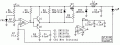
OK, paraphrasing your design Wookie, I have no idea if this will work The target voltages are 6V-24V. I'm not even sure if the MOSFET is a logic level (attaching datasheet). I'm still not confident reading MOSFET datasheets, so I may have to go back to the drawing board.

I drew this design from yours (or what I think I saw) because I want to understand it and how it works.


Studying a bit I need to add the equivalent to your C2, and maybe add a resistor to my R2 to lower the voltage.
 

Attachments

Last edited:

SgtWookie

Joined Jul 17, 2007
22,230
Q3 needs to have the source terminal towards Vcc.
R6 is much too large. Drop it down to 4.7 to 10 Ohms.
VR1 and R4 need to be on the base side of the driver, not on the emitters.
I don't see the point to R5 and C1. Tie the emitter to ground, and place C1 from GND to Q1's collector.

The Zener should be a low-current type; that has it's Zener voltage rated with the current through it at around 1mA to 5mA.

The 393 should only have to sink from 1mA to 5mA; preferably the Zener's rated current.

You could, of course, use an LM111/LM311 single comparator instead.
 
Last edited:

Wendy

Joined Mar 24, 2008
23,798
C1 allows for surge currents, it should speed up the switching of Q3 a bit, since C1 should swamp the gate capacitance of Q3. Once Q3 is switched it should be able to maintain. I was aiming for a max current of 10ma from U1b, the spec sheet is the same as the LM339 (16ma). Of course, this is worst case (24VDC). I'll be back with a revised schematic in a bit.
 

SgtWookie

Joined Jul 17, 2007
22,230
C1 allows for surge currents, it should speed up the switching of Q3 a bit, since C1 should swamp the gate capacitance of Q3. Once Q3 is switched it should be able to maintain.
If Q2's collector were connected to GND instead, you wouldn't have to worry about R5 vs C1's RC time constant. Current through either Q1 or Q2 will be momentary as the MOSFET's gate is discharged or charged.

If you use the Zener on the common emitter output, you're going to have to limit maximum gate discharge current to I(z). In the case of the 1N4733, that's 49mA instead of perhaps 200mA peak. Also, the steady-state power dissipation when Q3 is ON will be much greater than if you used a low-level Zener on the input (base) side.

I was aiming for a max current of 10ma from U1b, the spec sheet is the same as the LM339 (16ma). Of course, this is worst case (24VDC). I'll be back with a revised schematic in a bit.
OK, you're basing it on the typical current sink rating. I've been using the minimum current sink rating of 6mA, but going a step or two further and downgrading it to 3mA to 4.5mA. This will reduce power dissipation in the IC, Vsat will be lower, and gives it a much better chance of operating correctly over the full temperature range. Unless there is some dire need to push things to the edge, you're almost always better off from a reliability standpoint to operate components below their minimum specifications.
 

Wendy

Joined Mar 24, 2008
23,798
I figure this circuit can go to 24V, but not necessarily will. There is always somebody who will though.

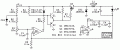
Latest effort...


R5 should be ½W, unless it is operated under 20V.
 

Attachments

Last edited:

Wendy

Joined Mar 24, 2008
23,798
If you use the Zener on the common emitter output, you're going to have to limit maximum gate discharge current to I(z). In the case of the 1N4733, that's 49mA instead of perhaps 200mA peak. Also, the steady-state power dissipation when Q3 is ON will be much greater than if you used a low-level Zener on the input (base) side.
I think I've done everything you've suggested. Not sure about the above statement though, though I suspect I've taken care of it.

I have every one of these components, so this is probably what I'll try baring any changes.
 
Top