Bridge Rectifier not outputting calculated voltage

ebeowulf17

Joined Aug 12, 2014
3,307
This written format is sometimes helpful but other times it's a barrier to communication. I don't know if I'm allowed to give you a phone number but if you call me we could talk about what you need and what will work or not work.

I'm assuming your IOT device needs a 12 volt supply to work. If it needs less, the voltage regulator chip can be changed to one that regulates a lower voltage. No matter whether your IOT draws full current (I think you said around .4 amps), or nothing the power supply voltage will be 12 volts.

As far as the sensing part of the circuit... I'm understanding that you're trying to measure the line voltage constantly. The transformer will isolate the 120 volt main so you don't have a shock hazard and the output of the transformer will vary with the line voltage. If you pull the current from the transformer before the bridge rectifier then you'll have a 12v rms voltage that varies with the line voltage. You can use one diode to rectify it and one capacitor to filter it and you'll have a DC voltage that is porportional to the AC line voltage. If I'm mis-understanding your objective or other information, let me know and I'll adjust accordingly.

I'm also going to draw the entire bridge circuit out on paper to make sure I'm not overlooking anything in the sensing circuit and I'll reply after I have done this.

Frank
I'm not the thread starter, so not the one who needs help here - I'm one of the people trying to help. Also I have severe hearing loss, so for me personally, written communication is a million times better than phone. Anyway, maybe the thread starter would appreciate a call, but none for me. Thanks!
 

ebeowulf17

Joined Aug 12, 2014
3,307
I"m sorry for not being clear. I'll address all the questions asked separately below.

There is a heater module where I need to measure AC voltage inside the module at 5 different places. The voltages at those 5 places vary according to a temperature controller inside the module. I need to design a board that can make this happen. I have a device that has 5 ADC's, 6 if you include the power line of the device.

The device can take voltage from 12V to 32V. At 12V the device consumes 0.3-0.4A. That's about 5W of power(Max). The average would be around 3.3W. I got this value when I connected the device to a DC power supply unit.

Also, the device power line is also an ADC. I'm not just powering the device, I'm also sensing the AC voltage to which the device is connected to(On the same line).


In the Diagram attached, I'm using the top part of the circuit to power the device and sense the voltage to which it's connected to. That's why I'm not using a voltage regulator.

Example: If the heater module is connected to 120VAC, the device gets 25VDC. If the heater module voltage drops to 60V, then the device gets around 12V. The device works and lets me know if the voltage ever drops. I'm sensing and powering the device at the same time.

To read AC voltages at 5 other places inside the heater module, I plan on using the bottom part of the circuit. Here R1 and R2 are 30K and 4.7K with a power rating of 2W. They won't burn until 250VAC (Simulated and tested on a PCB board) and the max current in the circuit will be 7.2mA. Also, the ADC's have high impedance. Hence I'm not using a stepdown transformer.

Example: If the voltage at a point is 120VAC, the ADC reads 15V. If it increases to 230V, then ADC reads 28V. I can sense 0-250VAC by ADC(0-32VDC).

Question:

I'm not using an isolation transformer in the bottom circuit (ADC part) considering the current is 7.2mA and it's going to high impedance (ADC). Is this safe? Ron already said it's fine.

Somebody brought it up now. Do I need to use a heat sink?

Mistake: In the diagram, the ADC line will be connected to the positive terminal of the 100uF smoothing capacitor. Sorry, my bad.

View attachment 202854

Thank you

Varun R
First off, feel free to disregard my comments in post 35. It looks like I was forgetting that the transformer-isolated power supply portion of the circuit would just float to match the non-isolated sides. Nevertheless, I see what look to me like other problems.

I would still want isolation in the bottom circuit. Otherwise, the whole IoT device is riding on line voltage. So, what you think of as the ADC negative input (shared with the IoT common, or "ground" level) will actually be at line voltage, whatever that may be, relative to actual "Earth" ground (60, 120, 240V ranges according to your description.) If it will all be safely locked away where humans can't touch it, maybe that's ok, but I don't like to have my low voltage DC electronics sitting at AC lines voltage waiting to shock people!

Also, your improvised DC supply doesn't look trustworthy to me. Relying on a series resistor to drop the right amount of voltage when you're not sure what the actual current draw is, and you have supply voltages covering a wide range from 60-240VAC, just seems crazy to me. Also, if it's really drawing anywhere near 300-400mA, you're going to need a MUCH bigger smoothing cap than 100uF. In my sims, it took about 2200uF to start looking anything remotely like DC instead of just rectified AC. Why not use a regulator for the supply, and just use a voltage divider on the pre-regulator signal to get the first ADC input? I must be missing something here, but it seems like you're doing an awful lot of work just to end up with an unreliable supply voltage!

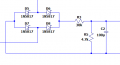
Finally, assuming you do want to stay with your non-isolated ADC inputs (which I don't recommend,) you'll need to move one of the resistors and a cap in your circuit. Move the 4.7k and the cap so that they run from ADC+ to ADC- instead of being in series on the ADC+ line. Otherwise, all you're doing is adding some series resistance, but you're still applying full mains voltage directly to your ADC input. Instant smoke (or fire!)

1585545874991.png
 

Thread Starter

vars90r

Joined Mar 24, 2020
30
Hello

I understand your concern about ADC ground being at line voltage. But I don't think that's the case. Here the ADC ground is the same as device ground. The device ground is connected to the isolation transformer in the top circuit. So the ADC ground is not connected to the line voltage anymore. Now, I'm worried if the ADC will read the right voltage? If it won't then I'll use a small isolation transformer for the bottom circuit as well.

I understand that it's not trustworthy but the device can adjust the current according to the voltage supplied. It makes sure that it pulls around 3W average. Sorry for now mentioning this, the Top part of the circuit will be using a 470uF smoothing capacitor (not 100uF). It's calculated using the formula below.

I(Load) = V * f * C
where
V = rectified voltage (lowest 12V)
f = 120HZ (it doubles from 60HZ because we rectified it)
C = 470uF
I (Min) = 0.6768A which is more than enough for the device.
I(Max) = 1.35 A (Hence the 32ohm protective resistor)

The bottom line, the 470uF capacitance should be fine. I cant use a regulator because If I do, I won't be able to sense the voltage to which the device is connected. The powerline of the device is also an ADC.


Yes!. You are right. There was a mistake in my drawing. I will connect the ADC positive wire to the +ve side of the smoothing capacitor. (I addressed this in my previous comment.)

I don't mind doing a phone call. Let me know if anybody still wants to do that.

Thank you all

Varun R
 

ebeowulf17

Joined Aug 12, 2014
3,307
I understand your concern about ADC ground being at line voltage. But I don't think that's the case. Here the ADC ground is the same as device ground. The device ground is connected to the isolation transformer in the top circuit. So the ADC ground is not connected to the line voltage anymore.
The device is isolated, thanks to the transformer... but only until you connect those extra lines through a rectifier directly to the ADC in the lower portion of your schematic. The voltage divider can scale down the voltage BETWEEN ADC+ and ADC-, but it doesn't change the fact that ADC- is riding on the rectified mains voltage. Depending on whether you've got two hot legs from split-phase or a hot and a neutral (and potentially also depending on the polarity of your connections) the exact voltage excursions of ADC- could go several different ways, but any way you look at it, that line is driven to at least 1/2 of your peak-to-peak line voltage (which in turn is 1.414 times your RMS voltage) and possibly the full peak-to-peak voltage.
I understand that it's not trustworthy but the device can adjust the current according to the voltage supplied. It makes sure that it pulls around 3W average. Sorry for now mentioning this, the Top part of the circuit will be using a 470uF smoothing capacitor (not 100uF). It's calculated using the formula below...

The bottom line, the 470uF capacitance should be fine. I cant use a regulator because If I do, I won't be able to sense the voltage to which the device is connected. The powerline of the device is also an ADC.
Well, if you really need to squeeze that one last ADC channel out of by wiring things this way, that's totally up to you. It seems an odd arrangement, but you sound confident in your math, and I'm in no position to evaluate it, so I'll take your word for it. I won't try to talk you out of it anymore. I certainly don't see it as a safety issue. Worst case scenarios are either brown-out on low voltage or frying the IoT device with over-voltage (what happens if it draws less current than you expect and full transformer voltage is delivered to IoT power/ADC inputs?) So, I leave it to your judgement.

But on the rectifier -> voltage divider -> ADC issue above, I would implore you to double and triple check yourself (probably with simulators, or at least some more experts like some of the other people in this forum,) because when I simulate that circuit, I end up with high voltage between the rectified ADC lines and ground. I don't think any part of that IoT device will be safe to touch - I think the whole thing will be riding on mains voltage, or at least a large fraction of it.
1585609512016.png
 

SistoAAC25

Joined Mar 31, 2020
1
I'm not the thread starter, so not the one who needs help here - I'm one of the people trying to help. Also I have severe hearing loss, so for me personally, written communication is a million times better than phone. Anyway, maybe the thread starter would appreciate a call, but none for me. Thanks!
Hello

I'm trying to build a rectifier to power our IoT device which would be deployed in the field where there is no DC voltage available. I only have a 120VAC power supply.

I'm using bridge MDB6S to rectifier the AC voltage. Please refer to the attached picture for the circuit diagram. Then I'm using voltage divider to get 15V across the load resistor. The voltage divider is between 30K and 4.7K. The smoothing capacitor is connected across the 4.7K resistor.

https://www.digikey.com/product-detail/en/on-semiconductor/MDB6S/MDB6SFSCT-ND/3137112

When I don't connect anything to the load resistor (4.7K), I measure 15V by a multimeter.

But when I connect our device across the load resistor, it only reads 7.8V. The device pulls 0.3 to 0.4 A of current. Keeping this in mind, I now connected a 470uF capacitor across the load resistor (4.7K). It still does the same.

Any suggestions?

Mod eidt: Direct to mains / transformerless power supply schematic deleted - JohnInTX
Hi,
I suggest this radical solution to Your question
 

Attachments

Thread Starter

vars90r

Joined Mar 24, 2020
30
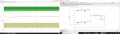
I did the simulation of the ADC circuit on Tina. I have attached the circuit and the waveforms to this message.

I also designed a PCB board for this circuit. I have connected the board to 3 AC voltages. The IoT device is reading data using three of its ADC's. I got the data just fine. This setup has been running for the past 7 hours. I have attached a screenshot related to this as well.

I do have a new problem. The ADC data is under the parameters Battery, Solar Bat and Solar bat on the screenshot.

All three parameters (ADC's) are reading 120-124V but for some reason, ADC 2 and 3 (Solar Bat and Solar Bat) are dropping to around 100V once in a while. Not sure why? I highlighted it in yellow

The only difference between those ADC's is that ADC 1 (Battery) was not used before today while I have used ADC 2 and 3 to test this circuit before. Is it possible that the Capacitors on ADC 2 and 3 are not able to retain max charge anymore compared to the ADC1 capacitor?

It can't be the circuit because they all are connected in the same way. The only difference is the capacitor's run time. One is new others 2 have been used for some time before (not too long though).
 

Attachments

mtripoli3

Joined Mar 1, 2016
35
Hello All,

Thank you so much for your responses. To answer one of your questions.

I want to monitor the voltage of a heater module. The heater is powered by plugging into a standard wall mount connection. The heater displays the voltage to which it's connected to on an LCD screen but I want to access this data remotely. Hence this setup. I want to know the voltage value. It doesn't have to be accurate. +5 or -5 voltages is fine too.

After reading all your comments, I have altered the schematic. Please refer to the attached doc.

The step-down transformer that I plan on using is https://www.mouser.com/ProductDetail/Bel-Signal-Transformer/CL2-25-24?qs=/ha2pyFaduhcNXvlILAyimwF1kKa1dl7RneqqZtIUkuogd36lQeeqw==

The bridge is https://www.digikey.com/product-detail/en/on-semiconductor/MDB6S/MDB6SFSCT-ND/3137112

Please let me know if this is safe. I'm sorry for asking stupid questions. I worked more on DC circuits and my primary work is writing firmware. I'm new to AC circuits(course work knowledge only). Please bear with me.


Note: The 30K and 4.7K resistors on the ADC circuit have a power rating of 2W. They won't burn at 120V.

Also, thank you so much.
View attachment 202419
Varun R
My 2¢... Are you sure this is really what you want to do at all? Do you know what a "True RMS-to_DC Converter, something like the AD636 or myriad other devices? Taken from their data sheet:

"The AD636 computes the true root-mean-square of a complex ac
(or ac plus dc) input signal and gives an equivalent dc output level.
The true rms value of a waveform is a more useful quantity than
the average rectified value because it is a measure of the power
in the signal. The rms value of an ac-coupled signal is also its
standard deviation."


Even if it's not appropriate for this design, you might want to get to know them. Link:

Analog Devices RMS...

Good luck!
M
 

ebeowulf17

Joined Aug 12, 2014
3,307
I did the simulation of the ADC circuit on Tina.
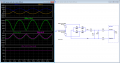
In your simulation, the AC voltage source is not grounded in any way. Most real AC sources are ground referenced. Are none of your AC sources tied to the power grid in any way? Are they not grounded at all? If not, that would explain the difference between your expectations and mine!

I can see where floating AC sources would give results like in your simulation, but if you try to measure ground referenced AC (like mains power from the regular power grid, any normal wall outlet, etc) then your whole ADC circuit will be riding on high voltage AC.
 

kaindub

Joined Oct 28, 2019
179
Dear vars90r
This forum is all about helping people understand electronics.
However what you are attempting is not what i would recommend as a first project. As many have pointed out, there needs to be isolation between mains and your project for safety.
By your own admission electronics is not your strong suit. And then you say you have designed a PCB for this project. Just because you have the tools available, does not ensure that you will design something that is safe and usable.
From the length of this post, it is also obvious that you need a lot of help. Again, this forum is about helping.
However I think at some point you need to recognise that one may have reached the limits of their current knowledge
Sorry to be so negative, but i think someone needs to call this out before you hurt yourself.
Why not farm the hardware part of this project out to someone who has more experience. You never know you may find an enthusiast who would be willing to design it for free.
 
Top