Facebook
 Google
 GitHub
 Linkedin
You are provided with a 230 V / 50 Hz ac supply, a 6-0-6 centre-tapped transformer and a
BJT of dc current gain 150. Biasing the transistor using a supply of 5.6 V (develop your
own), (i) design an amplifier of voltage gain 200; (ii) If this amplifier were to drive a load
of 75 Ω, what will be the gain of the amplifier ?; (iii) What should be the amplifier gain in
order to obtain an output of amplitude 100 mV for a sinusoidal input of amplitude 1 mV ?;
(iv) Simulate and verify all parts of the circuit. Use E96 series for your resistors.
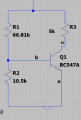
So far, i have assumed that ic=1mA, and considered the circuit with no Re(only small signal resistance of 25mV/1mA=25 Ohms), but then RC when substituted in the gain formula, we obtain it as 5k Ohms and assuming 10*Ib flows through R2 of voltage divider biasing configuration I ended up getting R2=10.5k Ohms and R1=66.818k Ohms, but then when the circuit is tested using simulation, it falls into saturation region.
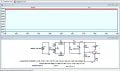
This is the output I got when simulated the below ckt, the transistor is in saturation region Vce<0.3V
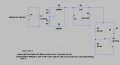
This is the circuit I simulated:
BJT of dc current gain 150. Biasing the transistor using a supply of 5.6 V (develop your
own), (i) design an amplifier of voltage gain 200; (ii) If this amplifier were to drive a load
of 75 Ω, what will be the gain of the amplifier ?; (iii) What should be the amplifier gain in
order to obtain an output of amplitude 100 mV for a sinusoidal input of amplitude 1 mV ?;
(iv) Simulate and verify all parts of the circuit. Use E96 series for your resistors.
So far, i have assumed that ic=1mA, and considered the circuit with no Re(only small signal resistance of 25mV/1mA=25 Ohms), but then RC when substituted in the gain formula, we obtain it as 5k Ohms and assuming 10*Ib flows through R2 of voltage divider biasing configuration I ended up getting R2=10.5k Ohms and R1=66.818k Ohms, but then when the circuit is tested using simulation, it falls into saturation region.
This is the output I got when simulated the below ckt, the transistor is in saturation region Vce<0.3V
This is the circuit I simulated: