Bench power supply short-protection

dl324

Joined Mar 30, 2015
18,326
Do you have a schematic for the power supply? It would be best to insert current sense circuitry before the regulated output. Putting it where you suggest would affect regulation at the load.

What is the maximum current you require before protection is engaged?
 

AlbertHall

Joined Jun 4, 2014
12,625
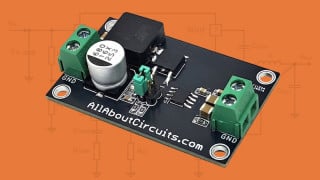
The LM2596 has a built-in current limit of about 4.5A so that would protect the regulator and laptop supply.
Do you want lower than that? Or adjustable? They would need extra circuitry.

[EDIT] LM2596S is the chip on the board in your picture.
 

ian field

Joined Oct 27, 2012
6,536
Hello,

I've made a bench power supply, ajustable voltage 1.5 to 19.2v , non-adjustable current.

Toi avoid short-circuit i'm seaching for a circuit protection.

I have some lm358, lm311, lm339 and some m50p03hdl mosfet (datasheet : http://www.alliedelec.com/m/d/9138f7af16108b22cec9bce58d1dcf4a.pdf)

So is a quick schematic of my bench power supply :


Thanks

Regards
Search online for; "electronic fuse" - usually a bistable latch that holds a MOSFET in conduction in its default state, a transistor sensing the volt drop across a current resistor trips the latch and switches off the MOSFET.

You can always come back for help with the small details when you've got the basic idea.
 

Thread Starter

Jon Sam

Joined Apr 6, 2016
42
Thanks for all your response

Do you have a schematic for the power supply? It would be best to insert current sense circuitry before the regulated output. Putting it where you suggest would affect regulation at the load.

What is the maximum current you require before protection is engaged?
No, i don't have any schematic for the power supply.
4A

The LM2596 has a built-in current limit of about 4.5A so that would protect the regulator and laptop supply.
Do you want lower than that? Or adjustable? They would need extra circuitry.
About 4a, i don't trust lm2596 current limit because it's for a power supply and the leads could touch each other often.

Search online for; "electronic fuse" - usually a bistable latch that holds a MOSFET in conduction in its default state, a transistor sensing the volt drop across a current resistor trips the latch and switches off the MOSFET.

You can always come back for help with the small details when you've got the basic idea.
What's a bistable latch ?

I found that
https://www.eeweb.com/blog/circuit_projects/electronically-designed-fuse-for-power-supply


I don't mind building my own switching step down converter like this the short circuit protection could be put before the regulated output as you said dl324.
There is some modules with adjustable current, same sort but with 2 pots but
the thing is if i adjust to 5a and there is a short 5a will run in my wires and could get very hot.

Thanks

Regards
 

Mark Hughes

Joined Jun 14, 2016
409
You've already seen the fuses posted and I suggest going with those, but here's an often overlooked hardware-store solution -- place a 75W (or 60 W) 12V incandescent bulb in series with your circuit on the output of your supply.

Short Circuit condition -- power is dissipated in the bulb -- lighting it up. (12 V)^2 / 75 W = 1.9 Ω. , 75 W / 12 V = 6.3 A (more than enough capacity for your circuit)
Open circuit condition -- nothing happens.
In-use condition, the bulb has a resistance of around 1.9 Ω, creating a drop in voltage across the bulb. But provided the resistance of your test circuit is more than several ohms, the power will dissipate in the test circuit, not the lightbulb leaving the bulb dimly lit or completely dark.

Best,
Mark
 

crutschow

Joined Mar 14, 2008
38,503
About 4a, i don't trust lm2596 current limit because it's for a power supply and the leads could touch each other often.
I don't think that's a significant concern.
The LM2596 internal limit will operate as often as needed without any problem or degradation of the circuit.
 

Dodgydave

Joined Jun 22, 2012
11,395
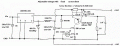
It can be done with a transistor and sense resistor on the output pin 2,

Like this circuit..
LM2596_current_limit_schematic.gif

the voltage is set as normal, but the current is set by the sense resistor. I= 0.7/ R,
So if you wanted a 3amp limit R is 230milli ohms @ 3W.
 

ian field

Joined Oct 27, 2012
6,536
Thanks for all your response


No, i don't have any schematic for the power supply.
4A


About 4a, i don't trust lm2596 current limit because it's for a power supply and the leads could touch each other often.


What's a bistable latch ?

I found that
https://www.eeweb.com/blog/circuit_projects/electronically-designed-fuse-for-power-supply

Regards
That circuit is the basic textbook emitter follower linear regulator with current limit.

What I was suggesting (the bistable) is basically the 2 transistor astable but with resistors instead of timing capacitors - you push it one way or the other and it stays there till you push it back again. One of its outputs controls a "power management" transistor or MOSFET. You deliberately skew the bias resistor so it always starts from power on in the state that enables the power management transistor. The current sensing bit of the circuit you linked is mated up to the bistable so it flips over at a set current.

The linear option involves a voltage overhead and wasted power, and if you try to put it ahead of the SMPSU - the SMPSU will try to compensate any voltage drop in the current limit.

The electronic fuse I mention has very low overhead voltage and can be either side of the SMPSU - but its strictly on or off, you have to reset it if it trips.

Linear slope current limiting on an SMPSU is more difficult than voltage regulation, and you have to hack into the circuit to do it.
 

Sensacell

Joined Jun 19, 2012
3,784
Putting a current limiter BEFORE a switch mode regulator is problematic, the current in the input is not the same as the output.
 

ian field

Joined Oct 27, 2012
6,536
Thanks you very much.
Get the datasheet for the SMPSU chip and check whether it has a shutdown pin - could be named inhibit, enable or one or two other names have been used.

Using that could be a more elegant solution than a power management transistor. The datasheet should define the operating points for such a pin. Using the bistable to control such a pin would give clean switching, just the basic current sensing bit on its own could cause a flaky transition between states.

In the early days of SMPSU TV sets; an overloaded PSU might pulse or "breathe" (the rustling sound of the EHT coming up). In many cases this was a product of the time constant in the regulation circuit, but you could do the same thing by using a monostable in place of the bistable - each time an overcurrent is detected; the monostable inhibits the SMPSU for a set period of time - of course with the PSU disabled, the overcurrent disappears and the PSU starts again when the monostable times out. This method is not for everyone because the PSU continues to try restarting into an overload. It simply reduces the overall amount of power supplied to the fault.
 

Thread Starter

Jon Sam

Joined Apr 6, 2016
42
Thanks

Get the datasheet for the SMPSU chip and check whether it has a shutdown pin
It's a chineese made converter without any brand, there is no datasheet.

why all the trouble when you can settle for this
Yes but imagine i set it to 4A then there is a short circuit where the 4 amps will go ? Heating up my wires ?
 
Top