Facebook
 Google
 GitHub
 Linkedin
Hello,
This is my first post in the forum.
I'm a hobbyist and I want to build a bench power supply, not necessarily from scratch. In fact I very much prefer to build it from power supply modules since it's much easier and also I think I already know how to do that.
I'm not sure about the requirements but I know that projects I'd wish to do include building circuits for power LED projects, testing brushless motors, and specially working with microcontrollers.
I researched a bit and read that for working with LEDs 60 volts and 6 amps is a good choice for the output, I'm not sure if it's correct but doesn't seem too far off because for example a 1 watt power LED has a voltage drop around 3v and maximum current of 300 mA so it's not hard to imagine chaining a couple of them in series would need that output.
I've also read that for embedded stuff usually a programmable power supply is needed which I'm not sure why, cause I only have experience with Arduino and its various modules so far, although I do plan to pivot my career in that direction.
So far I've read about the DPS5005 and ZK-4KX module but I think they aren't really suitable for my needs due to range and accuracy, although I'm on a very tight budget($60 more or less) and maybe should start with those.
If it's much cheaper to build it from scratch, I'm not really confident in my skills but I have some parts laying around like bridge rectifiers and voltage regulators and capacitors etc. which are needed for building a linear bench power supply from scratch.
So my questions are:
1. How accurate is the requirements I mentoined?
2. How realistic is to satisfy them within my specified budget?
3. Should I build from scratch or use modules?
This is my first post in the forum.
I'm a hobbyist and I want to build a bench power supply, not necessarily from scratch. In fact I very much prefer to build it from power supply modules since it's much easier and also I think I already know how to do that.
I'm not sure about the requirements but I know that projects I'd wish to do include building circuits for power LED projects, testing brushless motors, and specially working with microcontrollers.
I researched a bit and read that for working with LEDs 60 volts and 6 amps is a good choice for the output, I'm not sure if it's correct but doesn't seem too far off because for example a 1 watt power LED has a voltage drop around 3v and maximum current of 300 mA so it's not hard to imagine chaining a couple of them in series would need that output.
I've also read that for embedded stuff usually a programmable power supply is needed which I'm not sure why, cause I only have experience with Arduino and its various modules so far, although I do plan to pivot my career in that direction.
So far I've read about the DPS5005 and ZK-4KX module but I think they aren't really suitable for my needs due to range and accuracy, although I'm on a very tight budget($60 more or less) and maybe should start with those.
If it's much cheaper to build it from scratch, I'm not really confident in my skills but I have some parts laying around like bridge rectifiers and voltage regulators and capacitors etc. which are needed for building a linear bench power supply from scratch.
So my questions are:
1. How accurate is the requirements I mentoined?
2. How realistic is to satisfy them within my specified budget?
3. Should I build from scratch or use modules?


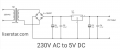


 Made me wanna get something like that in the future when I'll have the skills to build something with it