Bench power supply bipolar connection

ericgibbs

Joined Jan 29, 2010
21,448
hi C,
I am aware of the TS query, that is why I feel we should give clear unambiguous guidance.

E
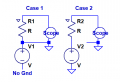
This diagram is the point I am trying to clarify regarding the statement that the device under measurement must be earth grounded.
Case 1 , we can use the scope to measure the voltage across R1 in Case 2 we cannot as it already earth grounded.
EG57_ 443.png
 

MrChips

Joined Oct 2, 2009
34,828
For the point of this discussion we shall assume that the circuit under test is already grounded.

To make a proper voltage measurement the reader needs to know how to use a dual channel oscilloscope in order to take a difference measurement.
 

ericgibbs

Joined Jan 29, 2010
21,448
hi,
If we recap on what the TS asked.
Suppose that I set it to series.
If for example I want to see ripple of the positive rail using an oscope, can I connect the common of the probe (ground) to the + of CH1 (or - of CH2)?


If he wanted to measure the ripple just on the CH1 Pos output, he could clip his Scope Ground to the CH1 Neg.

If wanted to measure the ripple across the two series connected outputs, he could clip the Scope ground to CH2 Neg.

E
 

MrChips

Joined Oct 2, 2009
34,828
And I stated it differently.
If TS wants to measure power supply ripple, set the oscilloscope input to AC.
Do not connect the oscilloscope ground clip.

Connect the dual PSU however he chooses, internal series or external series connection.
Establish where and how the two supplies are referenced to earth GND.
TS can use a DVM to confirm voltages at all terminals.
 

ericgibbs

Joined Jan 29, 2010
21,448
hi C,
Sorry if I sound pedantic, but how can he use the Scope to measure the isolated PSU outputs if he does not connect the Scope Ground/Common clip to one of the other PSU output terminals.?
E
 

dl324

Joined Mar 30, 2015
18,336
I think @dl324 reply implied this too
With respect to placing the ground clip from scope probes.

The scope should have probe ground connected to earth ground (unless the scope is battery operated). If the probe ground is connected to earth ground, there are restrictions where you can put the scope ground clip.

If the scope is floating, which novices shouldn't do, the restrictions are removed.
 

MrChips

Joined Oct 2, 2009
34,828
Without being condescending, we are trying to teach you what GND means and how to make a safe connection with your oscilloscope. If you already knew the meaning of GND there would be no need to ask this question.

The simple answer is:

1) Do not configure the two PSU in series internally.
2) Leave the two PSU fully isolated and connect in series externally. Do not connect to any GND terminal on the PSU.

Now you can use your oscilloscope safely if both PSU are floating.
Connect the oscilloscope ground clip where ever you choose to make a difference measurement.
In other words, you will be taking a voltage measurement between the oscilloscope probe tip and ground.
 

ericgibbs

Joined Jan 29, 2010
21,448
hi dl,
I agree your points are valid for most versions of power supplies, but as the two voltage outputs on the TS's PSU are floating, the Scope ground could be clipped to any output terminal.

Providing, the PSU was NOT connected to any external load that has already got a ground connection,

E
 

MrChips

Joined Oct 2, 2009
34,828
hi dl,
I agree your points are valid for most versions of power supplies, but as the two voltage outputs on the TS's PSU are floating, the Scope ground could be clipped to any output terminal.

Providing, the PSU was NOT connected to any external load that has already got a ground connection,

E
Providing, the PSU was NOT connected to any external load that has already got a ground connection,

Aha! Good point. Now we arrive at another restriction.
We were under the assumption that there is no load connected to the power supplies.
 

KeithWalker

Joined Jul 10, 2017
3,607
The voltage between any two points in the circuit can be measures using a double channel grounded scope, whether the circuit is grounded or not using a differential measurement. With the scope ground clip connected to circuit ground, or if the circuit is not grounded, to the circuit common, both input channels are switched to the same range the two probes are connected to the two points to be measured. The vertical display is switched to A-B or if that is not available, A+B with channel B polarity inverted. The display then shows the difference between the two measured points.
 

Thread Starter

kiltro

Joined Oct 24, 2011
63
Without being condescending, we are trying to teach you what GND means and how to make a safe connection with your oscilloscope. If you already knew the meaning of GND there would be no need to ask this question.
And yet after two pages I'm much more confused then before... o_O

1) Do not configure the two PSU in series internally.
2) Leave the two PSU fully isolated and connect in series externally. Do not connect to any GND terminal on the PSU.
Why? Aren't they still isolated from ground if connected internally? (I'm not at home but from memory they are, on my unit)
 

MrChips

Joined Oct 2, 2009
34,828
And yet after two pages I'm much more confused then before... o_O


Why? Aren't they still isolated from ground if connected internally? (I'm not at home but from memory they are, on my unit)
Why? Because I don’t know if any terminal is connected to GND internally without confirmation. The only safe way to know is to check it.

If they are still isolated and no load is connected then you are safe to measure with your oscilloscope.

Sadly, after two pages it is not any clearer to you.
 

MrChips

Joined Oct 2, 2009
34,828
There is a saying,

”Give a man a fish and you feed him for a day. Teach a man how to fish and you feed him for a lifetime.”

If we told you to connect the oscilloscope to points A and B and something gets destroyed would you put the blame on us?

We are trying to explain what you can do and what you cannot do with reasons why. It is now up to you to make the right decisions on your own.

Edit: So far, not one of the responses provides wrong information. They only differ in the specific configuration. In other words, know how your grounds (or common) are connected.
 

MrChips

Joined Oct 2, 2009
34,828
Let us recap.

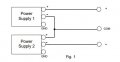
Two isolated PSUs connected in series give you POSITIVE-COMMON-NEGATIVE terminals.
The instruction warns you to remove any and all connections to GND. This is clear.

PSU in series.jpg

You can use your oscilloscope any way you choose provided that any load attached is not already grounded.

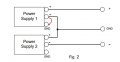
It is common practice to connect COMMON to GND (connection in red).
Now you have POSITIVE-GND-NEGATIVE terminals.
PSU in series with GND.jpg

Perhaps this is what is confusing you:
Before the series connects. you need to check if the negative terminals of both master and slave outputs are
connect to the GND terminal. if they are. must be disconnected. otherwise, short circuit will be caused in the slave output
when the two outputs are connected in series.
The connection between SLAVE (PS2) negative and GND must be removed. The connection between MASTER (PS1) negative and GND is maintained (red connection).

Now you can use the oscilloscope without connecting the grounding clip. If you want to use the grounding clip, the safe place to connect it is at another GND node.

If you want to measure any voltage or ripple between POSITIVE and NEGATIVE terminals, one option is to use a dual channel oscilloscope in difference mode.
 

dl324

Joined Mar 30, 2015
18,336
And yet after two pages I'm much more confused then before... o_O
What don't you understand?

Why? Aren't they still isolated from ground if connected internally? (I'm not at home but from memory they are, on my unit)
There's nothing wrong with using the switch that controls whether the supplies are independent or not, but you need to make sure you pay attention to the switch setting.

Connecting them in series externally just gives you a different visual of how the outputs are, or aren't, connected.

FWIW, I rarely connect power supply ground to earth ground. When you use a scope with its ground connected to earth ground, that introduces earth ground into the circuit.
 
Top