This is a classic topic in a digital logic course. It requires knowledge of Karnaugh Maps and Finite State Machines.
We have covered this in previous threads.
Oh! The lost art of Karnaugh maps and state machines!
I studied them back in the mid-70s, but back then the microprocessors were already in the midst of replacing discrete logic.
Hope someone else can help you.
I studied them back in the mid-70s, but back then the microprocessors were already in the midst of replacing discrete logic.
Hope someone else can help.
I suggest that a way to start learning about digital logic is to locate the manufacturer's data sheets , which in the earlier days included diagrams of how the internal logic worked. AND understand that many of the CMOS logic devices available in 1975 are still available today, and that most of the CMOS logic ICs available in 1984 are still available today. BUT how many of those processors are still available???
Don't be bashful. If you don't know how to start, say so and we can help you.
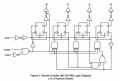
Looking at existing examples of BCD counters implemented with D flip flops (of which there aren't many, if any, commercial examples because other flip flops will have simpler glue logic) won't help you learn how to design from scratch.
EDIT: take that back. Motorola used D for CD4518:
You can start with a state diagram, but I find them unnecessary. I just make a truth table with the desired count sequence. Excitation data for a D flip flop is straightforward, but I still include it in my truth table.
I use an Excel spreadsheet that populates kmaps automatically. Because of that, I make mistakes because I don't always double check data before I generate equations and enter the data in a logic simulator. I found that making mistakes improved my troubleshooting skills. Students usually create such messy simulations that they can't even follow their own work and just start over. People who do that are giving up an opportunity to enhance their troubleshooting skills; which are as important as design skills. I can show you how I troubleshoot problems.

 Facebook
 Google
 GitHub
 Linkedin