Facebook
 Google
 GitHub
 Linkedin

Hi there,That just increases the simulated charge time, which is not really necessary to see what happens as the battery charges.
It would give a more realistic charge time, but that is easily calculated for a particular battery without doing the simulation.
Well it's not that hard to calculate the more realistic capacitor value, knowing it's never going to be exact anyway.
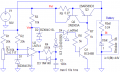
Actually things change quite a bit for charging simulations. That's because we also include another vital part: the series resistance.
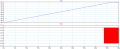
Without the series resistance the battery (capacitor) is going to look like it charges in a completely linear fashion, ie a straight line. That would mean that in a simulation that included both constant voltage and 'constant' current, we would see very little or no constant voltage as the voltage got close to the final voltage. Only after it charged very close to near completion would we see the constant-voltage phase.
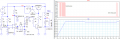
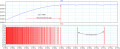
With a series resistance, we see the circuit simulation start to enter the constant-voltage phase quite a bit sooner before the battery (capacitor) has charged all the way up. That adds to the charge time considerably. The model in Danko's post includes this series resistance. It's also one of the more interesting facts about batteries. It's also not that hard to calculate the charge time mathematically with the series resistance.
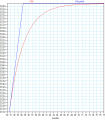
So the charge wave would not be a straight line, it would be a sort of straight line followed by a slow curve to the full voltage. The slow part of the curve increases the total charge time. We could reduce that by including compensation for the series resistance in the charger circuit, but that relies on a measurement of the series resistance which may not be that reliable so we could end up overcharging the battery.
Check it out in a simulator with and without a series resistor. It's very interesting to see that.