Constant Current Constant Voltage Battery Charger ..#2

BobTPH

Joined Jun 5, 2013
11,463
The bulk of the charging is at a constant current, not voltage. The charger must provide whatever voltage is needed to get the desired current. For was 12V that voltage is around 14V.

Why do you want 18V? What are you intending to charge with it?
 

Thread Starter

ParkGeonyong

Joined Nov 18, 2024
4
The bulk of the charging is at a constant current, not voltage. The charger must provide whatever voltage is needed to get the desired current. For was 12V that voltage is around 14V.

Why do you want 18V? What are you intending to charge with it?
Looking to charge a battery with 18650cell as 10S4P.
 

ericgibbs

Joined Jan 29, 2010
21,391
hi Park,
That battery model has this voltage?
The voltage of a 10s4p battery is 36 volts. A 10s4p battery is a cell combination of 10 series and 4 parallel.
E
 

Thread Starter

ParkGeonyong

Joined Nov 18, 2024
4
I'm going to make a battery pack charger.

We will use 18650 cells, so the cc-cv charging method should be implemented.

Based on the batteries for electric bicycles
I am thinking of using a total of 40 cells with 18650 cell 10S 4P.

The 18650 cell had a full-charge voltage of 4.2V / a rated voltage of 3.6V / a discharge end of 2.65
It's 10 series, so it's 42/36/26.5 respectively.

Based on standard charging, I think the charging current is about 7A.

I'm thinking of using about 42V as SMPS for input power!

In the case of LT1084, the maximum output is 5A, so I'm going to look for other devices.
 

Attachments

ericgibbs

Joined Jan 29, 2010
21,391
Hi,
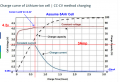
This graph plot should help you with the design.
Note the CC charge should stop when the cell is 4.2V the the it should be charged at CV until the charge falls to approx 50mA.
E
LI_Ion_Graph1.png
 

sparky 1

Joined Nov 3, 2018
1,218
The CC and CV simulations are very good. Some battery packs do not last because a few individual batteries have percentage less voltage.
Those of us that are learning. On a large battery pack, the charging method shown greatly improves the balance which is important.
As the batteries get old the chances are improved for extending the useful life. Imagine the effect of a bad individual battery compared on graph,
the voltage does not keep up with the rest. After a balanced full charge is performed, each individual battery can be checked snipped and spot welded.
We see both the source and sink feature on chargers we can be more confident when a decision to remove a few low batteries is made
to correctly maintain an expensive battery pack during it's useful life it is good to have a charger designed for even and well balanced charging.

Nice that the simulation and analysis that were shared are all appropriate simulation files for basic CC CV charging and discharging.
The what, where, and how. Is a graph enough to know there is a problem in real life? What would it take to collect the voltage for each cell?
 
Last edited:
Top