back to basics KCL

WBahn

Joined Mar 31, 2012
32,876
also to prove the point on how screwed up this is, as you said there is no consistency in the book.

In one section they define current into the node as negative and out of the node as positive as you showed in your example.

but In the same problem they show it the opposite

View attachment 321106

this is what is so infuriating

they book seems to have no consistency even within the same problem!
so how could themath possibly close
It is often the case that different polarities are used for different aspects of a problem. The classic example is nodal analysis, in which each node equation is traditionally analyzed with the currents defined so that they are flowing out of the node.

But the current flowing out of one node is flowing into the next. Yet when you analyze the next node, you analyze it with the currents flowing out of it.

In essence, you have local current definitions that only apply to that part of the analysis and are understood to not apply to any other part of the analysis. But symbolic parameters that are defined at the overall problem level should be used consistently throughout the work.

I would have to see exactly how the book presents the work to see whether they are being inconsistent, or whether they are following an analysis convention that they have established.

If the book is being too sloppy in this regard, you have two options. Take the time to reverse engineer what they are doing at each step of the process, or get a different book. I have several texts, in a variety of subjects, that I have set aside because the authors were so sloppy that it rose above my tolerance threshold.
 

WBahn

Joined Mar 31, 2012
32,876
How does it not matter?
the book is literally defining a KCL equation in two different ways within the same problem
Each analysis is it's own entity. They are free to define terms however they want for each analysis. The problem would come in if they define them differently in the two analysis and THEN tried to treat them as if they were the same thing (i.e., if they did what you were doing).

I'm not saying that this is ideal -- it isn't. But it isn't wrong unless they try to apply the result of one variable in one analysis directly to a different analysis without accounting for the different definitions.
 

Thread Starter

mike _Jacobs

Joined Jun 9, 2021
223
It is often the case that different polarities are used for different aspects of a problem. The classic example is nodal analysis, in which each node equation is traditionally analyzed with the currents defined so that they are flowing out of the node.

But the current flowing out of one node is flowing into the next. Yet when you analyze the next node, you analyze it with the currents flowing out of it.

In essence, you have local current definitions that only apply to that part of the analysis and are understood to not apply to any other part of the analysis. But symbolic parameters that are defined at the overall problem level should be used consistently throughout the work.

I would have to see exactly how the book presents the work to see whether they are being inconsistent, or whether they are following an analysis convention that they have established.

If the book is being too sloppy in this regard, you have two options. Take the time to reverse engineer what they are doing at each step of the process, or get a different book. I have several texts, in a variety of subjects, that I have set aside because the authors were so sloppy that it rose above my tolerance threshold.
Thanks

I agree with what your saying.
the problem is that this KCL equation thay They Changed polarities on is literally not only in the same problem but also part of the same damn equation

it’s not even worth hashing out because I know the answer.

the one I don’t know the answer is for is in my other post

could you please give that a look? It has all the details in it and thag is the one I’m truly stuck on
 

WBahn

Joined Mar 31, 2012
32,876
Thanks

I agree with what your saying.
the problem is that this KCL equation thay They Changed polarities on is literally not only in the same problem but also part of the same damn equation

it’s not even worth hashing out because I know the answer.

the one I don’t know the answer is for is in my other post

could you please give that a look? It has all the details in it and thag is the one I’m truly stuck on
I can't have a look because, as near as I can tell, you haven't posted the actual book's content. The closest I can find is what is in this post:

https://forum.allaboutcircuits.com/threads/back-to-basics-kcl.200546/post-1906404

Is that the problem you are talking about? If so, they have defined i and i_c consistently between the top and bottom circuits.

If you want me to look at what they did in the book, you need to show me what is in the book (not hand drawn renditions of it that you have made -- take pictures and post what is actually in the book).
 

MrChips

Joined Oct 2, 2009
34,827
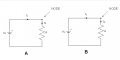
I have given this some thought to demonstrate where you are making an error.

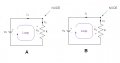
KCL.jpg
In the above example, we can choose the direction of the current arbitrarily.
Applying KCL in A gives:
I1 - I2 = 0

KCL in B gives:
I1 + I2 = 0

Both results are consistent.

Now let's apply KVL.
KVL.jpg
In A, we get:
Vs - V2 = 0

In B, we get
Vs + V2 = 0

In both A and B, I2 = V2/R
Let's substitute for V2 = I2 x R

For case A
Vs - V2 = 0
Vs - I2 x R = 0
Vs = I2 x R
I2 = Vs/R
I1 - I2 = 0
I1 = I2
I1 = Vs/R

For case B
Vs + V2 = 0
Vs + I2 x R = 0
Vs = -I2 x R
I2 = -Vs/R
I1 + I2 = 0
I1 = -I2
I1 = -(-Vs/R)
I1 = Vs/R
I2 = -Vs/R

The results of the two cases are consistent.

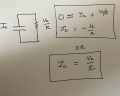
Here is what you did.
1714354188292.png


You stated:
0 = Ic + Vc/R

Without realizing it, you have chosen the current Vc/R in the resistor to be flowing into the node. Hence this would give you a negative result.

You need to draw your arrows of current flow and then apply KCL and KVL consistently.
 

WBahn

Joined Mar 31, 2012
32,876
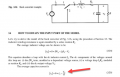
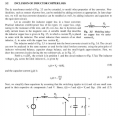
From your other thread, this is what I see as far as actual content from the text.

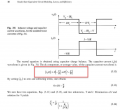
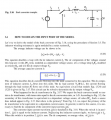
1714355718544.png

I have no idea what the parameter 'D' is that multiplies Vg source voltage. I'm going to guess that it is the transfer coefficient of the dependent voltage source they are talking about.

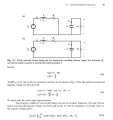
In Eq 3.24, the quantities Vg, i_L, v_L and v_C are all defined on the schematic.

It appears that the effect of the switching action is incorporated into the 'D' term.

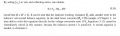
In Eq 3.25, they can get away without defining the reference direction for i_C because they are only working with it's average value and that average value is identically zero (since, if it weren't, the magnitude of the voltage on the capacitor would grow without bound).

I_L - V_C/R

is the current flowing downward in the capacitor, but this is not relevant because if i_C had been defined as the current flowing upward, you would have ended up with

-I_L + V_C/R

which is the exact same result.

To look at it any further, I need to see the actual content from the book.
 

Thread Starter

mike _Jacobs

Joined Jun 9, 2021
223
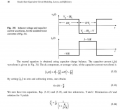
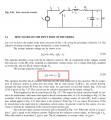
From your other thread, this is what I see as far as actual content from the text.

View attachment 321113

I have no idea what the parameter 'D' is that multiplies Vg source voltage. I'm going to guess that it is the transfer coefficient of the dependent voltage source they are talking about.

In Eq 3.24, the quantities Vg, i_L, v_L and v_C are all defined on the schematic.

It appears that the effect of the switching action is incorporated into the 'D' term.

In Eq 3.25, they can get away without defining the reference direction for i_C because they are only working with it's average value and that average value is identically zero (since, if it weren't, the magnitude of the voltage on the capacitor would grow without bound).

I_L - V_C/R

is the current flowing downward in the capacitor, but this is not relevant because if i_C had been defined as the current flowing upward, you would have ended up with

-I_L + V_C/R

which is the exact same result.

To look at it any further, I need to see the actual content from the book.
@WBahn
hi thanks for this
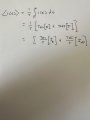
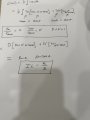
The book is trying to take the integral to find an expression for the average current flow of the capacitor

the book defines the average current

as the following
1714356777572.jpeg

the D and D’ you are see are the two terms

as follows

the integral has to distribute the 1/t term.

tonn/t-total is is d the duty cycle
Toff/t-off is the off percentage of the duty cycle d’

the key to this problem is that d + d’ = 1

the integral can be solved by finding both equations aka both switch state current KCL expressions and multiplying them by length (d) and (d’) by the height. Aka the KCL equation

the goal is to simplify it down such that d+d’ = 1 and you are left with the answer they say is the answer but I can’t make it work

1714357487838.jpeg

does it make sense now what I’m trying to prove? I’m trying to prove thag integral equals the expression the book says

and for that I need two properly written KCL equations one for each state
 
Last edited:

WBahn

Joined Mar 31, 2012
32,876
Again, if you want me to evaluate what is in the book, you need to show me what is in the book. I'm not going to just accept some handwritten stuff as being a faithful rendition of what is in the book -- I have seen too many times when such renditions are not accurate in some critical, sometimes subtle, way. The discussion is then ultimately meaningless because it is not a discussion about what is actually in the book, but rather a discussion about what someone claims and thinks is in the book.

If you can take pictures of your handwritten work and post them, why can't you take pictures of what is in the book and post those, so that we are using what is actually in the book as the basis for discussion?
 

Ian0

Joined Aug 7, 2020
13,132
Yes! but you just made my point. You had to make an assumption about which way the current is flowing. You are not able to just arbitrarily say that everything is flowing into the node or everything is flowing out of the node.
But, of the two possibilities (capacitor charged positive or capacitor charged negative) BOTH lead to the correct answer.
 

Thread Starter

mike _Jacobs

Joined Jun 9, 2021
223
Again, if you want me to evaluate what is in the book, you need to show me what is in the book. I'm not going to just accept some handwritten stuff as being a faithful rendition of what is in the book -- I have seen too many times when such renditions are not accurate in some critical, sometimes subtle, way. The discussion is then ultimately meaningless because it is not a discussion about what is actually in the book, but rather a discussion about what someone claims and thinks is in the book.

If you can take pictures of your handwritten work and post them, why can't you take pictures of what is in the book and post those, so that we are using what is actually in the book as the basis for discussion?
@WBahn
Morning, I have a PDF of the book. The reason i did not post it was because there is not much there.
I have color coded the question to try and help

RED = Boost Example
BLUE = BUCK which is the one i cant solve

So here is what the book is trying to do. This gets a bit confusing because i very poorly asked some questions in the context of a boost and some questions in the context of a buck. The buck is the proof im stuck on.

Here is what the book did.

  1. They wish to present how the transformer model of a DC/DC converter is defined. They give a semi step by step process showing how they got the answer. I followed along with that and completed it and although i don't understand why they did the KCL the way they did and i don't believe they are being consistent, i did get the same answer as the book.
  2. STEP 2 ( AND THIS IS WHERE IT ALL GOES TO HELL) The book builds on that same exact concept with a buck instead of a boost. However, with the derivation for the transformer model of the buck, they do not give a step by step derivation at all. They just give the answer. And this is what i was trying to do. I was trying to take the same technique presented on how to model the boost and use it to model the buck and try and get the same answer the book does. Which is what the book essentially tells you to do. However, i am unable to get the same answer.

BELOW THIS LINE IS THE BOOST EXAMPLE
----------------------------------------------------------------------------------
The section in the red box i was able to prove by following along and other then a wonky sign change it makes sense.
I am then trying to take that and follow the buck converter example which i cant get to prove out. That is the million dollar question.

1714395598690.png


1714395629150.png
1714395653377.png

1714395752416.png


Everything below this line in BLUE is for the buck converter example which is not much. They just give you the answer. So what i am trying to do is expound upon the boost example below and complete the buck proof now.

-----------------------------------------------------------------------------------------------------------------------------
The red box below is what im trying to prove using the same technique used above for the boost converter but now for the buck converter and that is where I'm stuck. This is all the book gives you. Its not even a question in the book. I just refuse to give up until i can figure out how they obtained that answer.
1714396306138.png
 

Attachments

BobTPH

Joined Jun 5, 2013
11,524
How does it not matter?
the book is literally defining a KCL equation in two different ways within the same problem
Each analysis is a separate problem.

When I use KCL, I associate an arrow with each current. You need to try convince yourself that the direction of the arrow makes no difference. Flipping any one arrow, simply results in the opposite sign for the solution.

I would suggest that you take a simple circuit with two currents and solve it with each combination of arrows. After each solution, reverse the arrow in all currents that come out negative. You will end up with the same diagram in all four cases.
 

Thread Starter

mike _Jacobs

Joined Jun 9, 2021
223
Each analysis is a separate problem.

When I use KCL, I associate an arrow with each current. You need to try convince yourself that the direction of the arrow makes no difference. Flipping any one arrow, simply results in the opposite sign for the solution.

I would suggest that you take a simple circuit with two currents and solve it with each combination of arrows. After each solution, reverse the arrow in all currents that come out negative. You will end up with the same diagram in all four cases.
Thanks. Fully agree.
The problem i was referring to above was the book changing conventions literally inside of a system of two equations. So the KCL equations were not independent
 
Top