back to basics KCL

Thread Starter

mike _Jacobs

Joined Jun 9, 2021
223
How do you write a KCL equation if you have literally no knowledge of the current flow direction.

If you dont know if the currents are coming into the node or out of the node is it even possible to use KCL.

Normally i would of just said, define currents into the node as + and exiting the node -
and then go write your equation.

If you dont know what is coming in and going out how can you write the equation.
You cant make an assumption because lets say you have a 4 branch node. Who knows if 2 are coming in and 2 are leaving or if 1 is coming in and 3 are leaving.

Is a requirement to use KCL that you know something about the polarities ?
 

MrChips

Joined Oct 2, 2009
34,628
How do you write a KCL equation if you have literally no knowledge of the current flow direction.

If you dont know if the currents are coming into the node or out of the node is it even possible to use KCL.

Normally i would of just said, define currents into the node as + and exiting the node -
and then go write your equation.

If you dont know what is coming in and going out how can you write the equation.
You cant make an assumption because lets say you have a 4 branch node. Who knows if 2 are coming in and 2 are leaving or if 1 is coming in and 3 are leaving.

Is a requirement to use KCL that you know something about the polarities ?
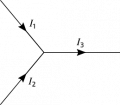
You don't need to know the current flow direction.
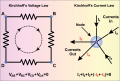
Simply annotate the branches with variables, I1, I2, I3, etc.

1714336609313.png

Then proceed with the KCL and KVL equations.
In the above diagram, I1 + I2 = I3.
Of course, you can write this as I1 + I2 - I3 = 0, if you want to follow a consistent rule.

If you wanted to draw I3 flowing into the node, then the equation becomes, I1 + I2 + I3 = 0.
In which case, I3 would be flowing away from the next node.

If the current value turns out to be negative, then it means the current is flowing in the direction opposite to the one you chose.
 

Thread Starter

mike _Jacobs

Joined Jun 9, 2021
223
You don't need to know the current flow direction.
Simply annotate the branches with variables, I1, I2, I3, etc.

View attachment 321082

Then proceed with the KCL and KVL equations.
In the above diagram, I1 + I2 = I3.

If the current value turns out to be negative, then it means the current is flowing in the direction opposite to the one you chose.
I dont know what you mean by "if it turns out"
 

MisterBill2

Joined Jan 23, 2018
27,186
MC suggested the more scientific approach. My concept is pick a direction to call positive. When done, the numbers will be right although the signs may be reversed. Close enough.
 

Thread Starter

mike _Jacobs

Joined Jun 9, 2021
223
When you have solved for all the current and voltage values, each value will have a sign, positive or negative.
I posted a link to the proof i am trying to make match a book.
The signs absolutely matter. If they are wrong, things don't cancel correctly and the proof fails
Since i apparently cant write the correct KCL equation that is why im making this post
 

MrChips

Joined Oct 2, 2009
34,628
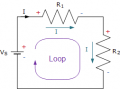
The general practice is to draw a current loop flowing in a clockwise direction. You may choose to do it differently. You will end up with the same answer.

1714337310640.png
 

Thread Starter

mike _Jacobs

Joined Jun 9, 2021
223
When you have solved for all the current and voltage values, each value will have a sign, positive or negative.
I dont see how that is possibly true.
If you make the wrong assumption in polarity with a system of equations it will cause certain things to add or subtract yielding the incorrect answer.
 

Thread Starter

mike _Jacobs

Joined Jun 9, 2021
223
The general practice is the draw a current loop flowing in a clockwise direction. You may choose to do it differently. You will end up with the same answer.

View attachment 321085
I think this is generally true but it does not always hold true.
I offer my other post as evidence. If you do not pick the correct polarity concerning a proof of a system, you will not get the correct answer.

That is what im trying to figure out and why im asking this seemingly stupid question
 

MrChips

Joined Oct 2, 2009
34,628
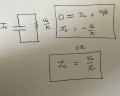
Your first equation reflects KCL at a node.
Where did you get Vc/R?

Use two currents I1 and I2 at the node in question.
I do not know which node you are applying KCL.
 

Thread Starter

mike _Jacobs

Joined Jun 9, 2021
223
This is not a rule. You can reverse the direction if you will.
The result is always correct, regardless of the direction chosen.
What i am saying is... this is not true if you are trying to do a proof to match a book.
You have to pick the same polarities as the book or your answer will not be the same by more then just a sign.
 

MrChips

Joined Oct 2, 2009
34,628
VC/R is a current
Its the voltage across the resistor divided by its resistance
We all know Vc/R is the current in the resistor but you did not draw in the diagram the direction of this current in order to apply KCL correctly.

If you apply KCL correctly,

I1 - I2 = 0
I1 - Vc/R = 0
 

Thread Starter

mike _Jacobs

Joined Jun 9, 2021
223
We all know Vc/R is the current in the resistor but you did not draw in the diagram the direction of this current in order to apply KCL correctly.

If you apply KCL correctly,

I1 - I2 = 0
I1 - Vc/R = 0
You are making my point

"apply KCL correctly"

You are now saying there is a "correct" way to apply it but before you said the polarity is your choice.
That is exactly my point. There is a "correct" way. Its not arbitrary.
 

MrChips

Joined Oct 2, 2009
34,628
You are making my point

"apply KCL correctly"

You are now saying there is a "correct" way to apply it but before you said the polarity is your choice.
That is exactly my point. There is a "correct" way. Its not arbitrary.
You are misinterpreting me.

I repeat, you do not need to know the direction of the current.
What you need to do is apply KCL and KVL consistently.

And since you refuse to accept this, then Kirchhoff was wrong.
I am now done with this.
 

Thread Starter

mike _Jacobs

Joined Jun 9, 2021
223
You are misinterpreting me.

I repeat, you do not need to know the direction of the current.
What you need to do is apply KCL and KVL consistently.
I know what your saying and that is what i have been told practically since birth.

However, in the proof i am trying to solve it does not work. If you do not pick the same polarity as the book you will get the wrong answer. Its not a matter of arbitrary or consistent. There is a right and a wrong when trying to complete a proof to match some answer in a book.
 
Top