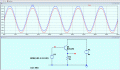
transistor basics ( as buffer )

Thread Starter

electronicsenjoyer089

Joined Feb 24, 2025
182
Hello, i had a question about the circuit below, basically it shows the VE is equal to 8.3V and i understood that, because VE=VB-0.7V (diode drop)
but why the signal goes from 0 to 8.3V and not from 0.7V to 8.3V? can someone explain? there is parasitic capacitor that cancels the dc component or where is my misunderstanding? thanks.
 

Attachments

ericgibbs

Joined Jan 29, 2010
21,391
hi 089,
I think the circuit is drawn on the assumption that below 0.7Vbe the transistor is Off, not conducting, which is incorrect.
Where did you find the circuit?
E
 

Thread Starter

electronicsenjoyer089

Joined Feb 24, 2025
182
Hello, i had a question about the circuit below, basically it shows the VE is equal to 8.3V and i understood that, because VE=VB-0.7V (diode drop)
but why the signal goes from 0 to 8.3V and not from 0.7V to 8.3V? can someone explain? there is parasitic capacitor that cancels the dc component or where is my misunderstanding? thanks.
or 0.7 is used to turn on the diode and other 0.7 is voltage drop on resistor?
 

Thread Starter

electronicsenjoyer089

Joined Feb 24, 2025
182
hi 089,
I think the circuit is drawn on the assumption that below 0.7Vbe the transistor is Off, not conducting, which is incorrect.
Where did you find the circuit?
E
i found it online, cus im trying to learn transistor basics.

Btw yeah 0.7V atleast for diode the be forward biased, so the first 0.7V (DC voltage) will drop on the diode and the rest is in output? ( beside the resistor drop)
 

Thread Starter

electronicsenjoyer089

Joined Feb 24, 2025
182
hi 089,
I think the circuit is drawn on the assumption that below 0.7Vbe the transistor is Off, not conducting, which is incorrect.
Where did you find the circuit?
E
maybe now i understood, if i apply any sinusoidal wave that starts from >=0.7V , then in output i will see it starting from 0, cus the diode wont conduct. And secondly the wave will be clamped VIN-0.7 by diode drop, is this correct? i understood well?
 

ericgibbs

Joined Jan 29, 2010
21,391
hi 089,
A NPN Silicon transistor will start conducting at approx Vbe = 0.65V
So if the Vbe is 0.7V it will be conducting.

A Vbe of 0.7V is often used as a typical conduction point, both for transistors and diodes when making a rough calculation.

Note in this simulation image the Vout is close to 0)v but not actually 0v as shown in your circuit diagram. Red plot trace.


E
EG57_ 2811.gif
 

Thread Starter

electronicsenjoyer089

Joined Feb 24, 2025
182
hi 089,
A NPN Silicon transistor will start conducting at approx Vbe = 0.65V
So if the Vbe is 0.7V it will be conducting.

A Vbe of 0.7V is often used as a typical conduction point, both for transistors and diodes when making a rough calculation.

Note in this simulation image the Vout is close to 0)v but not actually 0v as shown in your circuit diagram. Red plot trace.


E
View attachment 347041
hey thanks for the simulation, so if i understood well, if i put any sinusoidal wave below 0.7, by output it will be seen as 0V, like if i put VIN as a sinusoidal wave that goes from 0.4 to 9V, what i will see as output is gonna be from 0 to 8.3V right? cus the 0.4 drops on the diode
 

Thread Starter

electronicsenjoyer089

Joined Feb 24, 2025
182
hey thanks for the simulation, so if i understood well, if i put any sinusoidal wave below 0.7, by output it will be seen as 0V, like if i put VIN as a sinusoidal wave that goes from 0.4 to 9V, what i will see as output is gonna be from 0 to 8.3V right? cus the 0.4 drops on the diode
but what if i give a sinusoidal wave that goes from 1.4V to 9V? what i will have as output? a sinusoidal wave that goes from 1.4V-0.7V, so 0.7V to 8.3V? thanks for clarification and sorry for all these questions..
 

LvW

Joined Jun 13, 2013
1,996
maybe now i understood, if i apply any sinusoidal wave that starts from >=0.7V , then in output i will see it starting from 0, cus the diode wont conduct. And secondly the wave will be clamped VIN-0.7 by diode drop, is this correct? i understood well?
You should know that any pn-junction will not "sharply" start to conduct for a forward voltage above 0.7V.
Remember the well-known exponential function for a diode (forward biased) If=f(Vf).
This applies as well to the pn junction between B and E -Therefore: Ie=f(Vbe).
Now - what does an emitter follower do? It provides a replica of the input sgnal at the emitter node - shifted by the dc voltage drop across the B-E path (which is app. 0.65...0.7 volts).
Therefore, for an input signal of 0.7 volts, the voltage at the emitter node will be app. around Ve=0.7-(0.65..0.7) volts (app. some tenth of mV only)
 

Thread Starter

electronicsenjoyer089

Joined Feb 24, 2025
182
You should know that any pn-junction will not "sharply" start to conduct for a forward voltage above 0.7V.
Remember the well-known exponential function for a diode (forward biased) If=f(Vf).
This applies as well to the pn junction between B and E -Therefore: Ie=f(Vbe).
Now - what does an emitter follower do? It provides a replica of the input sgnal at the emitter node - shifted by the dc voltage drop across the B-E path (which is app. 0.65...0.7 volts).
Therefore, for an input signal of 0.7 volts, the voltage at the emitter node will be app. around Ve=0.7-(0.65..0.7) volts (app. some tenth of mV only)
ye its not a perfect 90° line we can say, so if i understood well this apply only for d.c signal? anything until 0.7V as dc i wont see it in output?
 

Thread Starter

electronicsenjoyer089

Joined Feb 24, 2025
182
ye its not a perfect 90° line we can say, so if i understood well this apply only for d.c signal? anything until 0.7V as dc i wont see it in output?
and what in case i got a sinusoidal wave made by a d.c component of 1.4V? so this means a sinusoidal wave from 1.4 to 9V, what i will see in output? a wave that goes from 0.7V to 8.3?. so 0.7V ( to simplify things ) until the diode conducts and then 0.7v drop that makes the signal go maximum to 8.3V ( basically 0.7V drop at the start cus it needs more than 0.7V to start conducting. then the high level maximum to 8.3V cus the voltage drop on diode by 0.7v no?
 
Last edited:

Thread Starter

electronicsenjoyer089

Joined Feb 24, 2025
182
and what in case i got a sinusoidal wave made by a d.c component of 1.4V? so this means a sinusoidal wave from 1.4 to 9V, what i will see in output? a wave that goes from 0.7V to 8.3?. so 0.7V ( to simplify things ) until the diode conducts and then 0.7v drop that makes the signal go maximum to 8.3V
tell me if im wrong or misunderstanding thanks, im really trying to understand things well
 

Thread Starter

electronicsenjoyer089

Joined Feb 24, 2025
182
hi 089,
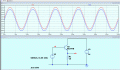
Plot 1.4V > 9V
E
View attachment 347048
hello, ok so what i can see here is basically that the diode removes always the d.c component by 0.7V, so what happens is that the signal gets shifted down by 0.7V ( so its incorrect to say that ''low level'' will be shifted down by 0.7V cus the diode starts conducting at 0.7V and the ''high level'', 9V will be shifted down, cus of the drop on the diode)
 
Top