Facebook
 Google
 GitHub
 Linkedin
I built a little audio amp pretty much for something to do, and I'm having one problem with it.
When the input is left floating (ie. not connected), there is a whine (or hum, but higher). When the input is connected to an audio device (or I ground the input pin), the whine stops. It's at about 900Hz, but changes a little over time and can also change by adjusting a pot (see below).
I think it might be the power supply ripple coming through, because it's around the same peak-to-peak value as the maximum that the supply's datasheet specifies (150mV p-p max). But that seems odd because I expected the circuit to reduce the ripple at least somewhat even without a regulator, according to simulation. It's a wall-wart switchmode supply.
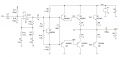
The schematic is attached. R19 (shown with the value "{ra}") is adjustable from 3.6k - 4.6k (to optimize distortion), and adjusting it affects the frequency of the whine over about an octave.
What might be causing this?
When the input is left floating (ie. not connected), there is a whine (or hum, but higher). When the input is connected to an audio device (or I ground the input pin), the whine stops. It's at about 900Hz, but changes a little over time and can also change by adjusting a pot (see below).
I think it might be the power supply ripple coming through, because it's around the same peak-to-peak value as the maximum that the supply's datasheet specifies (150mV p-p max). But that seems odd because I expected the circuit to reduce the ripple at least somewhat even without a regulator, according to simulation. It's a wall-wart switchmode supply.
The schematic is attached. R19 (shown with the value "{ra}") is adjustable from 3.6k - 4.6k (to optimize distortion), and adjusting it affects the frequency of the whine over about an octave.
What might be causing this?