Audio amp hum/whine

Thread Starter

Veracohr

Joined Jan 3, 2011
783
I built a little audio amp pretty much for something to do, and I'm having one problem with it.

When the input is left floating (ie. not connected), there is a whine (or hum, but higher). When the input is connected to an audio device (or I ground the input pin), the whine stops. It's at about 900Hz, but changes a little over time and can also change by adjusting a pot (see below).

I think it might be the power supply ripple coming through, because it's around the same peak-to-peak value as the maximum that the supply's datasheet specifies (150mV p-p max). But that seems odd because I expected the circuit to reduce the ripple at least somewhat even without a regulator, according to simulation. It's a wall-wart switchmode supply.

The schematic is attached. R19 (shown with the value "{ra}") is adjustable from 3.6k - 4.6k (to optimize distortion), and adjusting it affects the frequency of the whine over about an octave.

What might be causing this?
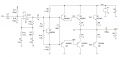
amp.png
 

#12

Joined Nov 30, 2010
18,224
Start with this one:
Connect R17 and R18, but not to the input. Add a filter cap at the center point and add a hundred k from the center voltage over to the input pin.

There is also the idea of not operating the amplifier with nothing plugged in to the input.
Old story about Fender amplifiers: If it hums when the volume control is turned to zero, don't play it with the volume control turned to zero. :D

You could try a couple of nanofarads across R3 to place a gain roll-off at 17KHz.
Add a nanofarad right across the power supply pins of U1...
or isolate the power supply to U1 with a few hundred ohms and filter with a hundred uf plus a nanoF.
 

Hypatia's Protege

Joined Mar 1, 2015
3,228
There is also the idea of not operating the amplifier with nothing plugged in to the input.
Indeed!:D

@Veracohr: In general, 'linear' and 'near linear' amplifiers tend to exhibit instability under 'zero' excitation conditions -- Double-ditto when the input is 'left floating' or otherwise terminated with excessively high impedance...

Best Regards
HP:)
 
Last edited:

studiot

Joined Nov 9, 2007
4,998
Mr Practical 12 is correct the problem is almost certainly arising at the input to the high impedance TL071.

How long is the connection between R17/R18 and the op amp?
Check the layout to avoid pickup.
And yes if that does not work then you will have to stabilise the artificial ground they create at their junction, better with two capacitors than one as #12 suggests.
 

Thread Starter

Veracohr

Joined Jan 3, 2011
783
Start with this one:
Connect R17 and R18, but not to the input. Add a filter cap at the center point and add a hundred k from the center voltage over to the input pin.
If this is what you mean, it didn't work and also significantly reduces the gain in simulation because of the size of the input cap. I assume one would want a low filter cutoff so I used a larger filter cap.

input.png


There is also the idea of not operating the amplifier with nothing plugged in to the input.
I've never had problems operating commercially made amplifiers with nothing plugged in.


or isolate the power supply to U1 with a few hundred ohms and filter with a hundred uf plus a nanoF.
This worked. 100 ohms plus 100uF. I didn't want to use too high of a resistor so as not to drop the opamp supply too much. Thanks!


Mr Practical 12 is correct the problem is almost certainly arising at the input to the high impedance TL071.
I also tried substituting a NE5532 (much lower input impedance) and it had the same problem.

How long is the connection between R17/R18 and the op amp?
A couple millimeters.

Since I also want to learn in addition to just having a working amp, what's going on that is causing this? The fact that adjusting the pot can change the frequency makes me doubt that it is just the power supply ripple, since I would expect that to be a steady frequency. Also, I connected an identical amp on a breadboard (the previous one is soldered on stripboard), and the buzz was MUCH louder. The only difference is that the output NPN transistors have much higher beta than the ones soldered (same model).
 

#12

Joined Nov 30, 2010
18,224
If this is what you mean, it didn't work and also significantly reduces the gain in simulation because of the size of the input cap. I assume one would want a low filter cutoff so I used a larger filter cap. That is not at all what I mean. The line from C9 jumps around R17, R18, and R11 and connects directly to the input pin. It does not connect to the junction of R17 and R18. A filter capacitor goes there. About 0.1 uf should do it.

View attachment 87843


I've never had problems operating commercially made amplifiers with nothing plugged in.
Maybe that's because they didn't use this design. Maybe the input jack grounded the input when you didn't have anything connected. Maybe there is already a ground reference resistor in the circuit that you can't see. Maybe they made a proper isolation circuit to keep the power supply frequency out of the op-amp. Maybe they used a different power supply. There are dozens of ways to not get the results you got.


This worked. 100 ohms plus 100uF. I didn't want to use too high of a resistor so as not to drop the opamp supply too much. Thanks!


I also tried substituting a NE5532 (much lower input impedance) and it had the same problem.That's because you didn't understand the input bias filter circuit.


A couple millimeters.

Since I also want to learn in addition to just having a working amp, what's going on that is causing this? The fact that adjusting the pot can change the frequency makes me doubt that it is just the power supply ripple, since I would expect that to be a steady frequency. Also, I connected an identical amp on a breadboard (the previous one is soldered on stripboard), and the buzz was MUCH louder. The only difference is that the output NPN transistors have much higher beta than the ones soldered (same model).
Somebody else can try to figure out why the second stage affects the first stage.
 

AnalogKid

Joined Aug 1, 2013
12,126
The schematic in post #6 has a problem. The DC bias network on the + input is not right. R17, R19, and C9 form a virtual ground network, and it's junction goes to the + input through R11 as shown. But the right side of C4 goes directly to the + input, *not* the DC bias point. Also, what is Vx and what is the purpose of R3 and C3?

ak
 

#12

Joined Nov 30, 2010
18,224
@AnalogKid
1) That's what I've been trying to tell him.
2)Vx is a feedback from the final output so gain = 1+ 39k/4.7k
give or take a bit for that 115k providing a DC path for the bias current of the inverting input.
 
Last edited:
Top