Attenuator With Current Dependent Resistor Challenge

Thread Starter

MrAl

Joined Jun 17, 2014
13,709
Sorry, but I doubt if it is "more exact".
The transconductance is DEFINED as
gm=d(Ic)/d/VBE)
That is nothing else than the slope of the well-known exponential Shockley equation Ic=f(VBE, Vt).
And the differential quotient (slope) is calculated to be gm=Ic/Vt.

This definition does not depend on beta and does not need such an artificial quantity re which appears in just one of the small-signal models for the BJT. Can you show how your expression is "more exact"?
Hello again,

I have to say i am a little surprised that you dont agree with this small detail as i think this has been known for some years. The reason for this is because the typical gm calculation is obtained from the collector current and the real value of 're' is calculated from the emitter current, and of course the ratio of collector current to emitter current is Beta/(Beta+1). It is close to 1 when Beta is large so many texts quote re=1/gm when really it's a little different.

What i did was took your advice and calculated the gain from the simpler circuit, and i must say that was a good idea because the circuit was MUCH easier to work with.
So i calculated the gain A with a value of 're' of 25 Ohms, and i did not get:
A=(1/25)*R4

instead i got
A=(1/25.5)*R4

and so from your calculation of A which was:
A=gm*R4

that means that:
gm=1/25.5 and not gm=1/25 which was 1/re.

Now calculating the 'other' way:
gm=a/re

we have:
gm=a/25

and with Beta=50 we have:
gm=(Beta/(Beta+1))/25
gm=(50/51)/25
gm=2/51=0.0392157

when with gm=1/re we would have had:
gm=1/25=0.04

and the ratio of 1/25 to 2/51 is 1.02, so about a 2 percent difference.

Now that i go back and look at the original transistor thread i see that Jony did use alpha also:
https://forum.allaboutcircuits.com/...gain-of-a-bjt-amplifier-circuit.154751/page-2
in post #35.

I was a little surprised you questioned this but i believe that is because you had been doing it that way for so many years and perhaps forgot how it originally came into being. Compounding the problem is that some texts estimate (note the work 'estimate') the value of 're' to be VT/iC which is the thermal voltage divided by the collector current rather than by the emitter current, and if you do it that way you get gm=1/re but that's not as exact.

But to prove this i think all you have to do is do what i did and that was simply to analyze the circuit you described to me and calculate the gain and calculate what 'gm' it would take to get the gain A from gm and R4, as you pointed out.

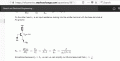
Here is a screen shot from a page on Stack Exchange...
 

Attachments

Jony130

Joined Feb 17, 2009
5,598
I think the problem lies in the fact the LvW is using the Shockley equation in "direct" way and treat the gm as one of the basic BJT's parameters.
Because we cannot argue with the fact that the gm is a slope of an Ic = f(Vbe) function. While re is an inverse of the slope ( Vbe = f(Ic) ) what is in conflict with the traditional view of a BJT as Vbe controlled current source (Ic). And it will be hard to discuss with that point of view.


MrAl
If I understand your "method" correctly you propose to include the re in the DC calculation as another unknown variable?
Hence we have now two unknowns Ic and re. Am I right?
 

Thread Starter

MrAl

Joined Jun 17, 2014
13,709
I think the problem lies in the fact the LvW is using the Shockley equation in "direct" way and treat the gm as one of the basic BJT's parameters.
Because we cannot argue with the fact that the gm is a slope of an Ic = f(Vbe) function. While re is an inverse of the slope ( Vbe = f(Ic) ) what is in conflict with the traditional view of a BJT as Vbe controlled current source (Ic). And it will be hard to discuss with that point of view.
Well to me it looks like the only difference is that 're' is calculated from emitter current, not collector current, while 'gm' is calculated from collector current and not emitter current, and the ratio 'alpha' makes the two methods match perfectly if applied to the calculations.
I will try to go farther with this but it's still a kind of side point for now.

MrAl
If I understand your "method" correctly you propose to include the re in the DC calculation as another unknown variable?
Hence we have now two unknowns Ic and re. Am I right?
Well, almost. I actually look at Ie and re because the emitter current is the 'right' way to calculate 're':
re=VT/Ie

and not:
re=VT/Ic

It is true that the second one is used in approximations also, but i consider the first to be the most accurate and that's what i read in different places on the web too.

So 're' becomes a variable but it gets absorbed into the calculation so we never need to calculate it directly.
With the standard method, we have to calculate 're' from the DC circuit conditions WITH NO 're' IN THE CIRCUIT.
When was the last time you actually had to calculate something while the circuit was missing a component that actually alters the behavior once it *is* inserted [rhetorical question].
Also, it is known that the base width changes, and it doesnt change just once, it changes as the emitter current changes. That means as the AC signal comes beaming into the circuit, the real value changes too. So if we imagine a sine wave, during the positive peak there will be more current making 're' larger, and during the negative peak there will be less current making 're' smaller. That HELPS to model the non linear behavior i think, but to what degree, how accurate this is, is hard to say without doing some extensive tests. In spite of that i accept that the variation could be small so accept the average of this behavior and call it just re(i) and allow re(i) to change just once.

If you want to see the difference, all you have to do is place 're' in the circuit WHILE you are calculating the DC emitter current (and collector current if desired). The value of 're' then assumes some value based on the other components and of course the Beta. You can then calculate 're' directly if you like, then proceed as usual to the AC analysis. See if you can spot anything of interest. Maybe use a simpler circuit but include R1 this time and some bias resistor.

I try not to rely on just one site either when looking for verification of some theory. The theory involving alpha has been known, and you used it yourself so i assume you are familiar with that.
 

LvW

Joined Jun 13, 2013
2,030
I think the problem lies in the fact the LvW is using the Shockley equation in "direct" way and treat the gm as one of the basic BJT's parameters.
Because we cannot argue with the fact that the gm is a slope of an Ic = f(Vbe) function. While re is an inverse of the slope ( Vbe = f(Ic) ) what is in conflict with the traditional view of a BJT as Vbe controlled current source (Ic). And it will be hard to discuss with that point of view.
To Joni
Hi Jony - just two questions:

1) Is it correct that the transconductance (watch the name!!) since decades is defined as gm=d(Ic)/d(Vbe) ?
I am sure you will agree and, therefore, I do not understand where the problem is.
Of course, I am using Shockleys equation in a "direct way" (not only me, ALL engineers follow this DEFINITION!!).
Do you propose another way - other than Shockley?
2) Why/where do you see any conflict "with the traditional view of the BJT as Vbee controlled current source" ?

To MrAl
Quote: "I was a little surprised you questioned this but i believe that is because you had been doing it that way for so many years and perhaps forgot how it originally came into being."

I like to repeat that I have quoted the DEFINITION of the transconductance. Why don`t you comment on this?
Don`t you accept this definition?
More than that, I did not forget, which quantity "originally came into being".
I still can trust my memory (I have the original papers from the inventors of the BJT): From the beginning, it was the transconductance gm which was defined as the parameter which specifies the relation between input (voltage) and output (collector current) - not such a "mysterious" resistance "re".
The part called "re" (which you prefer) is nothing else than an ARTIFICIAL QUANTITY which was introduced as part of an equivalent circuit diagram valid for small signals only.
Some people call this quantity "internal emitter resistance" which is - physically spoken - wrong.
No experienced engineer makes use of any equivalent circuit diagrams - and, in particular of the T-model.
The classical BJT small-signal diagram is based on the well known 4-pole equations (with r_pi and a current source i=vbe*gm)

In your last contribution you are speaking of 2% difference.
However, the most inportant remark is missing: Which of the two results is more correct - and WHY?
 

Thread Starter

MrAl

Joined Jun 17, 2014
13,709
To Joni
Hi Jony - just two questions:

1) Is it correct that the transconductance (watch the name!!) since decades is defined as gm=d(Ic)/d(Vbe) ?
I am sure you will agree and, therefore, I do not understand where the problem is.
Of course, I am using Shockleys equation in a "direct way" (not only me, ALL engineers follow this DEFINITION!!).
Do you propose another way - other than Shockley?
2) Why/where do you see any conflict "with the traditional view of the BJT as Vbee controlled current source" ?

To MrAl
Quote: "I was a little surprised you questioned this but i believe that is because you had been doing it that way for so many years and perhaps forgot how it originally came into being."

I like to repeat that I have quoted the DEFINITION of the transconductance. Why don`t you comment on this?
Don`t you accept this definition?
More than that, I did not forget, which quantity "originally came into being".
I still can trust my memory (I have the original papers from the inventors of the BJT): From the beginning, it was the transconductance gm which was defined as the parameter which specifies the relation between input (voltage) and output (collector current) - not such a "mysterious" resistance "re".
The part called "re" (which you prefer) is nothing else than an ARTIFICIAL QUANTITY which was introduced as part of an equivalent circuit diagram valid for small signals only.
Some people call this quantity "internal emitter resistance" which is - physically spoken - wrong.
No experienced engineer makes use of any equivalent circuit diagrams - and, in particular of the T-model.
The classical BJT small-signal diagram is based on the well known 4-pole equations (with r_pi and a current source i=vbe*gm)

In your last contribution you are speaking of 2% difference.
However, the most inportant remark is missing: Which of the two results is more correct - and WHY?
Hello again,

Well you are telling me you NEVER heard of the value of 're' as calculated as:
re=alpha/gm
rather than:
re=1/gm
???

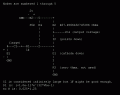
Did you not see the diagram i posted previously with the more drawn out calculation?
I repeat the drawing here for convenience

Also, now you are again mocking the "T" model. That's fine outside of this discussion, but that's the context of this discussion. If you dont like the T model then you wont like any of these methods and so you'll never accept any method of analysis, not just the 'new' method.

I just noticed that you also seem to have the wrong conception about what 're' actually represents. I believe that is because you dont use this model much or maybe not at all.

Now make sure you LOOK at this drawing as it has the information needed...
 

Attachments

Last edited:

Jony130

Joined Feb 17, 2009
5,598
Hi Jony - just two questions:

1) Is it correct that the transconductance (watch the name!!) since decades is defined as gm=d(Ic)/d(Vbe) ?
I am sure you will agree and, therefore, I do not understand where the problem is.
Of course, I am using Shockleys equation in a "direct way" (not only me, ALL engineers follow this DEFINITION!!).
Do you propose another way - other than Shockley?
2) Why/where do you see any conflict "with the traditional view of the BJT as Vbe controlled current source" ?
In my last post, I was trying to explain your point of view to the MrAl .


All I was trying to say is that the gm is a "pure/natural" BJT's parameter which is coming directly from the Shockley equation Ic = f(VBE).
And this is why you do not have any interest in using such a "strange" parameter as re which is also a slope of a function. But this function looks rather strange Vbe = f(Ie).
And because of this it will be hard or even impossible to convince you to the re (T-model) model. Because you do not see any benefit in doing such a thing.

I try not to rely on just one site either when looking for verification of some theory. The theory involving alpha has been known, and you used it yourself so i assume you are familiar with that.
Yes, I'm familiar with that. I'm also aware of the fact that the T-model is not very popular (U.Tietze in his "German Bible" about electronics do not even use the name T-model )). But on the other hand the "re" by itself is very popular.

But I think that the main disagreement is laying in the fact that you are trying to use the small-signal quantity in DC analysis.
Also, what is the theoretical background which allows us to use "re" in DC analysis?
And what is the benefice of this analysis if now we have to deal additional unknown.
 

LvW

Joined Jun 13, 2013
2,030
Hello again,

Well you are telling me you NEVER heard of the value of 're' as calculated as:
re=alpha/gm
rather than:
re=1/gm
???
.
My question was and still is why your method - based on your definition (as often claimed by you) - would me more exact!!

Quote: "I just noticed that you also seem to have the wrong conception about what 're' actually represents."

OK - teach me: What does it "represent"?
 

Thread Starter

MrAl

Joined Jun 17, 2014
13,709
In my last post, I was trying to explain your point of view to the MrAl .


All I was trying to say is that the gm is a "pure/natural" BJT's parameter which is coming directly from the Shockley equation Ic = f(VBE).
And this is why you do not have any interest in using such a "strange" parameter as re which is also a slope of a function. But this function looks rather strange Vbe = f(Ie).
And because of this it will be hard or even impossible to convince you to the re (T-model) model. Because you do not see any benefit in doing such a thing.


Yes, I'm familiar with that. I'm also aware of the fact that the T-model is not very popular (U.Tietze in his "German Bible" about electronics do not even use the name T-model )). But on the other hand the "re" by itself is very popular.

But I think that the main disagreement is laying in the fact that you are trying to use the small-signal quantity in DC analysis.
Also, what is the theoretical background which allows us to use "re" in DC analysis?
And what is the benefice of this analysis if now we have to deal additional unknown.
Hi,

Some good questions, thanks.

To start, it is easy to visualize in the standard method that if we had 1ma DC emitter current then we would come up with a value of 're' call it Re1, but if we change the bias and end up with 2ma DC emitter current then we would come up with a value of 're' call it Re2, and the relationship between Re1 and Re2 would be found by the ratio of the two currents. Because the emitter current is in the denominator, that means that Re2 would be 1/2 of Re1.
But why do we have to keep calculating new values of 're' when we change the bias conditions?
It is because 're' changes as the DC bias conditions change.
So why not incorporate that right into the model? That's what re(i) is all about.

LvW keeps stressing that the slope has to do with gm and re. So let's calculate 're' from an approximate Ebers Moll.
Starting with:
ie=Ies*(e^(Vbe/VT)-1)
solving for Vbe:
Vbe=ln(ie/Ies+1)*VT
now find re=dVbe/die and get:
re=VT/((ie/Ies+1)*Ies)
Simplify:
re=VT/(Ies+ie)

and since Ies is typically very very small on the order of 10e-12, we can approximate with really good accuracy:
re=VT/ie

and here nobody said 'ie' was a constant.
It makes sense to me right away that 're' should be really depicted as:
re(ie)=VT/ie

in the same way we make any function:
y(x)=VT/x

and we dont insist that 'x' must be a constant.

Now that i've discussed this several times and had more time to think about it, i think maybe it is time to hear arguments as to why this method would NOT work. I've presented plenty of proof for why it should work, within the context of the model being discussed.

Does it make things more difficult?
Only on the surface. If we only have one DC power supply value ever for that particular circuit, then maybe it's an overkill.
But another example that i gave previously is that if we wanted to create a spice model to mimic this behavior, it would be easier to make 're' a current controlled resistor rather than a static resistor value so we dont have to keep changing it.
Also, because of what was calculated i have a suspicion that it models the behavior better, although it's probably not enough to worry about so i wont push that end of it.

Comments welcome, pro or con.
 

Thread Starter

MrAl

Joined Jun 17, 2014
13,709
My question was and still is why your method - based on your definition (as often claimed by you) - would me more exact!!

Quote: "I just noticed that you also seem to have the wrong conception about what 're' actually represents."

OK - teach me: What does it "represent"?
Hi,

That's a cool reply, really. "OK - teach me". I like that because it's like, "Ok if you know it all then tell me all about it" :)

First, i wont profess to know everything about everything, but when i run across certain things i know something is wrong, or right. It may be limited to those things, but i am not very often wrong.
I dont think i can teach you much, but i know we learn from each other.

I've already explained about the exactness of re=alpha/gm rather than re=1/gm, and it is evident by other posts on other web sites and instructional sites. I did not care too much about this originally because it doesnt change things that much, as to how it relates to the main question being brought up in this thread. So i still consider it a side issue.

The nature of 're' is the resistance looking into the emitter terminal. It's an equivalent resistance that once known, can help solve circuit problems. You seem to be rejecting this concept altogether now, so i cant see what you want to say overall except maybe that,
"There are better models out there".
For that i agree totally, with no reserves. But again the context of this discussion was limited to the model that uses 're' to calculate certain things about the circuit.

Let me just ask you one little question.
Given the context of this discussion, do you yourself see any advantage for using re(i) instead of just a static value of 're'?

Another problem that is related, is to solve some nonlinear diode circuits. That is, with diodes that are given by the real diode equation. The real diode equation always has a variable current 'id' in it.
 

LvW

Joined Jun 13, 2013
2,030
Quote: "Given the context of this discussion, do you yourself see any advantage for using re(i) instead of just a static value of 're'?"

I really don`t know how you can say that I am using a "static value of re".
At least 10 times I have stressed the fact that ther quantity you call re can be drived dircectly from the exponential curve as a differential quotient (slope). Please show me one single sentence where I have stated that the transconductance would be a static quantity.

Perhaps I can convince you using the two classical four-pole equations (using the hybrid parameters h):.

vbe=ib*h11+vce*h12
ic =ib*h21+vce*h22

Neglecting the small parameters h12 and h22 we arrive at the well-known ratio

h21/h11=ic/vbe >>> d(Ic)/d(Vbe)=gm

As you can see, we do not use any "resistance"re and we do not need the emitter current.
The transconductance follows directly from the classical four-pole equations of corcuit theory..
May be I am old-fashioned, but I try to follow the definitions which are used since 1948 or so....(with success !).
Why don`t you answer my questions? (Why is "your" method more exact?)

To me, it is now a useless "discussion" (enriched with silly assertions).
 

Thread Starter

MrAl

Joined Jun 17, 2014
13,709
Quote: "Given the context of this discussion, do you yourself see any advantage for using re(i) instead of just a static value of 're'?"

I really don`t know how you can say that I am using a "static value of re".
At least 10 times I have stressed the fact that ther quantity you call re can be drived dircectly from the exponential curve as a differential quotient (slope). Please show me one single sentence where I have stated that the transconductance would be a static quantity.

Perhaps I can convince you using the two classical four-pole equations (using the hybrid parameters h):.

vbe=ib*h11+vce*h12
ic =ib*h21+vce*h22

Neglecting the small parameters h12 and h22 we arrive at the well-known ratio

h21/h11=ic/vbe >>> d(Ic)/d(Vbe)=gm

As you can see, we do not use any "resistance"re and we do not need the emitter current.
The transconductance follows directly from the classical four-pole equations of corcuit theory..
May be I am old-fashioned, but I try to follow the definitions which are used since 1948 or so....(with success !).
Why don`t you answer my questions? (Why is "your" method more exact?)

To me, it is now a useless "discussion" (enriched with silly assertions).
Hello,

Nobody is breaking your arm to talk about this.
It's not 'my' method and you ignore what i show you from other sites.

I see no good reason to talk about this with you anymore as you keep repeating your assertions that have nothing or next to nothing to do with my intended discussion, So we've reached an impasse. It happens, no big deal i guess, life goes on.
Time to move on to something bigger and better :)
Thank you for your interest just the same.
 

LvW

Joined Jun 13, 2013
2,030
Quote: "I see no good reason to talk about this with you anymore as you keep repeating your assertions that have nothing or next to nothing to do with my intended discussion"

The problem was the following: Your " intended discussion" was not concentrated on one single point;that means: You could not make clear what you really wanted to say.
* At first, your claim was that the quantity "re" was different for DC and AC calculations (that means: You were of the opinion, that such a resistive value "re - a differential quantity (1) - would appeat also in DC calculations;

* Lateron you included the supply voltages into your formulas ...and your criticism was that I would not consider supply changes.

* Now you concentrate yourself on the slope of the emitter current curve rather than ther collector current (what do you think about the four-pole equations - not correct?).....forgetting the two above mentioned point you have brought into the discussion.

So - I ask myself: What is your intention ? What do want to say?
Several times you were claiming that your novel methods would be more exact - however, without any proof!!
That is the real problem of this discussion.
 

Thread Starter

MrAl

Joined Jun 17, 2014
13,709
Quote: "I see no good reason to talk about this with you anymore as you keep repeating your assertions that have nothing or next to nothing to do with my intended discussion"

The problem was the following: Your " intended discussion" was not concentrated on one single point;that means: You could not make clear what you really wanted to say.
* At first, your claim was that the quantity "re" was different for DC and AC calculations (that means: You were of the opinion, that such a resistive value "re - a differential quantity (1) - would appeat also in DC calculations;

* Lateron you included the supply voltages into your formulas ...and your criticism was that I would not consider supply changes.

* Now you concentrate yourself on the slope of the emitter current curve rather than ther collector current (what do you think about the four-pole equations - not correct?).....forgetting the two above mentioned point you have brought into the discussion.

So - I ask myself: What is your intention ? What do want to say?
Several times you were claiming that your novel methods would be more exact - however, without any proof!!
That is the real problem of this discussion.
Hello again,

Thanks for the reply.

What i found was that you cant agree even with one of the most basic concepts that can be found on several other web sites including university level papers (not that that is the end-all of all end-all's). If you cant agree with myself and those web sites, then we will never come to an agreement on the things that follow because they are built on those fundamental building blocks.
Not only that, i CALCULATED what YOU told me to calculate, and i got the very same result as those other web sites, and you seemed to go right on pressing your idea of what is right anyway. So what do you expect me to say after all this?

What i can say is that there are approximations, and some are considered better than others. You're sticking to your approximation no matter what else is introduced. Now sticking to your approximation i am not saying is BAD, because you get similar results (although not the same exactly), and you know from experience that you get reasonable results (and that's good too). But when someone points out a better way to do it, and it's not just ME, then you should at least consider it, at the very least. But you dont seem to even want to consider it so i am at a loss for words that would take this conversation with you to the next step.

For now, all i am asserting is that re=alpha/gm and not re=1/gm and i got that 'better' result from the calculation that YOU instructed me to do (as well as other web sites that mention this stuff too). You can easily repeat this calculation too, or just think about it for a second or two:
doesnt it make sense that Beta should be in the calculation somewhere?

But the main point is that i believe that re(i) is better than just 're'.
You also stated that you dont use a 'static' value of 're', but that's probably because you dont use the T model.

So anyway, i think we talked about all these points already and you dont agree with all or most of them so that's why i have trouble believing that we can ever come to an agreement on this. We have to be able to agree on at least the fundamental basics, or the things that follow will never make any sense. If someone didnt believe in Ohm's Law, you'd have a heck of a time trying to teach them circuit analysis :)

As always, regardless whether or not we agree on certain issues, thanks for your interest in this.
 

LvW

Joined Jun 13, 2013
2,030
MrAl - I really don`t want to be rude but the main problem is that I even cannot say if I agree (or not), because I really don`t know what I could declare my consent on. The whole thread is totally "muddled" and confusing.

As I have written already, since beginning of this discussion (which has started in another - closed - thread) you have announced a novel improved (more exact) method for calculating transistor gain values.
However, up to now you have not yet clearly described this method and you have not shown why and in which respect your invention would be more exact (as often claimed).

If I am wrong - please show us in which thread you have demonstrated the advanages if compared with the "old" technique.
In order to concentrate on the main subject - without words, words, words, but with formulas and numbers - I have asked you to explain your improvement starting with the classical gain expression A=-gm*Rc.
However, no answer.
Several times I have mentioned that practical engineers do not need small-signal models containing such "nebulized" quantities like "re", which you have concentrated on.
Instead, I have supported my view using the established system theory and the classical four-pole equations which clearly lead to the definition of gm=Ic/Vt.
However, no substantial comment from your side (but words, words,....)

Finally, with respect to your last sentence, what is the "certain issue" we cannot agree upon?
I really don`t know what you mean.......
Perhaps is best to say "we agree not to agree..." - but, for my opinion very unsatisfying.

With regards and good wishes for 2019
LvW
 

Thread Starter

MrAl

Joined Jun 17, 2014
13,709
MrAl - I really don`t want to be rude but the main problem is that I even cannot say if I agree (or not), because I really don`t know what I could declare my consent on. The whole thread is totally "muddled" and confusing.

As I have written already, since beginning of this discussion (which has started in another - closed - thread) you have announced a novel improved (more exact) method for calculating transistor gain values.
However, up to now you have not yet clearly described this method and you have not shown why and in which respect your invention would be more exact (as often claimed).

If I am wrong - please show us in which thread you have demonstrated the advanages if compared with the "old" technique.
In order to concentrate on the main subject - without words, words, words, but with formulas and numbers - I have asked you to explain your improvement starting with the classical gain expression A=-gm*Rc.
However, no answer.
Several times I have mentioned that practical engineers do not need small-signal models containing such "nebulized" quantities like "re", which you have concentrated on.
Instead, I have supported my view using the established system theory and the classical four-pole equations which clearly lead to the definition of gm=Ic/Vt.
However, no substantial comment from your side (but words, words,....)

Finally, with respect to your last sentence, what is the "certain issue" we cannot agree upon?
I really don`t know what you mean.......
Perhaps is best to say "we agree not to agree..." - but, for my opinion very unsatisfying.

With regards and good wishes for 2019
LvW
Hello,

Well i feel that i have presented enough information already. I've stated various advantages, you've ignored them.
You are arguing points that i never even disagreed with...that makes no sense to me.

Yes have a Happy New Year.
Mine is pretty good so far, see how it goes in a few months :)
 

Thread Starter

MrAl

Joined Jun 17, 2014
13,709
Hello again,

Just for the heck of it i thought i would go back to what Wbahn suggested and compared this to a simplified Ebers Mole model. The results look like they will match closely although i am not completely done with this yet.
What this does show makes it apparent what is happening as well as numerically how and why the static re and dynamic re cause differences.

Keep in mind now that this thread is mainly to compare the differences between using 're' as a static one-time-only calculation and using a more dynamic re(i) with 'i' being the emitter current.

The circuit is simpler now with just a single bias resistor of 65k and input resistor of 1k and collector resistor of 467.5 Ohms.

First the two gains:
Ebers Mole: gain=9.465
Static 're' model: gain=9.412

NOW be sure to NOTE that in the Ebers Mole model, NOTHING is static. The base emitter diode behaves like a base emitter diode, not like a resistor, and follows the typical:
Vbe=(ln(Id/Is+1)*k*n*T)/q

That, in itself, should suggest that a dynamic resistor 're' could model the circuit better than a static 're' where the dynamic resistor can change with changing conditions.
What this means is that the resistance SWINGS as the diode current Id changes. It also implies that this diode is ALWAYS in the circuit, and never comes out for both DC and AC perturbed analysis. That means a lot because it says that sometimes the resistance will be lower than other times.

So taking all this in and looking at the two gains above, why is the Ebers Mole gain slightly higher than the static 're' model gain?
The answer must be that in the static 're' model, the value is calculated from a DC value that is not only constant, it is LOWER than the average current in a more advanced nonlinear model. This of course leads directly to the fact that Rc/Re will be LOWER for the static 're' model than for the Ebers Mole model, and that mirrors right to the dynamic 're' model using re(i) because the resistance re(i) is allowed to decrease as the emitter current increases, just like in the Ebers Mole model, and thus showing a slightly higher gain than with the static 're' model.

Therefore it makes sense to suggest that the dynamic re(i) model is more 'accurate' than the static 're' model, even though in a practical circuit it wont make that much difference. However, if you accept that Ebers Mole model then you must accept the dynamic re(i) model because it is either almost the same or identical.

I could probably show some of the math but it does get a little involved because we have to use the actual diode equation rather than just resistors and voltage sources. The nonlinear equation then has to be solved, although it is single variable with this simplified model so it's not extremely difficult.
If you'd like to verify, just set up the circuit as described above using Ebers Mole and calculate the gain. To adhere to the static 're' model you have to use the simplified Ebers Mole.
If you should happen to choose a different model then you will be wasting your time because there is nothing being asserted here that says that this technique should match any other type of model.
 
Last edited:

Thread Starter

MrAl

Joined Jun 17, 2014
13,709
Hi, can you show us the circuit diagram and what values you have chosen for Is and Vt.
Hi,

Yes and thanks for your interest in this, and Happy New Year.

Here is the circuit and diode equation. I think everything is there.
A couple notes though:
1. The voltage at node 3 (v3) is zero because R3 is not used.
2. The voltage Vbe in the diode equation is v2-v3, so it's just the voltage at node 2 (v2).
3. The node between the cap and R1 is not numbered, but would have been node 6.
4. The resistor R2 value was chosen carefully but you can probably round that to 467.5 Ohms. It was chosen to get exactly 1.5v at Vo1 the output DC voltage with zero input voltage.

EbersMoll_Comparison-1.gif
 
Last edited:

Jony130

Joined Feb 17, 2009
5,598
To be honest I don't understand yor schematic. Do we have a diode and two resistors in parallel ?
And the diode current is Id = 1.0E-11*e^(32*Vbe-1) ?
 

Thread Starter

MrAl

Joined Jun 17, 2014
13,709
To be honest I don't understand yor schematic. Do we have a diode and two resistors in parallel ?
And the diode current is Id = 1.0E-11*e^(32*Vbe-1) ?
Hi,

[See update in next post]

Not sure what you mean about the first question, but for the second, yes that is the diode current.

Here's a better schematic see if that helps.
Diode D1 has anode up, cathode connected to ground.
I show the three currents ib, ie, ic here too. Of course ie=ib+ic.
R2 is the collector resistor, R4 the input bias resistor.
During DC bias with E1=0vac, only R4 biases the 'transistor' as usual.
I2 is the current controlled current source pointing down, and is controlled by ib as usual and the Beta is 50.

EbersMoll_Comparison-2.gif
 
Last edited:
Top