Facebook
 Google
 GitHub
 Linkedin

Hello again,
Little update. Note external emitter resistor R3=30 Ohms for this test.
What i ended up proving is that with no external resistor (often called RE1) the static 're' model matches the approximate Ebers Moll.
Using the perturbed method, we have to perturb in BOTH directions, both plus and minus, and then take the average. When i do that i get results that match, but only when there is no external RE1 resistor (this is the resistor shown on the schematic as "R3" and is in addition to the static or dynamic 're' resistor). When the external resistor R3 is included, the results no longer match with the static 're' model but with the pseudo dynamic re(i) model they match near perfectly.
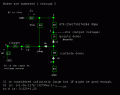
The circuit is shown in the attachment (note addition of R3) and the results are:
gain=-5.87377691074 (perturbed Ebers Moll plus and minus 1mv) re=n/a
gain=-5.87382131534 (semi dynamic re(i) method) re=29.30491274
Now with the static 're' model the resistor 're' comes out very different and is:
static 're' model: re=20.38296569
and it is plain to see that if in the semi dynamic model with re=29 the gain is G1 then with re=20 it's going to be different and will not match Ebers Moll.
Note the semi dynamic model is similar to the dynamic model, except once re(i) is calculated (from the actual DC conditions with that resistor always in the circuit) the value is held constant as the gain is calculated.
So the results now suggest the following points:
1. The static 're' model matches approximate Ebers Moll when no RE1 present.
2. When RE1 is present or not present, the pseudo dynamic model matches Ebers Moll but the static 're' model no longer matches Ebers Moll.
3. The complete dynamic model should match the pseudo dynamic model because we would perturb in both plus and minus directions.
Although the circuit are fairly simple, it's a bit of a task to get everything right and correlated properly. Try this at your own risk
[LATER]: Corrected value of R2 and node 3 numbering.
Little update. Note external emitter resistor R3=30 Ohms for this test.
What i ended up proving is that with no external resistor (often called RE1) the static 're' model matches the approximate Ebers Moll.
Using the perturbed method, we have to perturb in BOTH directions, both plus and minus, and then take the average. When i do that i get results that match, but only when there is no external RE1 resistor (this is the resistor shown on the schematic as "R3" and is in addition to the static or dynamic 're' resistor). When the external resistor R3 is included, the results no longer match with the static 're' model but with the pseudo dynamic re(i) model they match near perfectly.
The circuit is shown in the attachment (note addition of R3) and the results are:
gain=-5.87377691074 (perturbed Ebers Moll plus and minus 1mv) re=n/a
gain=-5.87382131534 (semi dynamic re(i) method) re=29.30491274
Now with the static 're' model the resistor 're' comes out very different and is:
static 're' model: re=20.38296569
and it is plain to see that if in the semi dynamic model with re=29 the gain is G1 then with re=20 it's going to be different and will not match Ebers Moll.
Note the semi dynamic model is similar to the dynamic model, except once re(i) is calculated (from the actual DC conditions with that resistor always in the circuit) the value is held constant as the gain is calculated.
So the results now suggest the following points:
1. The static 're' model matches approximate Ebers Moll when no RE1 present.
2. When RE1 is present or not present, the pseudo dynamic model matches Ebers Moll but the static 're' model no longer matches Ebers Moll.
3. The complete dynamic model should match the pseudo dynamic model because we would perturb in both plus and minus directions.
Although the circuit are fairly simple, it's a bit of a task to get everything right and correlated properly. Try this at your own risk
[LATER]: Corrected value of R2 and node 3 numbering.
Last edited: