Facebook
 Google
 GitHub
 Linkedin

Hello again,Sorry, but I doubt if it is "more exact".
The transconductance is DEFINED as
gm=d(Ic)/d/VBE)
That is nothing else than the slope of the well-known exponential Shockley equation Ic=f(VBE, Vt).
And the differential quotient (slope) is calculated to be gm=Ic/Vt.
This definition does not depend on beta and does not need such an artificial quantity re which appears in just one of the small-signal models for the BJT. Can you show how your expression is "more exact"?
I have to say i am a little surprised that you dont agree with this small detail as i think this has been known for some years. The reason for this is because the typical gm calculation is obtained from the collector current and the real value of 're' is calculated from the emitter current, and of course the ratio of collector current to emitter current is Beta/(Beta+1). It is close to 1 when Beta is large so many texts quote re=1/gm when really it's a little different.
What i did was took your advice and calculated the gain from the simpler circuit, and i must say that was a good idea because the circuit was MUCH easier to work with.
So i calculated the gain A with a value of 're' of 25 Ohms, and i did not get:
A=(1/25)*R4
instead i got
A=(1/25.5)*R4
and so from your calculation of A which was:
A=gm*R4
that means that:
gm=1/25.5 and not gm=1/25 which was 1/re.
Now calculating the 'other' way:
gm=a/re
we have:
gm=a/25
and with Beta=50 we have:
gm=(Beta/(Beta+1))/25
gm=(50/51)/25
gm=2/51=0.0392157
when with gm=1/re we would have had:
gm=1/25=0.04
and the ratio of 1/25 to 2/51 is 1.02, so about a 2 percent difference.
Now that i go back and look at the original transistor thread i see that Jony did use alpha also:
https://forum.allaboutcircuits.com/...gain-of-a-bjt-amplifier-circuit.154751/page-2
in post #35.
I was a little surprised you questioned this but i believe that is because you had been doing it that way for so many years and perhaps forgot how it originally came into being. Compounding the problem is that some texts estimate (note the work 'estimate') the value of 're' to be VT/iC which is the thermal voltage divided by the collector current rather than by the emitter current, and if you do it that way you get gm=1/re but that's not as exact.
But to prove this i think all you have to do is do what i did and that was simply to analyze the circuit you described to me and calculate the gain and calculate what 'gm' it would take to get the gain A from gm and R4, as you pointed out.
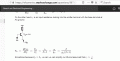
Here is a screen shot from a page on Stack Exchange...
Attachments
-
 30.3 KB Views: 4